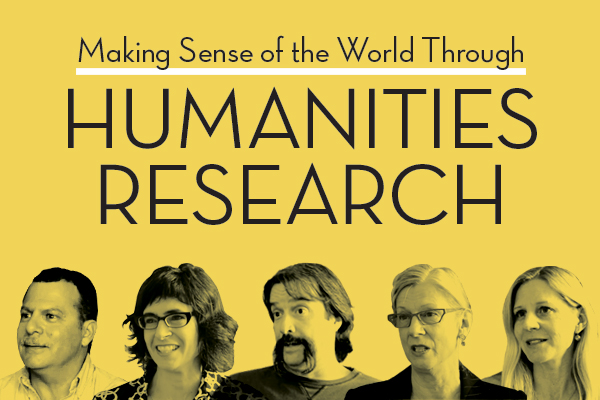
What is the value of humanities research? Why is it a practical component of an undergraduate’s education? The answer is simple. Explorations into literature, philosophy, art, music and poetry teach us how to make sense out of a complex and interdependent world.
Whether they’re deciphering ancient manuscripts, unraveling medieval mysteries, or reciting a Shakespeare play, humanist scholars help us understand the past and give us a clearer picture of what the future holds.
To support research in the humanities, the College of Liberal Arts created the Humanities Research Award, which provides $15,000 for research-related expenses such as travel, archival costs, supplies and materials.
Established in 2009, the annual award was created by Dean Randy Diehl in response to a shortage of external grants for humanities research. The funding allows professors to produce a book or a set of articles and make their work known to the academic community.
We caught up with some past recipients to learn more about their research –– from racial rhetoric to the history of America’s infrastructure to medieval art and literature.
Erika Bsumek, associate professor, Department of History
Research summary: Bsumek’s project “The Concrete West” examines how the American West was transformed by concrete, and how the profession of engineering changed over the course of the 20th century. Bsumek is also studying the impact of large construction projects (dams, highways, cities and suburbs) on the American West. Go here to watch the entire video Q&A. Watch her discuss her research on Navajo artisans on Not Even Past.
John Hartigan, Professor, Department of Anthropology
Research summary: How does race matter in the United States and Mexico? Is race a function of biology? Hartigan is conducting fieldwork at two national genomics institutes in Mexico to find answers to these broad questions about race. His project, “The Roots of Racial Thinking,” explores how corn and people are conceptualized and analyzed in remarkably similar terms. Go here to watch the entire video Q&A.
Julia Mickenberg, associate professor, Department of American Studies
Research summary: Mickenberg’s current project, “The New Woman Tries on Red,” examines a range of topics, including Soviets and suffragettes, and the relationship between the sexual revolution in the United States and the Soviet Union. Go here to watch the entire video Q&A.
Guy Raffa, associate professor, Department of French and Italian
Research summary: Raffa’s project “Dante’s Bones” tracks the skeletal history of Dante Alighieri’s mortal remains. The project shows how individuals and institutions have exploited Dante’s tomb and his remains to promote various political, religious, and cultural agendas. Go here to watch the entire video Q&A.
Marjorie Curry Woods, professor, Department of English
Research summary: Woods’ project, “Weeping for Dido,” explores how students, particularly boys, learned about their emotions by writing in the voices of distraught female characters during the Renaissance and the Middle Ages. After sifting through dozens of centuries-old manuscripts and teachers’ footnotes, Woods speculates that boys enjoyed writing speeches for female protagonists because they identified with their intense emotions. Go here to watch the entire video Q&A.