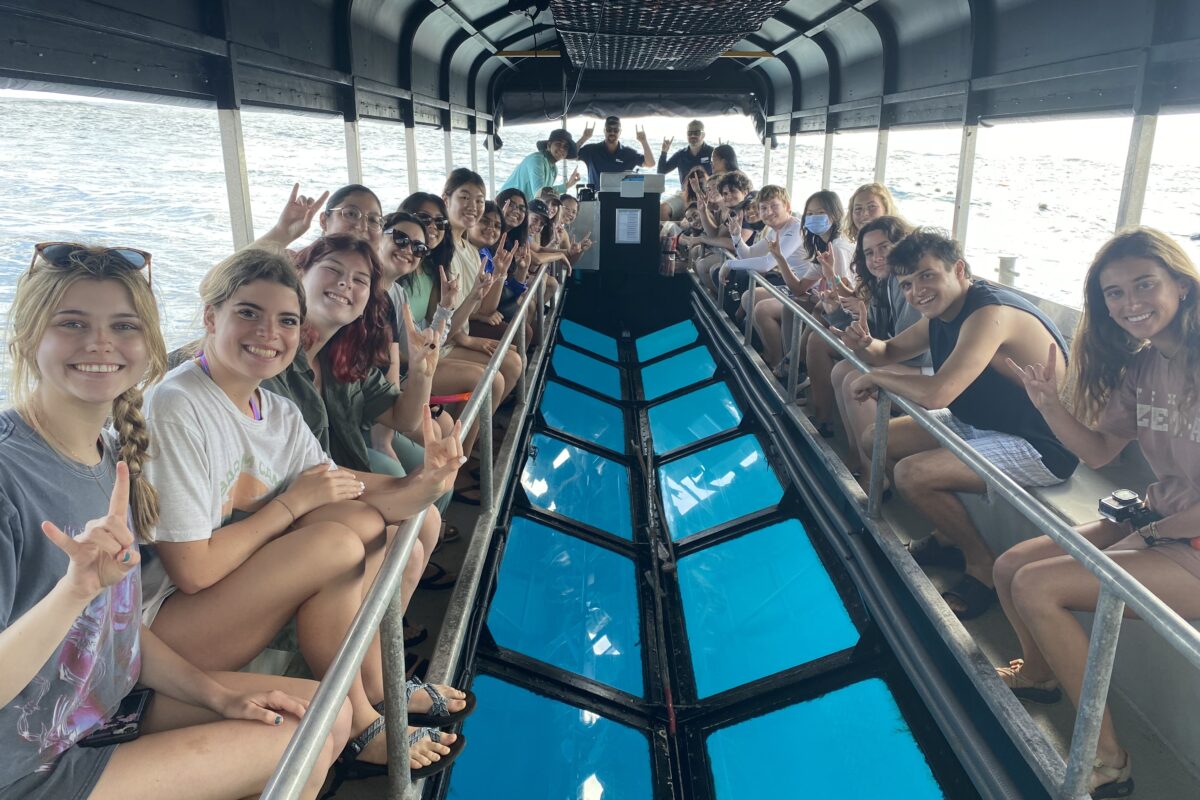
Of all the study abroad programs led by College of Liberal Arts faculty, only the Great Barrier Reef May Term includes snorkeling as part of students’ required coursework. Sponsored by the Clark Center for Australian and New Zealand Studies and led by government professor and center director Rhonda Evans, the program takes undergraduate students to Queensland, a state on Australia’s northern coast and home of the Great Barrier Reef. The course investigates the reef’s contemporary challenges and explores what it will take to develop solutions, and after a one-year hiatus it will be offered in 2026.
Since launching in 2022, almost 60 students have participated in the Great Barrier Reef program. Over their more than three weeks in the field, students tour various sites — including a sugarcane farm, the Port of Townsville, and, of course, the reef itself — and participate in conversations with government officials, policy experts, local stakeholders, and more. The immediate goal, Evans says, is for students to acquire a deeper appreciation of both the natural wonder of the reef and the complicated politics of protecting it. More broadly, the course shows students the political, economic, and societal complexities that communities confront when tackling significant problems.
Earlier this year we sat down with Evans to talk about the program, what she thinks students can learn from the reef, and the value of difficult conversations. An edited and condensed version of that conversation is below, and more information about the course and the Clark Center can be found at https://liberalarts.utexas.edu/cas/great-barrier-reef-may-term/.
First things first, tell us about the Great Barrier Reef program. Why did you decide to take students to the reef? How has the program changed since it first began?
I wanted students to have conversations with various stakeholders, like sugarcane farmers, tourism operators, commercial fishers, and government officials, to try to understand the social, political, and economic contexts within which challenges for the reef are created and solutions have to be implemented — and, of course, to experience the Great Barrier Reef itself.
Over the years, I’ve worked closely with American Universities International Programs (AUIP), a New Zealand-based company, to realize my vision for a program built around student conversations with residents, business owners, and government officials. These engagements show students how locals view the reef, how they see their responsibilities regarding the reef, and what they think of policies meant to protect it. The dialogues also transform how students see the various actors whose activities affect the reef. For example, because agricultural runoff adversely affects water quality along the reef, it can be easy to see cane farmers as one-dimensional villains. However, conversations with a farmer and a tour of a working farm offers a different perspective. Rather than wanting to eliminate farming, students start thinking about how you can accommodate competing interests.
In the first year, we spent all our time in the regional city of Townsville, where the Great Barrier Reef Marine Park Authority headquarters is located. Starting in the second year, we added a few days in Brisbane, the capital of the state of Queensland. This not only allows students to experience urban Australia but also allows us to engage with representatives from groups representing sugarcane growers and commercial fishermen as well as public servants and even a Member of the Queensland Parliament. In the third year, we added a few nights in Cairns, located in Far North Queensland, to improve the quality of the snorkeling experiences and support greater engagement with representatives from the marine tourism sector.
How do students interact with the Great Barrier Reef as part of this program? What kind of reactions have you had from the students who have participated?
Students engage directly with the Great Barrier Reef on two snorkeling excursions. Even those who’ve experienced coral reefs elsewhere in the world find it to be an amazing experience. Snorkeling allows students to appreciate the reef as an ecosystem, because it’s so much more than coral. Sadly, it also illustrates the reef’s vulnerabilities to climate change and tourism. We’ve observed damage to corals caused by tropical cyclones, dragging anchors, and the flippers of negligent snorkelers. These experiences inform the students’ reflection essays, where they express concerns about the cumulative impact of thousands of snorkelers and the carbon footprint of the tourism industry. I hope this leads students to think more deeply about their own impact on the natural world, whether that be while traveling or simply in the course of their everyday lives.
We also participate in a beach cleanup, which functions as both a service-learning and an experiential-learning activity. It’s one way to give back. Students collect and catalog marine debris, and the data they collect contributes to a larger project that documents the scale and scope of the problem posed by marine pollution. Through this activity, students confront the impact of human life on the reef’s waters, because even though the beaches we visit are pretty remote, we find all sorts of items, including debris from passing cargo ships.[WK1] During this exercise, they also learn about the pernicious effects of plastics on marine life. When plastic degrades it breaks down into tiny pieces that closely resemble the food that sea creatures eat, introducing plastic into the earliest links of the food chain.
How does this program connect to the other work the Clark Center is doing? Has it impacted your own research and scholarship?
Conversations with stakeholders have generated research projects for the Clark Center. Over the last year, I worked with a student from the 2023 program on a project examining the intersection of local governance systems with Australia’s international protection obligations. The idea emerged from student discussions with a group of Magnetic Island residents. Located off the coast of Townsville, the island lies within the Great Barrier Reef UNESCO World Heritage Area. We are mapping world heritage natural areas and local governance systems around the world and working on our first paper that examines Australia.
A second project came from meetings with the canegrowers’ association and the Queensland Seafood Industry Association. We noticed that although these two different organizations perform similar functions for their respective sectors, they do not possess similar resources. A couple students from the 2024 May Term spent the last year examining the political economy of interest representation in Queensland and exploring the relationship between organizational resources and regulatory policy outcomes.
Setting aside seeing the reef and working on research projects — both of which are obviously amazing opportunities — why else do you think UT students should participate in the Great Barrier Reef Program?
Everybody loves the Great Barrier Reef. It’s a global icon. You can see it from space, and yet it’s under serious threat from human driven causes. The question is, “If we can’t protect this, then how can we protect anything that generates less interest and empathy?” And it’s very easy to think in simplistic terms — to believe that there are simple solutions, clear villains and heroes, and that you can solve a problem by signing a petition or taking some other simple action. This course is meant to show students that it’s actually very complicated to determine the scope and cause of a problem, identify potential solutions, and get those solutions enacted and implemented.
My goal is not to have students throw up their hands and say, “it’s too hard, it’s too complicated.” It’s to get them to understand that, if you really want to solve problems in this world, you need to make a long-term commitment. It’s going to take a lot of time and a lot of effort and a lot of listening to people. I think most students really do take this lesson from the experience. They return to the United States with a much more sophisticated idea of what it takes to address the problems we face if we want to be serious about solving them.