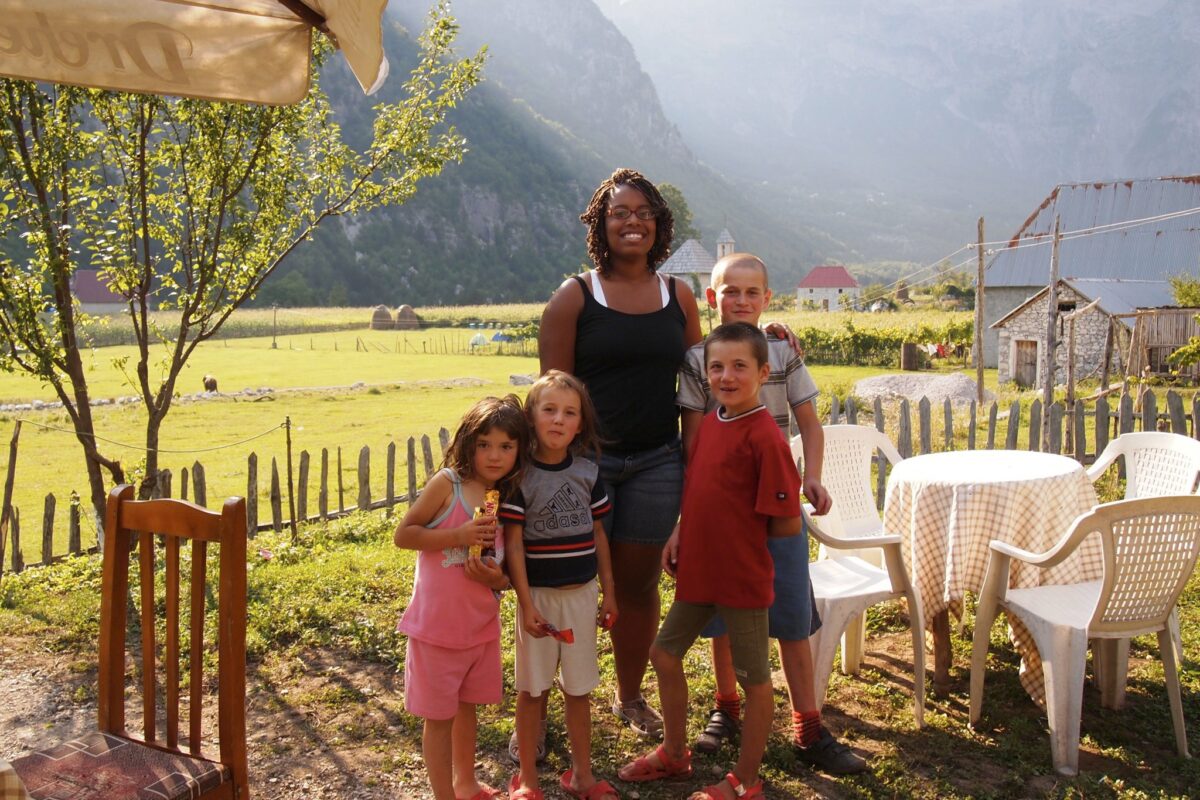
Chelsi West Ohueri didn’t set out to study Albania. As an undergraduate at Millsaps College in her hometown of Jackson, Mississippi, she was mostly just trying to figure out, as most undergraduates are, what she wanted to do, who she wanted to be, and where she wanted to end up.
“I went to college across the street from my elementary school and my high school,” she says. “I had a cousin who had escaped the South for the East Coast and couldn’t believe I stayed. She was so mad at me, and made me promise that I would at least study abroad.”
After turning in an excessively long anthropology paper — 28 pages for a six-page assignment — her professor suggested she apply to join an archaeological project that a colleague was leading in northern Albania. She remembers having only a vague idea of where the country was.
“I literally had to run back to my dorm and look at a globe,” says West Ohueri, now an assistant professor of Slavic and Eurasian studies at UT Austin. “It was so small it wasn’t even spelled out on the map — it just said ‘ALB.'” What she found when she got there would shape the next few decades of her life and career.
That first encounter with the country, in 2006, was almost cinematic in its disorientation. “We landed in Tirana, the capital city of Albania, after about five separate flights,” she remembers. “And when I got off the plane, people stared at me — not just glances, but full stares. I thought it was my shirt. I was wearing this crazy American t-shirt. But then I realized, no, it’s me.”
West Ohueri is Black, in other words, a strange thing to be in Albania, a formerly communist country that was only just emerging from decades of enforced separation from the rest of the world and didn’t have any people of African descent in its own population.
The trip was supposed to be a training in archaeology, but it didn’t go as planned. “I was a terrible archaeologist,” West Ohueri says. “I kept wandering off the dig and getting pulled into people’s homes to talk and drink coffee. Most of the time we didn’t even speak a common language.” Eventually, the project director reassigned her to work with the team’s ethnographer. It proved a fateful redirection. West Ohueri, it turned out, was much more interested in people than in pottery shards.
That pivot from archaeology to cultural anthropology would send her down a path that led through a Fulbright fellowship, a Ph.D. at UT Austin, and years of immersive fieldwork. In the process, she began to see Albania as a case study not just in regional identity or post-socialist politics but in global racialization. She has now distilled her insights into a new book for Cornell University Press, Encountering Race in Albania: An Ethnography of the Communist Afterlife, published this summer. Drawing on more than 15 years of research, the book explores the aftereffects of communism, the cultural politics of racial identity, and the uneasy ways that a country which sees itself as “raceless” negotiates questions of color, history, and belonging.
“When I first arrived,” says West Ohueri, “people told me, ‘We’ve never seen a Black person before.’ Some villagers would invite me into their homes to talk and drink coffee, touch my skin, braid my hair. Others just stared.” At the same time, she says, Albanians were insistent that race and racism weren’t a thing in their country. It was part of their national identity, in fact, that they were more hospitable to foreigners and outsiders than many of the countries and cultures around them. This struck West Ohueri as both true, to an extent, and incomplete. It was a very welcoming culture, but that wasn’t all it was.
“People around me, including Westerners, would say, ‘There’s no racism here.’ And I would think, okay, maybe there’s no racial animus akin to the U.S., but race clearly means something. Otherwise, why were people reacting to me this way?”
In Encountering Race in Albania, West Ohueri devotes extensive attention to the experiences of two of Albania’s main minority groups, the Roma (often derogatorily referred to as “gypsies”) and an ethnically similar but culturally distinct group that identifies itself as “Egyptian.” These groups have long been treated as racial “others” within Albania’s majority population, despite centuries of presence in the region.
“In villages and cities alike, Roma and Egyptians are often segregated to the edges of public life — geographically, economically, and socially,” West Ohueri says. “Their neighborhoods are frequently underdeveloped and stigmatized. People talk about them in coded and not-so-coded language. They’re perceived as inherently different.”
Albanian culture, West Ohueri writes, also has fascinating symbolic relationships to Blackness outside of its borders. She describes a television program from the communist era, for instance, that aired images of famine and poverty in Africa as a propaganda tool to suggest how fortunate Albanians were under the rule of Enver Hoxha, the communist dictator who led the country from 1944 until his death in 1985. “It wasn’t just an anti-Western message,” she notes. “It was a racialized one. Blackness was portrayed as synonymous with suffering and backwardness.” The residue of those narratives, she argues, still circulates in public discourse and popular culture.
American hip-hop culture, she says, has also had a major influence on youth culture in Albania and shapes how Albanians of different ethnicities view themselves, particularly in relation to the rest of Western Europe. “Albania occupies this strange position within the European imaginary,” West Ohueri says. “It’s geographically in Europe, but politically and culturally it’s often treated as peripheral — as less European.” That marginalization extends to the many Albanians who have emigrated to countries like Italy, Germany, Greece, and Switzerland since the fall of communism.
In these contexts, Albanians are often stereotyped as criminal, hypersexual, or unsophisticated, stereotypes that mirror how minorities are treated in the West. “Inside Albania, Albanians racialize Roma and Egyptians as darker, dirtier, and non-modern,” she explains. “But then those same Albanians may find themselves subjected to similar forms of racialization when they arrive in Paris or Athens or Milan.” In the book, she frames this condition as “peripheral whiteness” — an unstable position that reveals how whiteness is conditional, stratified, and policed.
Throughout Encountering Race in Albania, West Ohueri mixes careful theoretical analysis with evocative storytelling. One chapter unfolds through the lens of six different Albanian words that speak to the complex meaning of race and Blackness. Another traces the emergence of a racial vocabulary in Albanian popular culture. Throughout, West Ohueri explores the complexities of her own position as a Black female foreigner in a high-status position. She is from a wealthy and powerful nation. She has more access to resources than most of her subjects, but she has often been exoticized herself. And she loves the country and its culture, and over the years she was made many good friends there.
The book resists easy conclusions, instead inviting readers to think with West Ohueri as she puzzles through what race means in a post-communist, post-colonial, semi-peripheral European context, and more broadly the ways that race itself operates and is made, remade, produced, and reproduced over time.
For West Ohueri, the work of making meaning — of wrestling with difference and connection across cultural divides — is ongoing. “Albania is changing. The world is changing,” she says. “People have TikTok now. They travel. But the core questions are still there: Who belongs? Who is seen? Who is allowed to define the narrative?”