Imagine experiencing the coldest of cold plunges. Now imagine colder. Colder still. It takes your breath away, your teeth chatter, and you feel as if your soul has fled your body. No, this isn’t a New Year’s frolic into the frigid Atlantic at Coney Island seeking a sense of renewal. It’s the experience of a Yakutsk scuba diver searching for fossils below meters of ice in the Adycha River in Northwestern Siberia, the coldest inhabited place on Earth.
While reading a recent New York Times Magazine photo essay on these divers, I wondered what it would take, mentally, to make these arctic explorations. You would have to be able to access some kind of “other” plane beyond your conscious mind, I concluded, one that would allow you not to feel the cold or the fear and to commune with ancient nature, leading you to mastodon tusks and prehistoric shark teeth, while your conscious mind kept an eye on your oxygen tank.
It turns out this idea of an “other” plane is a well-traveled one in Siberian culture. It’s a spiritual place, an altered state of consciousness, and not everyone gets to go. Those that do cross over have a special title: shaman. They are thought to be able to communicate with the spirit world and to use its energy for the purposes of healing and helping others. They also function as soul escorts to make sure the dead cross into the afterlife and to offer general help from the spirit world for day-to-day difficulties, like infertility or lost livestock.
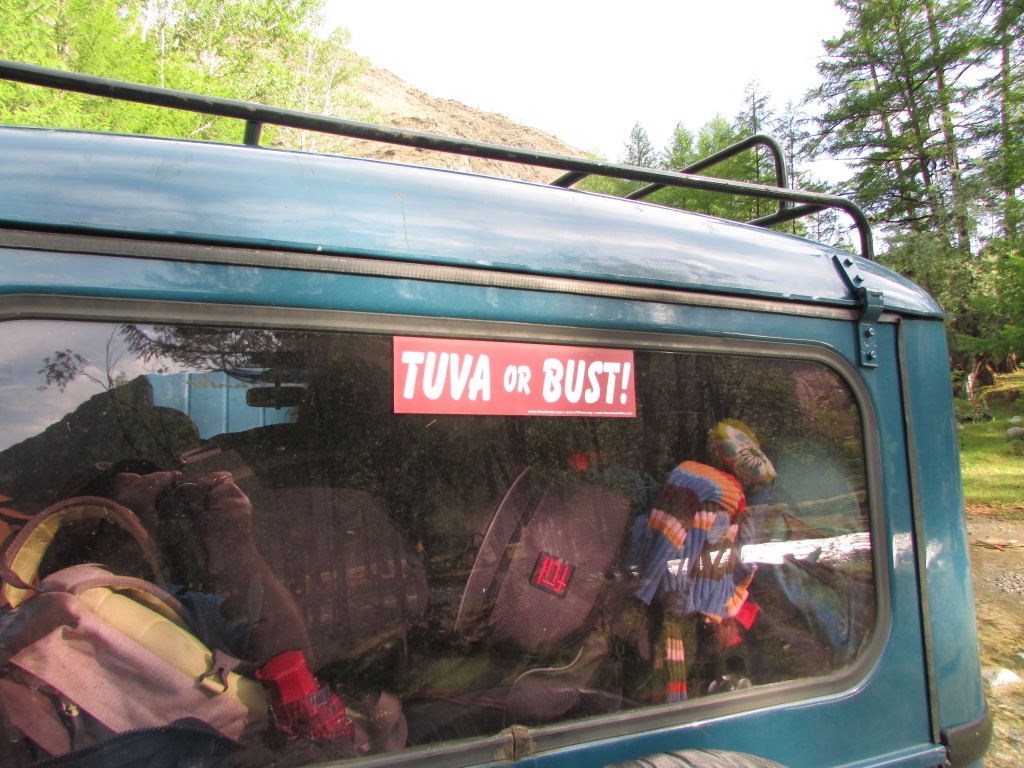
You may already know of shamanism, but it might not be quite what you think. That’s because, in our Western understanding of the word, it’s used to refer to a broad variety of religious settings worldwide. In fact, shamanism comes specifically, in name and concept, from its ancient Siberian origins, says Jason Roberts, an associate professor of instruction at UT Austin who holds joint appointments in the Department of Religious Studies and Slavic and Eurasian Studies. Roberts teaches a course about shamanic cultures and has also witnessed them first-hand in his travels to Russia’s Republic of Tuva and to the Transbaikal region, which sits in south-central Siberia and shares a border with northern Mongolia.
In his research, Roberts explores certain phenomena and themes in shamanistic groups that seems to us observers to be widespread. But he has come to believe that understanding these similarities as such might be a little bit of a cultural bait and switch, because in framing them as sharing or overlapping traditions we risk imposing a Western understanding that doesn’t necessarily exist in or apply to these cultures. Roberts emphasizes that while there is such a thing as a shaman in the specific sense, meaning the word comes from a Siberian language and refers specifically to their ritual specialist, it was through Western scholarship and theology that the word made its way into English and other languages.
So, what really makes a shaman a shaman? And what can we learn about ourselves from understanding our position as observers and students of shamanism? Roberts dives into these questions in his class “Shamanism and the Idea of the Primitive,” where he examines the origins and nature of Siberian shamanism, as well as its contemporary context, to get at answers.
“We’re looking at whether, regardless of what the cultures call their ritual specialists, they are essentially the same and it’s fine to use one word to refer to all of them, or whether this was some medieval theological Christian bias that says all heathens are the same,” he says. “Is it reductionist to call everyone a shaman?” The class toggles between some of the obvious similarities worldwide, Roberts says, but probes whether those similarities are essential.
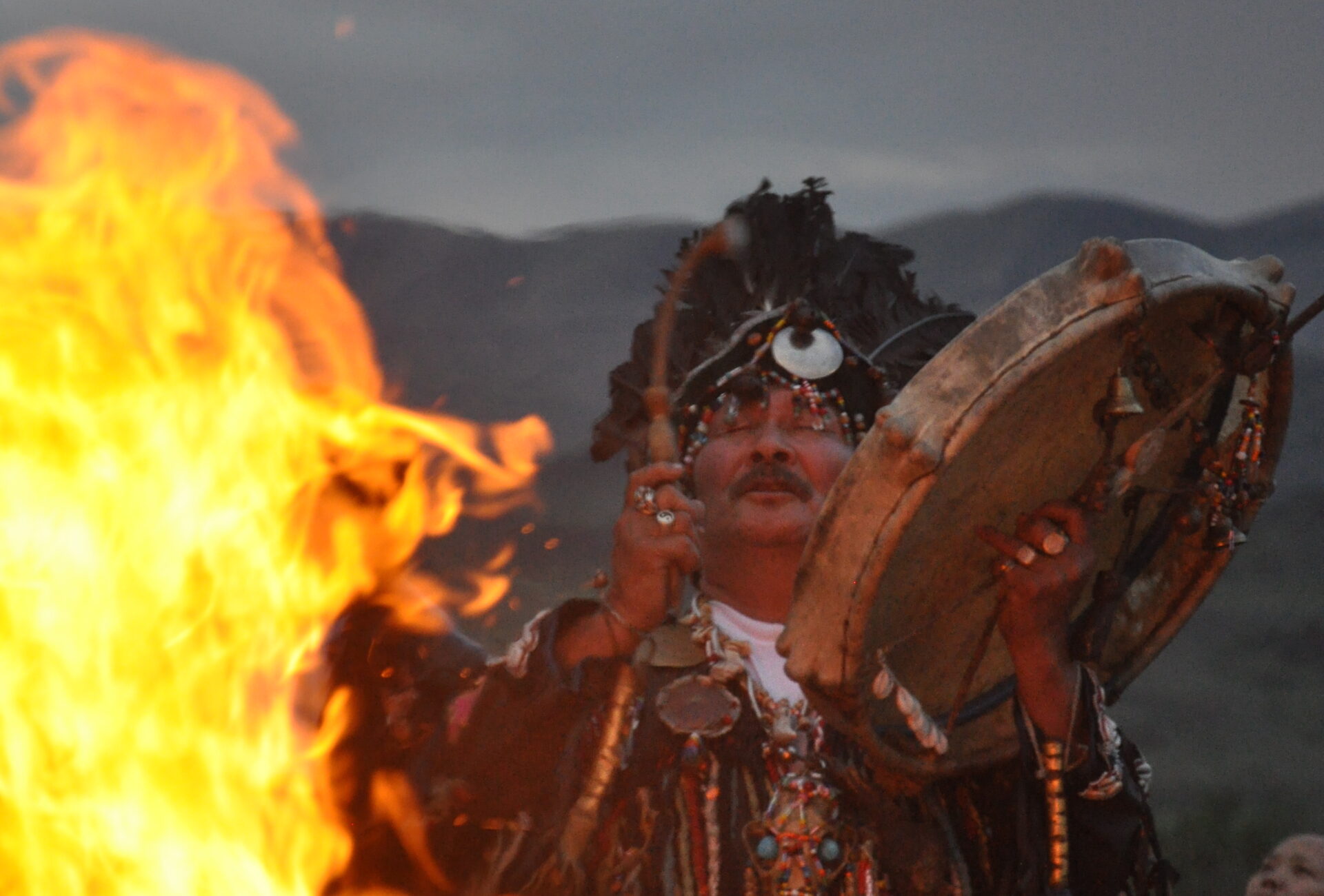
One of those similarities across cultures is the idea of an upper, middle, and lower world. “There is a reason that thought about the divers would occur to you,” Roberts told me, “because they are going into an underworld.” Other perceived similarities include the playing of drums; the wearing of feathered headdresses and leather coats with ornaments; the trance that takes the shaman to the other world; and scrying, which is a technique that includes looking into a reflective surface or object with the hope of connecting to spiritual wisdom. In some parts of the world, though not where Roberts travelled in Tuva, shamans use substances like psychedelic mushrooms or ayahuasca to aid in soul travel.
While we can look at these apparent commonalities and try to draw conclusions, there is no holistic way to understand shamanic culture without inhabiting the mind of a shaman or a person who goes to a shaman, Roberts says. This is a fundamental tenet of ethnographic research, but it can also be part of the fun. As long as we’re taking a thoughtful approach, Roberts says, trying to get to think other place can actually be a pretty useful and rich exercise.
“There’s a responsibility that goes along with focusing on difference not to exoticize or fetishize,” Roberts says, “so when I share this with students, I try to show that my/our own mental frameworks and fundamental assumptions are not immutable. Sometimes it’s the only way to notice those things about ourselves as a product and a part of our culture. Often the only way to check the mental furniture is to look at someone else’s, which I find endlessly useful.”
So how to check the mental furniture? Partly by exploring a culture’s history, though, in the case of Siberian shamanism, this can be a challenge on its own. Though there are records in Tuva, like standing stones, and early Western accounts of religion in the area by explorers and missionaries, the roots of shamanism aren’t exactly easy to pinpoint. Religious scholars don’t know for sure when shamanism started, so they can’t exactly say where it came from.
“Scholars in the late 19th and early 20th centuries posited shamanism as the oldest form of religion,” Roberts says, “so to ask about its roots in a context in which we’re first trying to decide if it is the oldest form means that it is, by definition, beyond intellectual recovery.” It’s impossible to know what was there before with certainty, he says. Furthermore, we’re talking about a preliterate society, so it’s not exactly easy to find archaeological evidence for ecstatic states or what else people were experiencing.
But this conundrum doesn’t get in the way of exploring other influences on shamanism’s history or practices, like why Siberia seems to be such a center of shamanic practice, Roberts says. After all, there’s more to it than just recorded history. There is something tangible about the landscape, nature, and animal world of Siberia that cultivates the idea of a shaman.
“For a steppe culture, their worldview is symbolically totally vertical, with the sky god, Tengri, being up,” Roberts explains. Given how far north Siberia is, the summer sun is basically omnipresent, and the growing season is fast and intense. Typical Siberian yurt dwellings have grid-patterned openings at the top, which are the central pillars of the spaces, and their doors always face the sun. The hearth is sacred (not surprisingly, in such a cold place) and is at the center of the yurt, letting smoke travel up and out the central pillar. The steppe landscape also tends to be relatively devoid of trees and is sometimes peppered with colossal mountains, leading to distinct horizon lines — a clear separation of above and below. The visual divide is everywhere you look, says Roberts, which has fundamentally shaped how Siberian people understand their world.
To illustrate to his students how the Tuvan environment impacts its peoples’ mindset, Roberts juxtaposes certain Tuvan traditions with Western ones. In his shamanism course, students examine two systems of divination — a Siberian system called Kumalak and the thoroughly European tarot — to show how time and space are encoded in a system of somewhat familiar symbols.
“For most tarot readings,” Roberts says, “the past is to the left, the future to the right, and up and down tend to have meanings that reflect upper and lower worlds. But in Kumalak, a system involving pebbles organized on a grid, which mirrors the one at the top of the yurt, you start in the upper right and then move left then down, which is very different from how a tarot reader lays out cards. And in Kumalak, the past is down.”
During the month Roberts spent in the Transbaikal region, he observed and talked to people who went to shamans and met the chief shaman of Tuva. He says his experiences there were a dip of the toe into the other plane and gave him more insight into the mindset of Tuvan people. “I hesitate to generalize from Tuva to all of Siberia,” says Roberts, “but I can say that I’ve noticed that. there are ideas about time and space that seem so self-evident in the West that just don’t exist in the Tuvan mental framework. There are some questions that we think about all the time that are just nonsensical there.”
Roberts’ hypothesis is that the Abrahamic god is viewed by believers as the creator of everything outside of time and space — a god that made everything that ever was and ever will be (in the past and the future). This, he believes, has created a conceptual structure for Western thought within which it is possible to imagine an answer to any conceivable question about the future. We may not know the answer, but we assume there is one, even if we don’t have an explicit belief in a providential god. In a society like Tuva’s, however, there are certain questions about the future that are fundamentally inaccessible, since god is watching it unfold with us.
“So,” says Roberts, “while a Tuvan nomad might ask about past events — ‘Where is my goat?’ or ‘Who stole my goat?’ — to ask questions about the future — ‘Will I find my goat?’ or ‘Will my goat be stolen tomorrow?’ — is ridiculous. Westerners are overwhelmingly concerned with the unknowable future, and this concept doesn’t exist in the most traditional Tuvan mindset.”
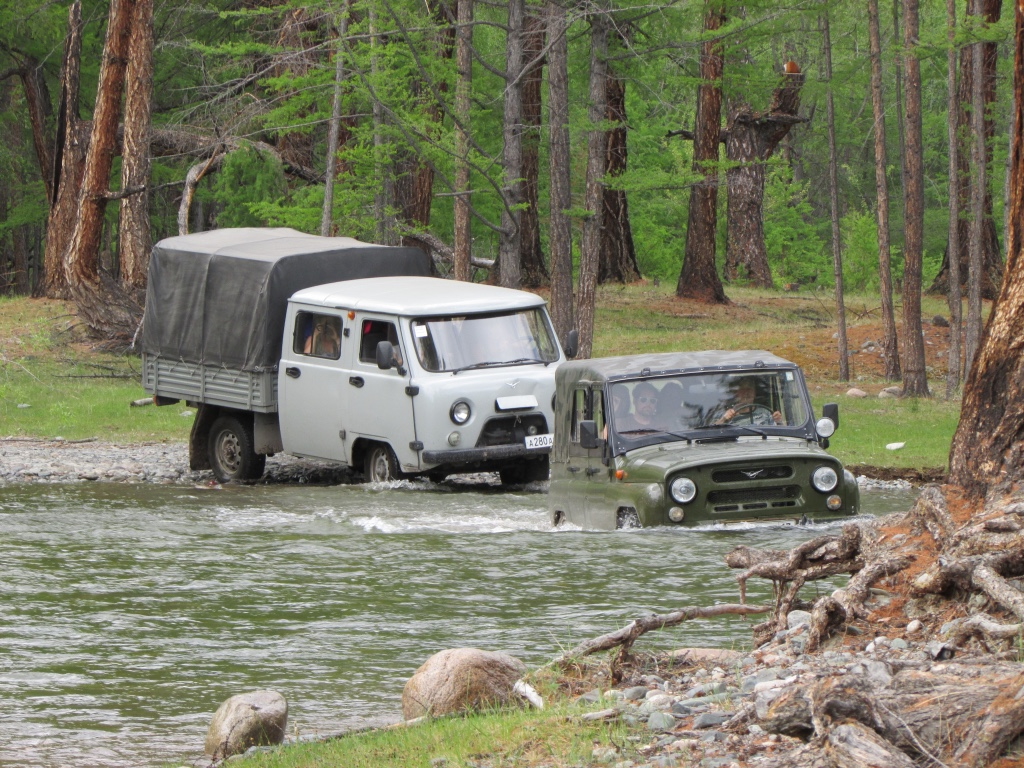
When he’s trying to explain the conundrum of ethnography to students, Roberts usually recounts a story from his time in Tuva that illustrates the concept and gets specifically at how Tuvans don’t even conceive of agonizing about the unknown like we might. To get to the yurt camp where he stayed for a week in the wild, Roberts went off-road with his guides for hours and stopped at the bank of a river with no bridge. The hosts promptly began wrapping parts of the engine of their Soviet-era Jeep in plastic wrap because, he says, “we were just going to drive through the river with our luggage in our laps while water came up through the floorboards.”
As the engine was being prepared, Roberts saw one of the guides kneel at the river in prayer and drink directly from the water while doing some sort of prostrate, push-up movement. “When he was finished, I asked what he was doing,” says Roberts, “and he told me he was asking the river for permission to cross. I was so excited to be getting such juicy bits of religious studies ethnography, and the follow-up question seemed obvious to me: How do you know if the river says no? At that, he looked at me like I had two heads and said, ‘you drown.'”