It was an introductory course on Mediterranean archaeology in her first year of college that hooked Catherine Pratt. “I just fell in love with it,” she recalls. “So I met with the professor and said, ‘How do I do this?’”
The signs were there even earlier: a love of history, a sense of wanderlust, and an affinity for a certain swashbuckling archaeologist. “I remember being in eighth grade and watching Indiana Jones and saying, ‘That’s what I want to do,’” says Pratt, now an assistant professor of classics at The University of Texas at Austin.
Pratt’s first-year professor outlined the courses she would need to take — in archaeology, history, classics, Latin, and ancient Greek — to prepare her for graduate studies. The summer after her sophomore year, she attended a field school he ran at an excavation site on Crete. “He said to me, ‘You might like the material, but you don’t know if you like archeology unless you’re in the field, unless you’re getting dirty, unless you’re wheelbarrowing 50 wheelbarrows a day full of dirt in the sun,’” Pratt says. “Thankfully, I loved it, and there was no going back for me.”
Pratt went on to earn her master’s and doctorate in archaeology at UCLA. She taught for 10 years at the University of Western Ontario before joining UT Austin in 2023.
Pratt’s area of specialty is the pre-Classical Mediterranean, with a focus on socioeconomics and cultural interactions. Her first book, Oil, Wine, and the Cultural Economy of Ancient Greece (Cambridge University Press, 2021), looked at the significance of the two commodities from the Bronze Age to the Archaic period, demonstrating how they became integral to Greek identity. This year, she published a second book with Cambridge University Press, Economy and Commodity Production in the Aegean Bronze Age, which focuses on the Minoan and Mycenaean states.
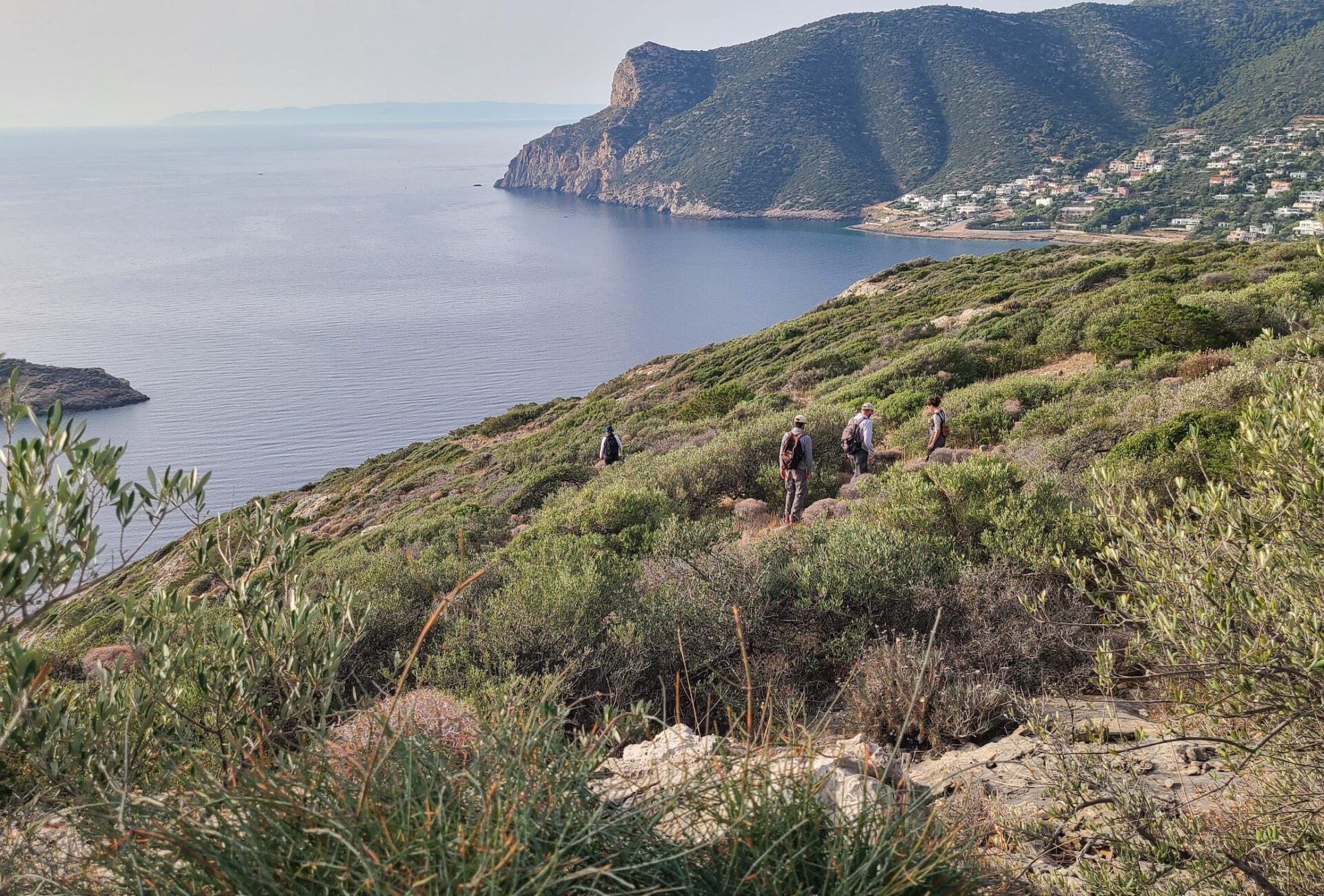
She also serves as co-director of the Bays of East Attica Regional Survey (or BEARS), an archaeological project in the Greek town of Porto Rafti, which stretches around a bay of the Aegean Sea. The project, which launched in 2019, brought together a diverse team of archaeologists to survey the area to determine its use from the Neolithic period to the early modern period. After three summers of field work, team members spent two summers processing their finds and analyzing data, which will be compiled into a volume about the project. The materials are housed nearby at the Brauron Archaeological Museum, the site of a sanctuary to Artemis, goddess of the hunt.
Pratt has been drawn to Greek archaeology, and the Bronze Age cultures of the Minoans and the Mycenaeans in particular, since her undergraduate days. “Something about the mystery of Bronze Age archaeology really called to me,” she explains. “We know very little about the cultures. There’s still a lot that we don’t understand and that’s debated.”
That’s in part because scholars have yet to decipher Linear A, the written language developed by the Minoans, who built a civilization on the island of Crete from about 3000 to 1100 BCE. Scholars have succeeded in cracking the code of Linear B, the script of the Mycenaeans, who flourished on the Greek mainland from 1700 to 1100 BCE. “We know a little more about them, but even those texts are very enigmatic,” Pratt says.
Study of the Bronze Age also had a relatively late start as a discipline, she adds. “The study of the classical period in Greece, or the Roman imperial period, was happening since, well, the ancient period. Romans were studying Greeks and so on. The Bronze Age, in a lot of ways, was forgotten for a long time,” she says. And the interest the Ancient Greeks did have in this earlier period was mainly limited to the myths and epics of that era, such as The Iliad and The Odyssey.
“People really didn’t even know the Bronze Age existed — that the people really did exist; that they weren’t just stories,” Pratt says. It wasn’t until the late 1800s that scholars became interested in the era — and then, she notes, it was with the questionable goal of “proving” that the Homeric epics were actually true. In their quest to find remains from the tales, archaeologists explored sites such as Troy, where they found evidence of ancient cultures that predated the Bronze Age.
As Pratt delved further into her studies, her interests focused on the interactions among the cultures around the Aegean and the Near East. “One of the ways that we can see those types of interactions is through the economy, through trade,” she says. “Because we can physically see, archeologically, things moving around. I can find a pot in Crete that was made in Egypt, and that tells me that they had some sort of connection. Whether it was direct or whether it was through trade networks is a different story. But we know that the connection existed.”
Pratt was interested in the inter-cultural transmission not just of items but also of ideas and technology. Much of her work looks at the trade of commodities such as olive oil and wine — the subject of her doctoral dissertation, which became her first book. “I was interested in the fact that those two commodities were really integral to the functioning of ancient Greek societies from the Bronze Age onwards,” she says. Both served important social purposes, as key elements in rituals and celebrations, and both continue to be used that way, across many cultures. “Most people have at least one of those things, probably more, in their kitchen today,” Pratt notes. “We still value them very highly.”
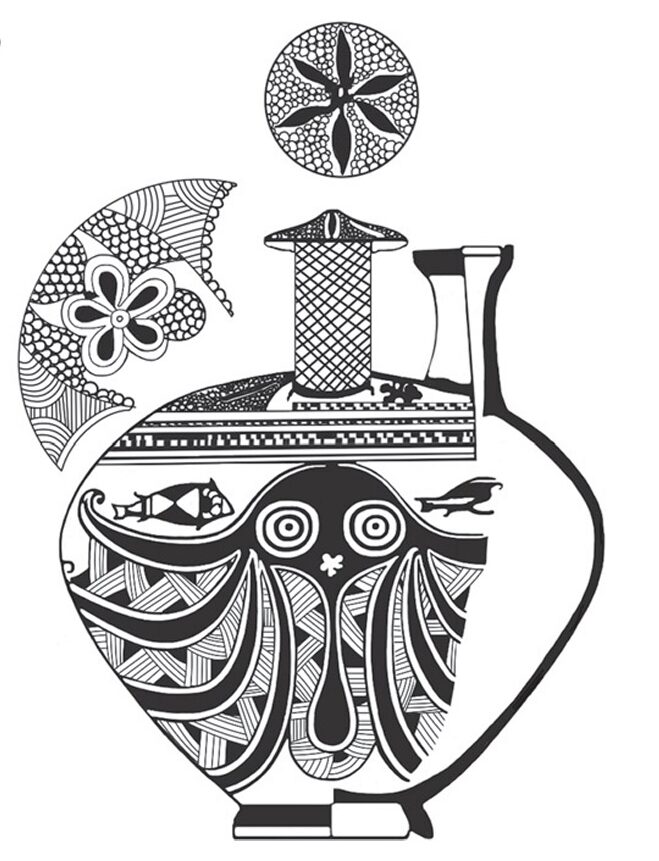
Wine and olive oil lend themselves well to study because they can be traced through the amphoras and similar containers that held them, which have held up better over time than less durable containers, such as baskets. “Archeologically, pottery is the most enduring material that humans engaged with, other than maybe stone,” Pratt explains. “It’s ubiquitous in the ancient world. So we can use things like amphoras as a proxy, as a signifier of the contents.” The specific content — wine, oil, other substances — can be determined through residue analysis.
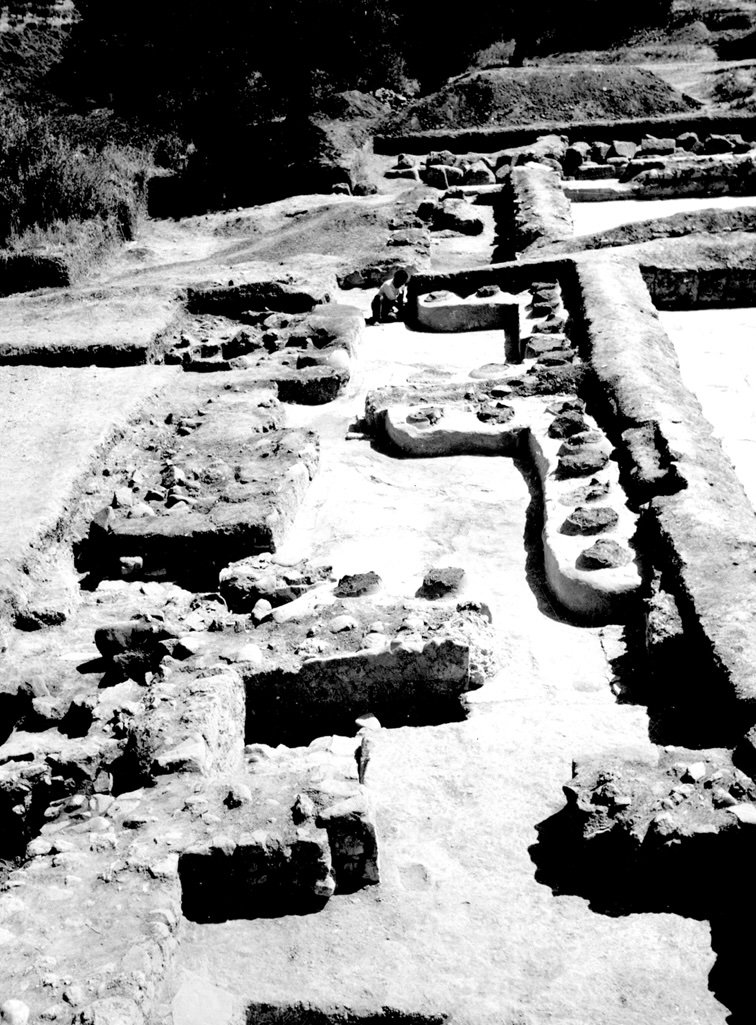
Pylos Rooms 23 and 24 from northeast. After Blegen and Rawson 1966 fig. 102. Courtesy of The Department of Classics University of Cincinnati.
In her most recent research, Pratt applied a similar lens to the study of another food that played a crucial role in ancient Greece: figs. “I realized that we know a fair amount about commodities like olive oil and wine and wheat,” she says, “but no one had ever done a deep dive into figs, even though in the tablets that we have from the Bronze Age they are so prominent.” While figs weren’t significant in ritual and social events, as wine and olive oil were, they played an important practical role in the economy, she notes. “They’re easy to grow, they’re easy to dry, they’re easy to store. You can carry them around with you. You can distribute them easily, and they have a lot of calories. In an agrarian economy, figs are a good source of energy.”
Pratt is currently working on her next book, Gift of Athena: Panathenaic Amphoras and the Making of Athens. It will look at the iconic olive oil-filled amphoras that were given to winners of the Panathenaic athletics games. “The amphoras were beautifully decorated by famous artists and were full of very good olive oil, sacred olive oil from certain groves that were owned by the state,” she says. As the victors returned home from the games with their prizes, the vessels spread throughout the region — a “clever marketing” strategy, she says, that resulted in amphoras emerging as an enduring symbol of Athens. In June, Pratt received a Faculty Research Fellow Award from the UT Austin Humanities Institute to support the project.
Pratt is also kept busy in the classroom, where she teaches both undergraduate and graduate courses, including classes on ancient Egypt, the ancient Mediterranean world, and Greek archaeology. This year she’s teaching, for the second time, “Ancient Societies and Sustainability,” an interdisciplinary course that looks at the effects of climate change on ancient societies. While we tend to think of climate change as a modern problem, “humans have been dealing with it ever since we were humans,” Pratt says. “How did ancient people deal with climatic problems? How did they adapt? How did they manage their resources?”
The first time Pratt taught the class, it was evenly split between classics majors and sustainability majors. “I had the students who knew more about sustainability and then students who knew more about the history and the ancient world, and it led to really interesting discussions,” she says. “I’m a historian. I know about ancient climate change. I don’t know much about modern sustainable practices. So we all learn together.”
Every year, Pratt sees a handful of students in her undergraduate classes who have identified archaeology as their life’s passion, just like she did 20 years ago. And, as her advisor did for her back then, she strives to offer them an honest sense of what to expect, both the joy and challenges of the field.
Most students, however, are there for other reasons: maybe they like history; maybe they need to fulfill a graduation requirement; maybe they grew up enamored of the Percy Jackson books. Whatever brings them to the class, Pratt says, they leave with valuable skills — how to write, how to conduct research, how to analyze visual information — that they can apply to whatever they choose to pursue. They also usually leave with an appreciation of archaeology’s ability to unearth fascinating stories of people and places from long ago. “It’s hard to make this material terribly boring,” Pratt says with a laugh.