Imagine the following scenario: Your neighbor asks you to help them with some yard work and, because you can’t think of an excuse fast enough, you agree. It’s a tedious and sweaty endeavor, but when it’s over the neighbor thanks you and gives you some money for your trouble. When you meet up with a friend that evening, they ask how your day went. Are you more likely to describe the experience as fun if your neighbor rewarded you with five dollars or with a hundred dollars? Think before you answer because, yes, this is a trick question.
It turns out you’re more likely to say you enjoyed helping your neighbor if you were given the smaller amount of money. This is due to a psychological phenomenon called “cognitive dissonance” in which people feel mental discomfort when their actions contradict their beliefs or values. In this case, our belief is that doing yardwork for next to nothing is silly, whereas doing it for a hundred bucks is reasonable. And if we’ve already done the work for a paltry five dollars, then our only option for eliminating cognitive dissonance is to retroactively decide that yardwork is fun, actually. This phenomenon has been studied by psychologists and exploited by marketers, and it’s just one of many surprising findings that UT professors Sam Gosling and Kathryn Paige Harden discuss in their Introduction to Psychology course.
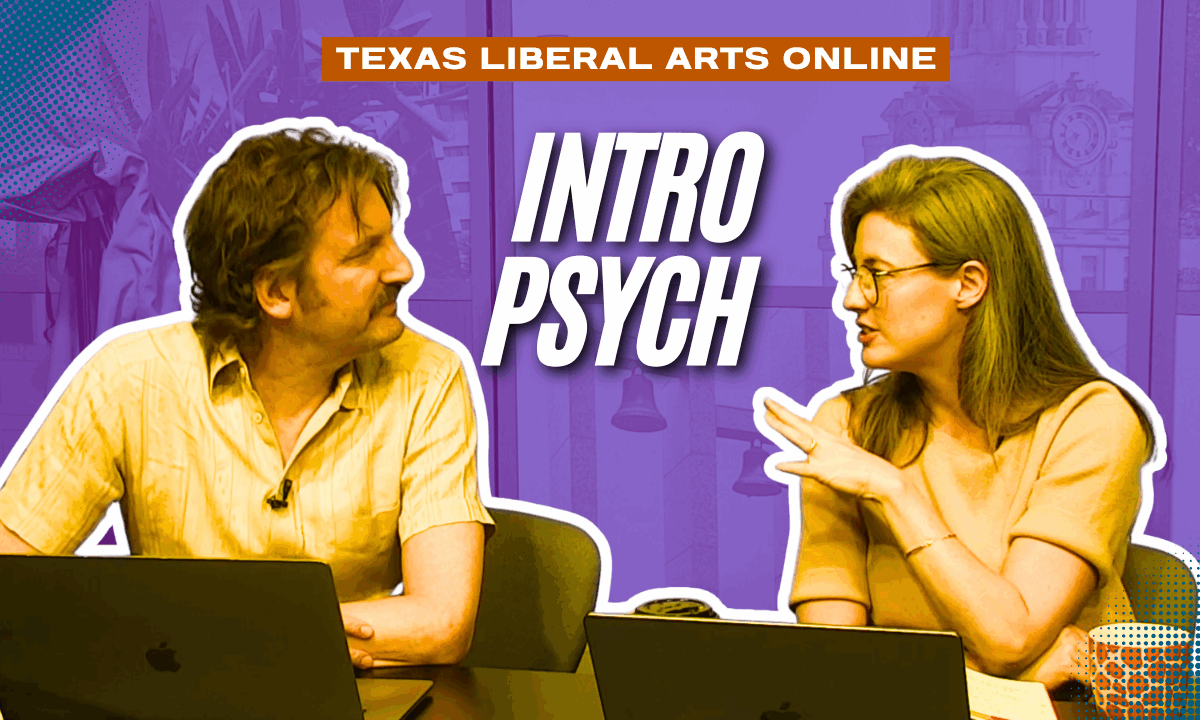
For the past five years, Gosling and Harden have taught an interactive online version of this course, produced by Liberal Arts Instructional Technology Services (LAITS). In it, they present theories and research on human thoughts, emotions, and behaviors interspersed with video clips and real-world examples that connect psychology to everyday life. Because the online course format is more like a variety show than a traditional lecture, we were able to turn some of its most intriguing insights into short YouTube videos.
Each week, we’ll be posting new videos covering topics like memory, intelligence, personality, dreams, sexuality, and more, all of which you can enjoy with no previous knowledge of psychology and no homework.
Whether you’re interested in psychology but don’t have time for a full class or are just looking to refresh your knowledge of key concepts learned in the past, these clips will entertain, enlighten, and help you better understand yourself and the people around you.
For instance, have you ever wondered why so many people are afraid of snakes? Find out in this video:
Why are dating shows more likely to send contestants on a helicopter ride than to the symphony? It’s all about how we interpret our reactions to stimuli like heights:
Why can’t you remember being a baby? There are actually several possible explanations:
Psychology also has practical lessons to offer. You can learn how to lucid dream and figure out who’s bluffing at poker. You can even get your roommate to do the dishes using a conditioning technique called “shaping.” But why read about it when you can watch that video and all the others here?