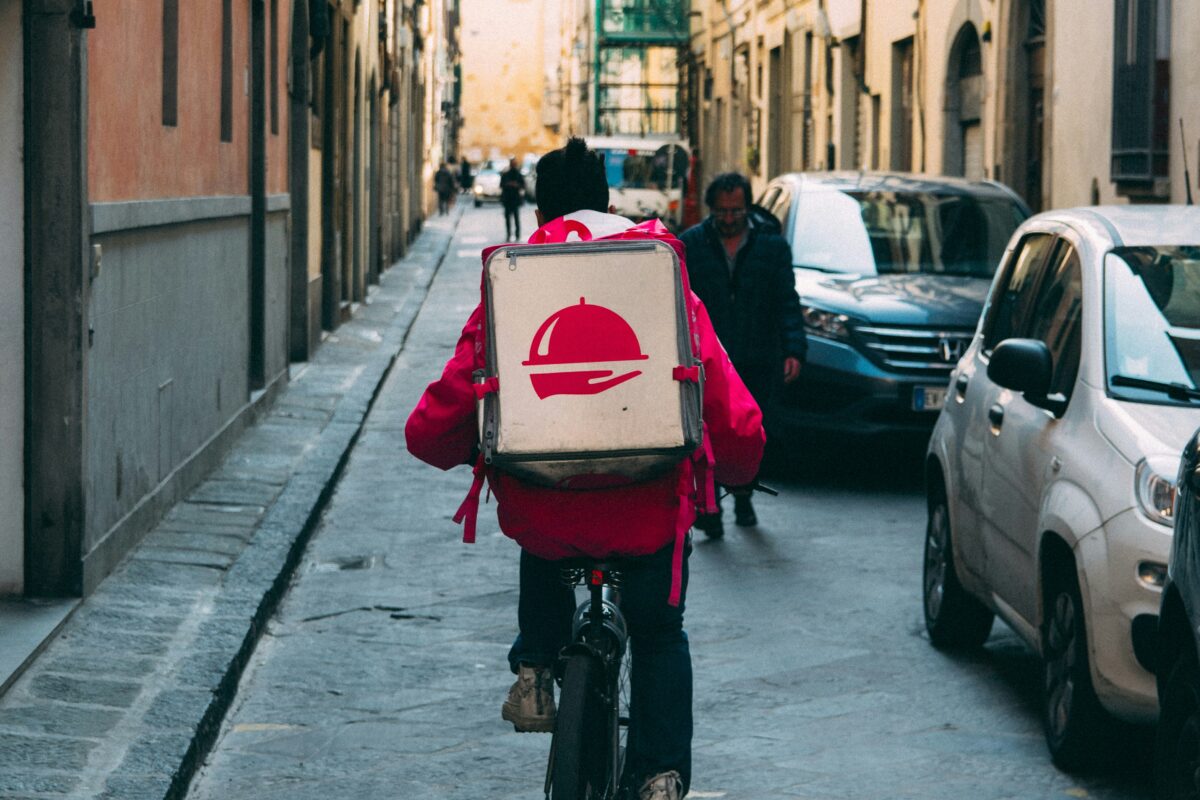
UT Austin sociologist Kathleen Griesbach has spent years studying what happens when work loses its basic coordinates, when workers simply do not know when and where they’ll be working next. The temptation is to treat this phenomenon — what we call “precarious work” today — as something brand new, a post-recession invention of hustling freelancers and gig apps. But, Griesbach argues, that assessment reveals a lack of historical awareness. Swap out “gig economy” for 1990s temp agencies and “platforms” for 1930s “piecework” and you’ll see that the underlying mechanics remain consistent. What is now framed as disruption is often just the old instabilities in a new form.
As a researcher interested in modern work, Griesbach is always asking herself, “What does instability look like today, and how do workers in different industries manage and make sense of it?” That question, she says, cuts through the media’s coverage of the future of work to focus on something more fundamental: how people construct meaning from circumstances that resist coherent explanation.
Through interviews with oil field workers, agricultural laborers, adjunct professors, and on-demand food delivery workers, Griesbach maps the narratives that emerge when workers’ expectations about their employment are undermined by instability in time and space: in where and when they will have work. Her findings complicate the prevailing wisdom about American workers’ relationship to economic insecurity. Rather than defaulting to either entrepreneurial optimism or resigned acceptance, Griesbach argues that workers develop “positioning stories,” narratives that “mobilize and reframe particular features of work.” She identifies six main positioning stories that recur across industries: four that respond to particular time and space uncertainties ( the “sacrifice story,” the “addiction story”, “working on the self,” and “the heaviness of time”) and two that highlight workers’ sense of meaning and exploitation (“living big” and “getting burned”).
Each of these narratives is fluid, shifting depending on which aspect of their situation a worker is trying to clarify. For example, Griesbach has found that workers whose jobs require geographic displacement, such as oil field crews and agricultural laborers, consistently deploy a rhetorical strategy that recasts physical separation as a noble sacrifice. This framing transcends income levels: When interviewed about their work, an oil field worker earning six figures during a boom and a farm worker making a few thousand dollars for a season of grueling labor used nearly identical language to explain their present suffering in service of future security. Both spoke of endurance, of building something better, and of the temporary nature of their displacement.
But these same workers also described feeling manipulated by forces they can neither predict nor control. For example, Manny, an oil field worker, told Griesbach that his relationship with the industry resembled a relationship with a cheating girlfriend. “You’re like, ‘Well, I don’t trust you that much,'” he said. Evie, an adjunct professor, similarly described her employment situation as “a list of jobs that are just like bad boyfriends. They’re there, they’re not, they keep you on the hook. And just when you’re like, ‘I’m gonna quit,’ they come back and they go, ‘Oh darling, I love you.'”
These aren’t throwaway metaphors, Griesbach argues in a recent paper for The American Sociological Review. Instead, they’re the expressions of people trying to make emotional sense of situations that are financially crazy-making. This emotional logic, she explains, has a particular resonance within our American cultural context, where the American dream is fundamentally a story of individual agency and meritocratic success. Workers’ narrative frameworks accordingly transform flexibility and self-reliance from economic necessities into cultural virtues.
Griesbach’s research also reveals another tension: The cultural narrative of the American dream “diverges sharply from the reality of these individuals’ working lives,” creating a dissonance that shows up in the contradictory stories workers tell about their circumstances. The divergence between dream and reality also erodes workers’ faith in the familiar “pull yourself up by your bootstraps” idea. An oil field worker who describes himself as “middle class, thinking we’re on top of the world” while acknowledging “they have us by a chain” is articulating the gap between American mythology and his real experience, Griesbach says.
Her deep dive into workers’ narratives suggests that they often move between different frameworks to explain their relationship with work depending on what part of their experience they’re examining. The same worker might invoke personal agency and self-improvement in one breath, channeling a distinctly American faith in reinvention, and in the next pivot to structural critique. The resulting contradiction isn’t cognitive dissonance, Griesbach says, but an accurate reflection of chaotic conditions.
Those chaotic conditions shape workers’ understanding of their lives in other ways, too. Workers navigating unpredictable schedules, for example, develop what Griesbach terms “addiction stories.” They describe their work as compulsive, game-like, something they’re drawn to despite its obvious costs. Meanwhile, those facing cyclical uncertainty, such as agricultural workers following harvest schedules or adjuncts cobbling together semester-by-semester employment, eventually construct narratives around what Griesbach calls “the heaviness of time.” These are stories about watching seasons accumulate without meaningful progress toward security.
“I think I held on to the dream too long,” one adjunct told Griesbach, reflecting on years of uncertain course assignments and inadequate pay. Other workers similarly celebrate the meaning they derive from their labor (“living big”) while critiquing the systems that capitalize on their commitment.
When asked what these conflicting stories reveal about the future of work, Griesbach reframes the question entirely. The point isn’t to predict what work will become, she says, but to understand what we want it to be and how the stories people tell themselves might actually shape that outcome. “If we’re going to have work that’s unstable in these ways,” Griesbach says, “what is it that workers need to be able to keep their families together and plan for the future?”
It’s a question that gets at how our current discourse around flexible work — the promise of freedom from rigid schedules or “being your own boss” — obscures fundamental questions about economic security. Griesbach suggests that flexibility in work functions differently depending on who controls it. When workers control their schedules and working conditions, flexibility can indeed provide autonomy. But when algorithms or market forces control these variables, flexibility can become a narrative weapon and transfers risk from institutions to individuals.
“Broadly, time and space have been scrambled for a lot of workers,” Griesbach says, and this scrambling affects not just workers’ schedules and commutes but also their ability to construct coherent narratives about professional life — narratives that can either reinforce their isolation or become the catalyst for action.
So, what happens when workers can’t tell themselves a story that makes sense? Sometimes they simply quit or accept the contradictions of their employment, particularly if they have few other options. But in one of Griesbach’s most interesting findings, sometimes workers’ contradictory positioning stories did not produce resignation. Instead, these workers stopped trying to solve problems alone and instead pursued collective action. Several adjuncts Griesbach interviewed became union organizers. Some delivery drivers quit their platforms and started organizing against their companies, and a group of agricultural workers jointly pursued legal action against wage theft.
“The fact that I will take this job for such low money makes me part of the problem,” one adjunct organizer told Griesbach. “I need to do something to kind of mitigate what I’m doing here, so that’s why I organize.” When individual explanations for economic hardship stop working, collective ones start to look more appealing. As Griesbach notes, workers “are at once articulating individual-focused stories while at the same time telling very critical stories,” creating “complex and fragmentary interpretations where workers can challenge structural conditions even amid their ongoing consent to them.”
Griesbach’s research shows that positioning stories are doing the heavy lifting of modern work life. Workers aren’t just coping with uncertainty, they’re actively constructing elaborate narrative frameworks to make sense of chaotic situations. These stories, a kind of shared language, “reveal who workers hold accountable for their circumstances,” says Griesbach, “how they feel about themselves and their place in the world, and what actions they think are possible.”
As remote work, contract employment, and algorithmic management become standard across industries — from tech workers to healthcare professionals — Griesbach argues it’s essential that we design work that can adapt without abandoning the human need for some kind of predictability, or at the very least the security of knowing you’ll be able to pay the bills tomorrow. Her research into positioning stories offers a way to recognize when workers’ survival narratives are at a breaking point, and it suggests that the one of the biggest questions facing today’s workers isn’t about whether work is more precarious now than it has been, or even whether it will become more precarious still. Instead the question is whether the stories we tell ourselves about that precarity will help us endure it or reimagine it.