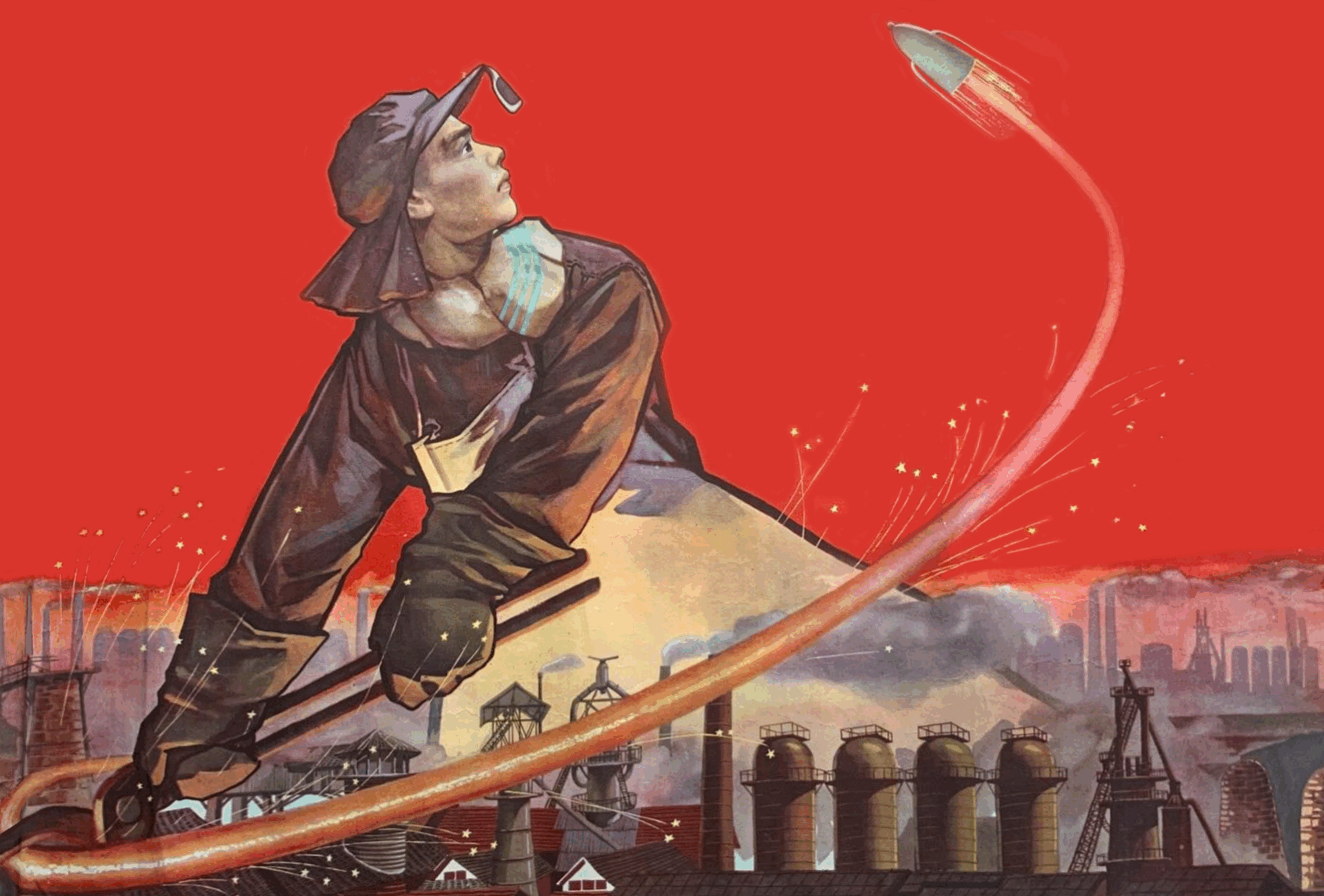
The word worker is more load-bearing than most when it comes to politics and culture. It carries weight in seemingly every system of propaganda. It features in every articulable political program. It plays a commanding role in many social antagonisms — the industrious we versus the lazy them, or the virtuous past versus the sinful present.
This complexity is at the heart of The Master in Bondage: Factory Workers in China, 1949-2019, the most recent book by UT Austin professor of history and Asian studies Huaiyin Li. In it, Li shows how Chinese workers were ensnared not just by their immediate circumstances but by these reductive tropes that treated them variously as victim, bystander, or paragon.
It’s a book that challenges both Cold War-era critiques and romantic socialist portrayals. Li pulls back the curtain on a world in which workers were labeled and ranked based on class origin, political behavior, and workplace participation. It’s a world of complex social rewards and sanctions. Factory workers were symbolically elevated as political “masters” of the factory while being trapped within a rigid and exploitative system. Their rights were conditional, their autonomy constrained, and their participation choreographed.
“My inquiry centers on the roles and agency of Chinese workers, both as individuals and as a collective within factory settings,” says Li. “How did they perceive themselves, and how did this perception shape their actions in the workplace?”
Function Over Form
One of the three pillars of Li’s work is its focus on actual function over stated form. He looks, for instance, at institutions like the Staff and Workers’ Congress (SWC) and trade unions. These groups paid lip service to empowering workers democratically, but their practical function were to maintain labor discipline and ideological conformity.
Similarly, employees of state-owned enterprises (SOEs) “enjoyed lifetime employment, higher wages, and comprehensive benefits—privileges not extended to the broader working class.” But this security came at the cost of being effectively indentured, with little mobility or autonomy. Since independent trade unions were non-existent, employees of SOEs couldn’t collectively bargaining for better wages and benefits, and lacked the mobility of even many of their counterparts in the Soviet Union.
The Maoist state also implemented measures to reshape workers’ political consciousness. These involved “classifying family backgrounds, stigmatizing ‘undesired elements,’ encouraging party membership applications, awarding political honors, and holding regular political study sessions,” says Li.
These efforts didn’t always succeed in emotionally binding workers’ hearts to the socialist party-state, but they proved effective, says Li, “as disciplinary mechanisms, shaping workers into a compliant labor force.”
A second pillar of Li’s work is his “microhistorical” approach to the subject, using close-up studies of different contexts and institutions to better understand general principles. In his first monograph, Village Governance in North China, 1875–1936, Li used this method to examine the everyday lives of Chinese villagers. This work led to his second book, Village China Under Socialism and Reform, 1948–2008, and now to The Master in Bondage, where the primary site of investigation is no longer the village but rather the factory and the institutions and forces that surround and shape life within it
Li moves fluidly back and forth between formal entities like unions, party-state organizations, and factory management and less tangible but no less significant factors like workers’ self-identity, shared values, peer pressure, kinship structures, and workplace norms.
“It is the interplay between these tangible and intangible forces that creates a social milieu in which villagers’ behaviors can be better understood across different circumstances,” says Li.
This approach aligns with a larger shift in Chinese social history as a discipline. “The traditional focus on institutional transformations, significant events, and grand narratives of revolution or modernization has given way to a growing interest in grassroots experiences,” he says.
This focus on grassroots experiences points to the third pillar of Li’s approach, which is a revisionist effort to loosen up some of the old narratives that have shaped Chinese workers have been understood.
”For nearly three decades after the Chinese Communist Party’s rise to power in 1949,” says Li, “state-owned enterprise workers were celebrated as socialist ‘masters,’ portrayed as highly motivated and efficient in their duties. Yet this idealized image underwent a dramatic reversal during the economic reforms of the 1980s and 1990s.”
In contrast to the Maoist era, the reform period of Deng Xiaoping made it fashionable to portray workers as lazy and inefficient. In this new telling, the “iron rice bowl” of guaranteed employment and equal wages was to blame for poor worker motivation and performance.
A major aim of Li’s project is to bring the everyday reality of workers out from under these tendentious narratives. His Chinese worker is an active agent moving through a complex social world. It’s a world that incentivizes conformity while still allowing workers some freedom to assert their needs. And Li stresses the social part. It’s a world in which pride, social rank, and peer pressure matter as much as formal policies and procedures.
Li’s empiricism adds texture to the debate around worker productivity and motivation. In interviews with Li, surviving SOE workers strenuously defended their work ethic and insisted that outright shirking was rare. But a true accounting of their on-the-job behavior also pokes holes in the “master” image of Maoist propaganda.
”Workers, as rational actors, were reluctant to exert maximum effort when labor was not directly tied to reward,” says Li. “However, as our informants consistently emphasized, outright shirking or deliberate slowdowns were rare due to the strong formal and informal constraints shaping workplace behavior.”
This “contextualized rationality” of workers, as Li puts it, brings into relief the legibility of their choices without idealizing them. If workers give less than their all, it is not a moral failing but a strategic compromise — “a way to avoid reprimands from cadres while preserving solidarity with peers,” says Li.
The era Li recounts is decades in the past. Across years of reform, the old Maoist system has been done away with in favor of a new normal in which workers have more flexibility at the cost of greater job insecurity. Today, core economic sectors such as manufacturing and construction are dominated by rural migrant laborers employed by private companies.
“Decades of reform have dismantled the old equilibrium in labor relations,” says Li, “yet the restructured enterprises of the 21st century have failed to establish a new one.”