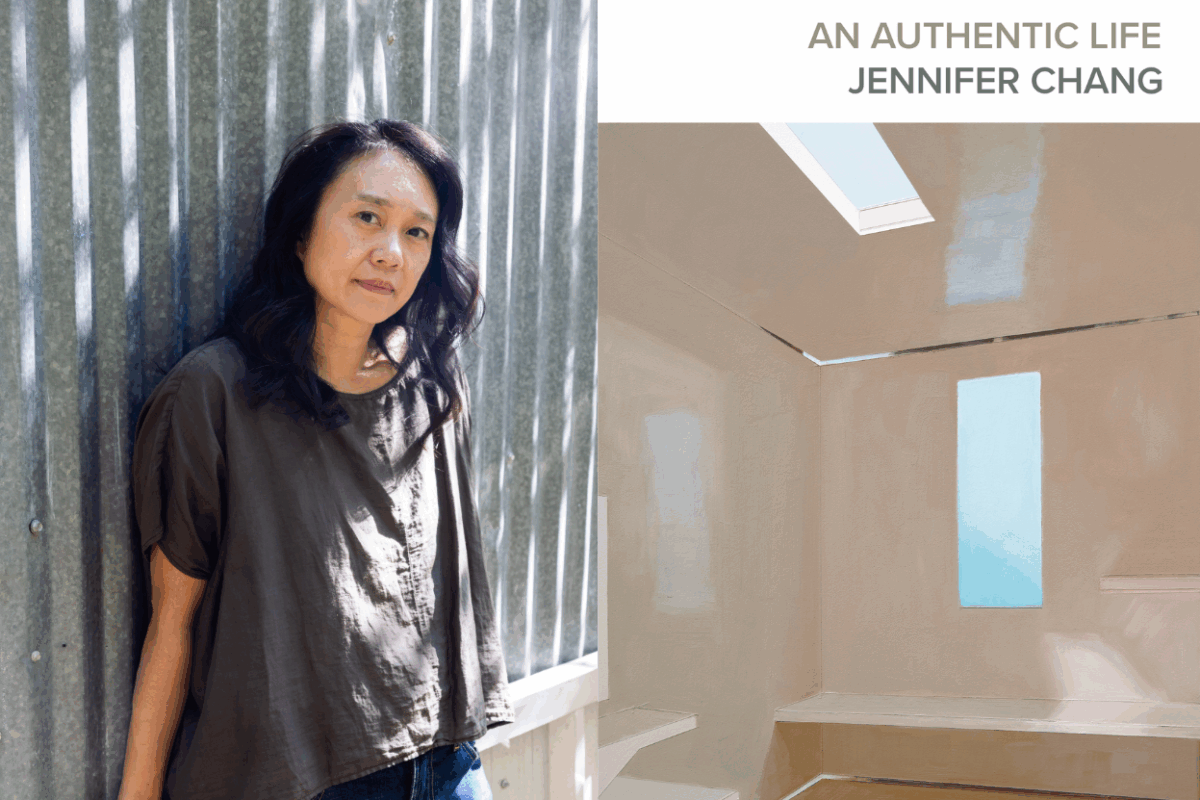
Jennifer Chang, an award-winning poet and member of UT Austin’s English faculty, wrote much of her third poetry collection, An Authentic Life (Copper Canyon Press, 2024), in the basement of her home during the early days of the pandemic. From the uncertainty of that time grew a collection that explores philosophy, patriarchy, and war alongside moments of family and domestic life. Since its publication last fall, An Authentic Life has been named a finalist for the Pulitzer Prize, the National Book Critics Circle Award, and the Virginia Literary Award, with critics calling it “sprawling yet urgent, meditative yet lucid.”
Late last month Chang and I met online to discuss the new collection, what it means to know or unlearn something, and what she’s working on next. An edited and condensed version of our conversation is below, and you can find more about Chang and her work here.
An Authentic Life is your third collection. When did you know that you were writing poems for this book specifically? Can you walk me through the origin story behind this collection?
I was writing poems during lockdown, and a lot of the core poems came early in that first year of the pandemic. As a parent at that time, my kids were quite young, and my husband and I were both working full time. I was living in Washington D.C. and I would go down to the basement to write. I was just trying to escape. But I was also trying to make sense of the time. I found myself going back to books I had read in college, specifically Plato, and thinking that if I understood something about the origins of democracy and the origins of our understanding of politics and the polis, I might feel better about what was happening, both in terms of our country at the time and our responsibility to each other.
A lot of the poems didn’t feel like poems. They just felt like I was reacting to the research. When I read those books in college, I didn’t understand them, and when I read them as an adult, they were giving me no answers. I was also working through another murkiness, in which I was thinking not so much about the philosophy as the figure of Socrates. In many ways he is an annoying character. He’s always asking questions and won’t drop a topic, pestering people and dominating every conversation he’s in. It reminded me a lot of my father, and it reminded me, too, about other figures of patriarchal authority.
As I was writing these poems, I was asked to apply for a job at a prestigious university that was seeking a senior poet. The director of that program reached out to me to tell me about this job, and I said, “I am not a senior poet. I have nothing. I’ve only had these two books. I’m toiling in the basement, my children are screaming at me, I’m still changing diapers.” And the person very generously said, “Just put together whatever you’re working on. Call it your third book and submit it and you’ll at least get an interview.” And I did all that that he said. Partly I was just like, well, what the hell? I was flattered by the invitation and intrigued by what it meant to put something together and call it a book. This was in late 2020, and I was surprised to find I had a lot more poems than I expected. I called the book An Authentic Life, because that poem existed at that time.
It was a much more expedited process than I was accustomed to. There was this external pressure to present something, and in that external pressure I saw that I had something. It crystallized what I was doing. And because I had to talk about it in the interview, the ideas started becoming clear. I normally like to work through darkness, a murky inquiry, not knowing what I’m doing, but I suddenly knew what I was doing in a way that I hadn’t before in the process of writing a book. From that point on, it didn’t get easier, but my concentration became more focused, and I was more intentional. I think it lit a fire under me because I saw that I was writing about these patterns of patriarchy across family and public life. It made me excited and angry, and I needed to give voice to that.
It’s interesting that an arbitrary deadline or pressure, “just put together what you have,” can be so clarifying for a project.
I think clarifying is the right word. A lot of times when we’re deep in a process, whatever kind of work you’re doing — and all work, whether it’s humanities or science-based, is creative because you are trying to make something new — in some ways it’s helpful not to know what you’re doing. But once you have that moment of clarification, it can make what you’re doing more precise. The light gets turned on and you’re not only working instinctually.
I think about that moment of clarification, too, when I work with students, my graduate students in particular, because I feel like it’s so hard to ask an MFA student to write essentially a manuscript of their first book in three years. It feels almost cruel. Even to write a poem a week, I just feel like, oh God, I can’t believe I’m doing this to you. But then that external pressure can be productive.
Where does a poem start for you? Is it an image or a word or a question?
It’s a little bit of all of those things, but I do find that when I’m immersed in reading and thinking, some kind of a cultural experience, or sometimes even teaching, anything where I’m deep in thought, language comes out of it because I invariably react to it. I’m reacting to what I read or reacting to artwork or music or conversation. I think about poems as being part of a conversation, whether that conversation is with the history of poetry or a conversation with a friend or a student. Many of my ideas are triggered by other people’s ideas, so I truly do think of the poems as dialogues. Even before I wrote this book, I’ve always thought of poems as being conversations. That word “conversation” has the word “verse” in it, as in you’re turning with someone. You’re turning with a history or an existing conversation.
And in these poems, the people that you’re in conversation with are Plato, Socrates, the big figures of this western tradition. You said during lockdown you were revisiting some of those writings that come up in the poems, like the Apology and Phaedo. How did you think about those conversations at that time?
There were a couple of the Socratic dialogues I have taught for many years. I’m thinking particularly of Crito, where the question is “what is justice, and what does it mean to exact justice?” Is it just to be punished for something that you don’t think you did? And I think those kinds of questions — what is truth? What does it mean to live a good life? — are always questions I’ve harbored in my imagination but also direct how I live. During the pandemic, those questions became more urgent. Those first months we were so scared; we didn’t know if we were going to live. So these questions about “what does it mean to live a good life? What does it mean to be in community? What does it mean to be a citizen?,” they were no longer abstract. Suddenly these questions had taken on a truly mortal dimension, a material dimension. I wasn’t afraid to die, but I felt like, being a parent to young children too, I had to make sense of what it meant to be living through a time when our freedoms were so curtailed.
The other thing I’ve always thought is that there’s something inherently philosophical about being a parent, because you do have to think about these questions. “How do you raise a child?” is, at heart, a question about what it means to be a good person. How do I raise a good person? And what does goodness mean? Those questions are always there, and I was seeing those questions in a much more salient way in 2020 and 2021.
How have those questions evolved for you over the years since? Or have they?
They have evolved, though we’re still living in the shadow of the pandemic. A lot of the political divisions we’re experiencing are partly born of that experience.
One aspect of the book is thinking about patriarchy and where power resides and how we’re complicit in power we may not even abide by. Even those of us who are powerless, we’re complicit in the ways that authority overtakes our freedom or our sense of self. As I’ve been traveling on book tour and meeting with people who’ve read the book, I’ve had many conversations with people who have told me about their experience with their parents or their experience of being an immigrant or a child of immigrants. Those conversations always really move and surprise me, because I worry about poetry. It is such a solitary exercise that it can risk being solipsistic. And what if it’s too much? What if these connections I’m making are too much my own, too private? So it was surprising to see all different kinds of people come talk to me about this vast abstraction, about the weight of power on our lives and how it has also caused us to limit ourselves, or the ways that we accepted power without question and how we figured out how to get out from under that power. Some of that is history, some of that is family. Some of that is our education.
You just answered a lot of this question, but what has surprised you most about how the book has been received?
In Austin at BookPeople, this woman came up to me after the reading and she’d been crying. And I was like, are you okay? That was not my intention! And she said that she had had this very difficult relationship with her mother and her mother had just passed. She was still feeling the weight of that relationship, feeling so powerless, and there was something in the poems that spoke to her about that. That observation that she still felt like a child was, in some ways, in my own writing. I’ve been writing from a place where I feel totally innocent, almost ignorant and helpless, like I don’t know what to do. I’m writing to figure out how these words will get me out of a state of helplessness.
I’ve had younger Asian people come up to me and say there are so many depictions of Asian mothers, but few of Asian fathers, who are often a domineering presence in our families. I didn’t expect that. Or people thinking about unlearning. Another aspect of the book has been about education as another authoritative presence in your life and how much of our adulthood and coming of age is realizing, “oh, a lot of my education was not helpful.”
In my own education, I went to a college with a strong emphasis on Western civilization, a core curriculum. I thought I was going to be a classics major. I loved it, I still love so many aspects of that, but it took me a long time to recognize that there was something missing in that discourse. I read with such guilelessness that I didn’t know how to question my teachers or even the authors I admired.
Unlearning and relearning are woven through the collection from the very beginning, starting with the epigraphs. Are the poems themselves representing a new way of learning? Or a new relationship between knowing and reason or knowing and art?
Writing has been one way I’ve arrived at knowledge of myself and the world, and it’s not always the same as what I’ve been taught in classrooms or even what I’ve read on my own. I don’t know why that is. I talk about this with my students, that sometimes your writing knows more than you do and you’re writing your way towards, to use your word, clarification.
The question of what constitutes knowledge is another one that figures in the book and in my writing in general. The image that I’m writing, is that something that I know? Or am I imagining it? And if it’s something that I know, is it something that I know from my experience or is it from something that I’ve read in a book?
I think about, for example, the Jamaican poet Claude McKay writing about daffodils. He did that in part because he was a British subject and read Wordsworth, but daffodils don’t grow in Jamaica. So he’s writing about a flower that has been previously deemed poetic even though he has no familiarity with it. That knowledge is not experiential knowledge, that knowledge is academic, literary knowledge. So there are different kinds of knowledge that I’m aware exist or coexist in my writing, my education, and in my imagination. When I’m writing, one thing I’m doing is filtering out which of these forms of knowledge matter and which of them is authentic to my understanding of myself and what it means to be in the world.
It’s funny to be a teacher who is so dubious of knowledge because I do feel like I’m very suspicious of what we think we know and what we recognize as truth or wisdom. I spent so much of my younger life trusting these figures. I wrote down everything my teachers said and I did what they told me to, not recognizing that I have volition in my decisions about what matters to me in a poem or in my career or in my everyday life.
Thinking about teachers (and that we’re both here because we work at UT Austin): In the notes to this book, you write that your poem “The Age of Unreason” has its roots in a lecture given by Eric Tang, UT’s director of the Center for Asian American Studies, about a shooting that targeted Asian children in California after the Vietnam War. Reading that note and thinking about that poem, I’m curious how you balance writing poetry — this individual, private, creative work — with being at the university, teaching, and being a colleague among scholars from all different disciplines. How do you think about that relationship between that individual work and being part of this larger university community?
I don’t want to sound hyperbolic, but it’s such a privilege to be at UT. When you get to work in a university like UT, you are truly walking among brilliant people. Every person has their own store of knowledge that is grounded in certain foundations and very specific training. Even in my short time here, conversations with my colleagues have sparked writing, like “The Age of Unreason.”
The lecture in that poem was the first one I attended after lockdown. It was either my first or second year here, and it was the first public event the Center for Asian American Studies had done since COVID. I was excited to go to a lecture, and I was excited to be part of the center; I’d never been at a university before that had an Asian American studies program that matriculates students.
Eric was someone I had talked to for a long time on the phone before accepting the job offer to come to UT. It was wonderful to bask in his charisma and to get excited about learning and teaching. And those two things, learning and teaching, are the formation of community building. We become a community through those two processes.
So I was sitting in the audience of his lecture, and many of us were still wearing masks, and he started recounting this history that I knew nothing about. It happens so often in ethnic studies: “This is part of the history of America and you’ve never learned about it, it never appeared in any of your textbooks in school. Now that you know, what are you going to do about it?” Something changes in your perception — “Where am I? Who am I? What is this place?” — of the university, but also of the country and the world.
I think that’s something that is very unique to being part of a university community, where when you share ideas and when you talk to each other, your world gets bigger. That lecture was a thrill. But it wasn’t just the history itself, it was also his argument that this kind of violence was not a violence that was necessarily specific. It wasn’t about hate, it was about something cultural and societal. Further, it made me think about, as the poem indicates, all the violent play that we engage in as children, because the violence was enacted upon school children.
Looking ahead: What are you working on now? What’s next for you in your writing?
Right now, I’m trying to figure out this new environment I’ve moved into. In my first three books, I’ve written about forests, and the forests that I know are hardwood forests of the northeast, which have a high canopy. The trees are so different here, so I’m trying to learn more about the trees and the various ecosystems. I’m reading books that reference trees. And I would like to write shorter poems. For me, every time I work on a new book, I have to figure out what a poem is anew. And I haven’t figured that out yet.