As a scholar of South Asia’s food history and assistant professor of instruction in UT Austin’s Asian Studies department, Andrea Gutiérrez has spent years tackling modern misconceptions about how peoples of South Asia eat and filling in literal missing chapters from historical books. But her love affair with India didn’t begin with food.
When she was in her 20s and living in Spain working as a teacher and translator, Gutiérrez became serious enough about her yoga practice that she wanted to go to the source of the teachings. So, she set off for India. She remembers staying in a sparse hotel room in Mysore, in the southwest of the country, and waking up in the morning to the clamor of birds and calls to prayer at the mosque. “It’s a very different sensory experience from our compartmentalized Western living,” she says. “I fell in love with it instantly.”
Visiting India before beginning her career as a researcher proved valuable to Gutiérrez’s ability to absorb different aspects of the country’s culture. She traveled and explored vastly different regions over extended periods of time, noting how migrations of people and ideas influenced culinary traditions.
The common American experience of Indian food — tandoori, biryani, creamy curries — stems from when the Mughals governed the subcontinent in the 16th to the 19th centuries, relatively late in India’s history. Restaurant dishes also often serve ingredients like tomatoes, potatoes, and chilies that aren’t native to India and thus wouldn’t be available in premodern recipes. As a result, Gutiérrez says, our sense of Indian food in America is profoundly narrow. The truth is, “there are micro cuisines for every single region, ethnic group, clan, community, and family,” she explains. “All these different ways of cooking amazing food demonstrate innovation given the restrictions in terms of access, poverty, and droughts.”
While in India, Gutiérrez began a cookbook project to record some of the older traditions. She convinced various housewives in South India to let her take notes and document their cooking and food processing methods in their kitchens, on their cool black kadappa (granite) counterslabs, and on their bright sunny rooftops. She spent hours testing their traditional recipes in her own kitchen and writing cultural and historical articles to intersperse in the cookbook, sometimes writing on food processing methods and other times writing on individual food items like clarified butter (ghee) and the overlap between its role in everyday kitchens and its ritual uses in gesture and mantra during sacrifice. The roots of her cookbook project transformed over her years of graduate study into research on different sorts of historical textual analysis, as she produced articles on historical recipe collections recorded in manuscripts and stone temple walls. She has presented these as the early culinary sciences of India, technical knowledge that kings needed to know well to successfully entertain vassal kings and other elites.
The longer she worked on the topic and wrestled with its challenges, the more she noticed many writers and food historians who focused on India hadn’t read the original texts and didn’t know any Indian languages. Instead, these writers were essentially playing a convoluted game of telephone and drawing their evidence from outdated and incomplete translations and summaries. This meant they didn’t — or couldn’t — make connections that were evident to Gutiérrez. “Food is so popular and accessible that it has become an area where anyone feels qualified to write books about it,” she says. “My priority changed from personally replicating modern dishes to realizing, ‘Wait a minute, no one has ever bothered to read the historical recipes.’”
Translating historical texts from India is a notoriously difficult task — the country has 22 official languages, and its people speak more than 100 others. Still, Gutiérrez believed it was important to find out what she could learn from the texts. In 2020, she completed her Ph.D. in Asian cultures and languages at The University of Texas at Austin, having gained the language skills and rigor in historical methodology necessary to interpret historical recipes, and in 2022 she joined the Asian Studies faculty.
Throughout her studies and her scholarship, Gutiérrez focused on the practical art of cooking as much as she did on language and history. “It’s one thing to read about a yogurt that was fermented with a ground sesame culture, but it’s another thing altogether to taste and smell it and use it in your cooking,” says Gutiérrez. “The ground sesame, much like tahini, lends such a different depth to yogurt fermented this way. But my point is that you actually can taste differences that are lovely and help you step into the past — in this case into a past of almost 1,100 years ago!”
Food is also a vehicle of personal, cultural, and political expression. There was a big push for regional cookbook writing during the late colonial period in India for this very reason, Gutiérrez says. “When the British were in power and bossing everybody around, something that Indians could still do was cook their own traditional food the way they wanted it,” she explains. “So even though British people popularized foods like pudding and toast and jam as mainstream, Indians could still maintain their own traditions by cooking their heritage foods at home in the kitchen, sites that the British empire wasn’t able to gain control over.”
Much of India’s population today continue to follow a historical practice of traditional medicine called Ayurveda, which includes the idea that food is medicine. Following an Ayurvedic diet today often means no alcohol and vegetable-forward meals. However, Gutiérrez found that meat was relatively common in ancient and premodern Indian food writing, but modern publications of classical cookbooks sometimes totally omit the meat sections. This discovery earned her the Emerging Global Food Historian Prize awarded by the journal Global Food History.
“People in India today always mention Ayurveda as a medical tradition where what you eat is also your medicine,” says Gutiérrez. “And in the past food was certainly used medicinally. But those foods may have included meat, bone broth, or alcohol depending on what kind of medical treatment you were getting. It’s quite different from the popular idea today that Ayurveda means healthy, low-fat vegetarian food. The idea of eating for health almost never comes up in these royal recipe collections. They wanted things to taste good!”
Gutiérrez’s research on food is not simply confined to early texts and academic journals. She has a longtime collaboration with researcher, cultural anthropologist, and blogger Deepa S. Reddy. Reddy’s blog, Pâticheri, explores Indian food traditions and their intersections with the many ethnic groups and foods of India. Reddy is also a capable and persistent cook, and she partners with Gutiérrez to reproduce dishes in the hopes that making meals from the past will inform their understanding of the present.
“With modern recipes, you get the name of the dish and then the ingredients and then the preparation method and so on,” Gutiérrez explains. “Premodern recipes were very different. You wouldn’t have the name of the dish, so you have to guess what sort of dish it might be as you’re reading, and sometimes it can be baffling.”
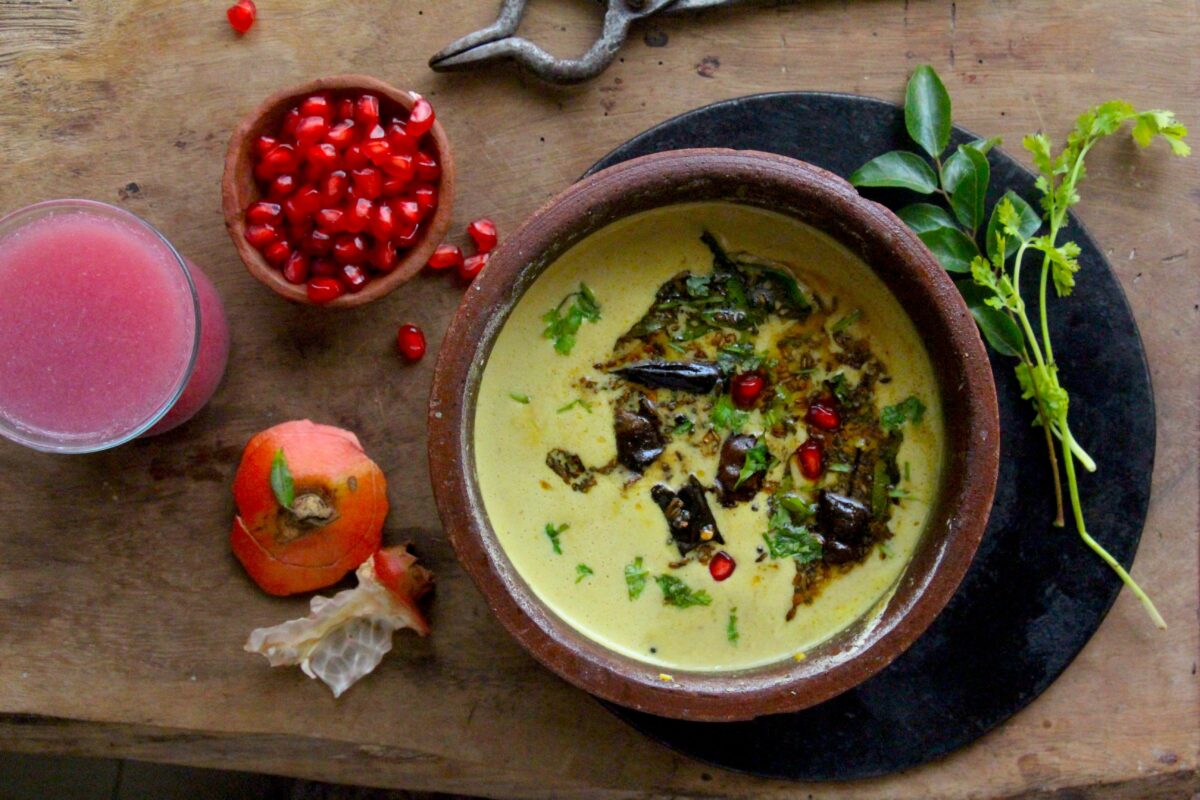
For example, Gutiérrez found that several texts mention buttermilk recipes that were written by Nala, a legendary Indian king, but when she examined the cookbook titled Nala’s Mirror on Cooking (Pākadarpaṇa), the buttermilk chapter was missing. So Gutiérrez took the buttermilk recipes purportedly by Nala in other books, compared them to other recipes from Nala’s Mirror on Cooking, and translated them. Then Reddy experimented, cooked, and photographed many versions to compare their culinary and regional styles.
“Academics working on South Asian history have already invested a lot of time thinking about ideology, social change, and texts across genres,” says Gutiérrez. “For example, I’ll read something in the Hindu epic Ramayana that is relevant and discussed in cookbooks written 1,500 years later. A non-expert or non-South-Asian-language-reading food historian won’t be able to put these data sets together, and in translation they would never recognize that the same categories of dishes or dish types are even being discussed.”
Take the example of a recipe fragment that puzzled Gutiérrez for years. Part of the original stone carving had rubbed off and become illegible, and she couldn’t figure out what dish would have both eggplant and jackfruit. The key came when she examined a historical text that described local food offerings to the gods and realized a signature offering of the local temple was eggplant gotsu. This meant that the same dish had been offered to the deity at that temple for over 700 years, a verifiable line of culinary presence few other temples could boast. “It’s only with all sorts of cross study, returning to material after years, re-translating, and thinking seriously about place, that one can come to certain discoveries,” says Gutiérrez. “I have come to many similar discoveries with various sets of materials after returning years later to re-translate and ‘tackle’ the problem again, but with new eyes.”
In 2024, Gutiérrez collaborated with Seattle restaurant Nirmal’s to recreate dishes that would have been eaten in premodern India before the European encounter, like jungle fowl tahari, pumpkin curry with broad beans, and King Bhima’s sweet and cooling shrikhand. (The restaurateur, Oliver Bangera, had to source the wild hen from a wild game farm in Canada.) She plans to complete her book, Royal Pleasures of the Kitchen: Recipes & Dining in India’s History, in the next few years, and Nirmal’s has agreed to host a similar premodern dinner night for the book release party.
However meticulous her research and recreations may be, Gutiérrez will never be able to try the exact dishes she studies, as ingredients, tastes, and cooking methods have changed over time. But this doesn’t faze her. “We take photos in the hope to have a memory of a moment, but the moment is ephemeral. It’s gone and you’re not going to experience the moment in the photo again,” she says. “But that doesn’t mean that it’s bad to have a photo.” Recreating historical recipes, for Gutiérrez, is another way to get a taste of the past.