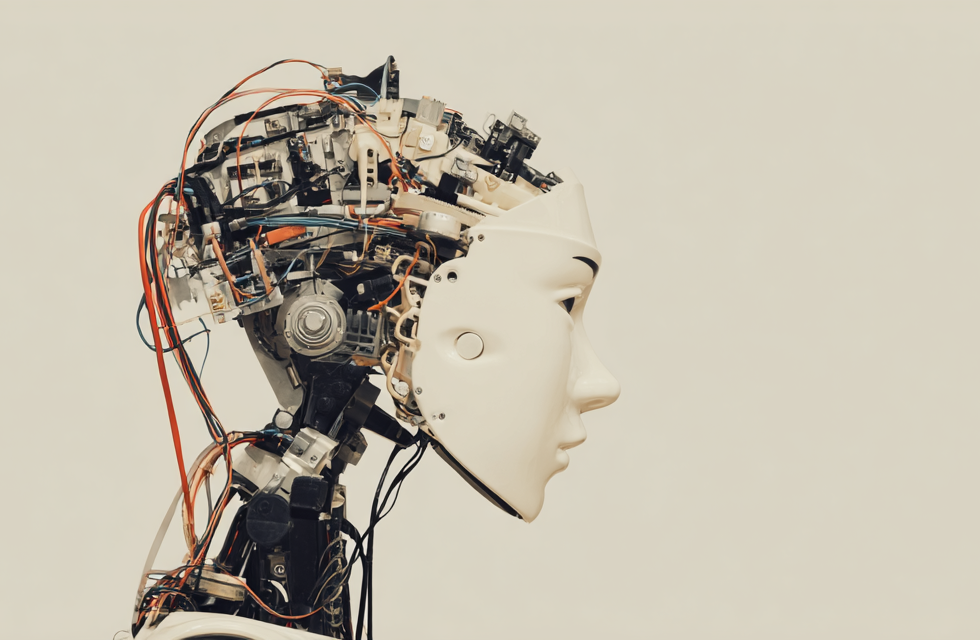
In our current age of widespread large language model AI, philosophical questions of consciousness feel particularly relevant. What does it mean to be conscious, and is this an experience exclusive to humans? If not — if we’re willing to accept that non-human organisms can experience consciousness similar to ours — could our understanding of consciousness expand to include sophisticated AI models, now or in the future?
To help answer these questions and more, I spoke late last fall with UT Austin philosophy professor Michael Tye, who also happens to be one of our most influential contemporary philosophers of mind. His books, including Ten Problems of Consciousness and Tense Bees and Shell-Shocked Crabs: Are Animals Conscious?, have helped shape current debates about consciousness in humans and non-humans. In his new paper, the well-titled “How Can We Tell if a Machine is Conscious?”, he turns his attention to the possibility of AI consciousness and alternatives to the famous Turing test. Below is a transcript of our conversation, lightly edited for concision and clarity.
Michael, thanks for joining us. Before we get into whether machines can be conscious, I’ll start with the obvious question. What is consciousness? What do we mean when we talk about it, and what does it mean to have it?
I think it’s useful initially to distinguish between what is sometimes called “creature consciousness” and what is sometimes called “state consciousness.” Creature consciousness is consciousness that creatures have for various things. For example, imagine I’m conscious that I’m late for an appointment. That is an attribute of me; I’m a creature. That’s an example of creature consciousness, and it’s also a self-consciousness.
Another kind of creature consciousness is higher order consciousness. This is the consciousness creatures have of what’s going on in their own minds, consciousness of a mental state by another mental state. Then there’s a very general notion of consciousness which creatures have. Suppose I say to you, “let me go upstairs to see if my daughter’s conscious yet.” All I really mean there is, “let me go upstairs and see if she’s functioning properly, if she’s awake and can come down and have a conversation.”
Those are three kinds of consciousness. They’re important in various ways, but they’re not the kinds of consciousness that philosophers are primarily puzzled about. Historically, I think what has happened is that when scientists have talked to philosophers, they didn’t quite get the kind of consciousness that philosophers were on about. So they thought, what’s the big puzzle here? And then they proposed theories with respect to the sorts of consciousness I’ve just distinguished.
The kind of consciousness I haven’t gone through yet is state consciousness. The idea here is that some of our mental states — some, but not all — are inherently conscious. Some examples would be pain, the visual experience of red, the experience of anger, feeling an itch. Those mental states are such that by their very nature they are conscious mental states; they have a distinctive conscious or subjective character to them. That kind of consciousness is known as phenomenal consciousness, and it’s what philosophers have been primarily puzzled about. What is it exactly that these states have that makes them have their distinctive phenomenal or subjective character? And how are we to understand how that arises as a result of neurological activity? How are we to fit it into our overall picture of the structure of the world? This has given rise to what has come to be called “the hard problem of consciousness.”
What is the hard problem of consciousness, and why do we care about it?
Well, because we want to understand ourselves, and it’s a big stretch for our understanding of ourselves. The hard problem of consciousness is associated with David Chalmers, but he didn’t really invent this problem. There are plenty of people who’ve formulated the problem in one form or another right the way back to the late 1800s or something.
The thought is simply this: We get a story about what’s going on in the brain neurophysiologically, chemically, and, if you like to go down to this level, even quantum mechanically. We get a full detailed physical story of what’s going on when a certain kind of phenomenal conscious state is present. In the example of the feeling of pain, we get a complete physical story of the neurological chemical basis of the feeling of pain. It still seems to make perfectly good sense for us to ask ourselves how it is that that particular set of neurological goings-on generated this particular feeling. Why didn’t it generate a different feeling? Why didn’t it generate a feeling of an itch, for example? Why did it generate any feeling at all? There seems to be a huge gap in our understanding here; it’s called the explanatory gap. We can say that when this is going on physically, we get this subjective, conscious state, but we still want something more than that.
That’s the problem, and there are various strategies with respect to it. Some people argue that it’s not a genuine problem, it’s a pseudo problem. Other people take it seriously. And it’s resulted in there being some proposed theories that are, initially, at any rate, pretty counterintuitive.
In your paper, you give the example of a leech as something that doesn’t have anything like consciousness. It will move in such a way that we could imagine that it has a conscious experience of pain or desire, but from what we know scientifically about how the leech’s neurons work, we can draw a pretty strong conclusion that it doesn’t have conscious experiences at all. But we feel that there’s something different about our experience. Can you say more about that distinction?
The leech doesn’t have many neurons. Its body is divided into segments, and I think that each segment has something like 400 neurons. If you look at how it is that leeches move, they appear to operate in a completely automatic, stimulus-response way. They have receptors that respond to vibrations in the ground that are made by their prey, so they can orient themselves with respect to their prey, and they have other receptors which pick up the scent that their prey emanates. These receptors make the leech automatically move in certain directions. It doesn’t move in those directions because it has decided to itself that it’s now going to move due to a desire of a certain sort. That’s not how the leech operates. The leech operates much more like an automatic door opener. If you stand in front of the automatic door, it’s not that it decides to open or wants to open. It’s built in such a way that it inevitably opens.
Not many animals, in my view, are at all like the leech here. It’s the exception rather than the rule. Usually animals move as they do because of decisions that they make reflecting desires and beliefs that they have. There’s a mental antecedent to their behavior.
Now, I think that the experiences that we have by their very nature play a certain role for us. They enable us to form appropriate beliefs and make appropriate decisions. For example, suppose I have a visual experience of red. What it’s representing with respect to some object before me, that information is available to my cognitive centers. I can then believe that the object before me is red and make certain decisions as to where I want to move. Experiences in general, I think, are cognitively poised. They stand ready and available to make a direct difference with respect to what we want, what we believe, what we decide.
Another example is the feeling of pain. When you feel pain, that is immediately available to the centers that form desires. You want it to stop; you believe the source of the pain is over here; that then makes you form a decision to move in this other direction, and off you go. Experiences produce behavior, but they do so via various cognitive estates. In the case of the leech, you don’t have anything of that sort going on, so I think that leeches are not conscious. But in many other animals, I think it’s plausible to suppose that you get the behavior as a result of various cognitive states. It’s plausible to suppose that those cognitive states are present because various experiences are present.
When I think about the “hard problem of consciousness,” intuitively what I hear is that there’s something special about consciousness. It’s not just that it’s a hard problem — there’s lots of hard problems in science — it’s that there’s something special and distinctive about the problem of consciousness in particular. Do you think that’s right?
That’s a reasonable response. One thing we might say here is that there are other hard problems too, but the more you reflect on consciousness, the weirder the situation seems, because it doesn’t seem as if there’s any immediate connection between what we get from science about what’s going on in the brain and what we experience. Why does that collection of physical goings on feel this way? Why doesn’t it feel some other very different way? Our feelings vary hugely subjectively, so why does it feel exactly this way? It seems like there’s a reasonable question to ask. It seems like there should be an answer to it, but it seems whatever else we come up with, we get a more detailed story about what’s going on functionally. But again, why does that produce this feeling?
There are things that can be said, and I myself have said them through the years, because I’ve been a committed, straightforward physicalist, if you look back to many of my earlier publications. But the problem is, if you stick around long enough, you have time to reflect. And what you want, in the end, is a view that you can believe. And what I found myself coming to think was that something had been left out. Intellectual honesty required me to admit that and then to consider some other alternatives.
What do you mean when you say that in your earlier development you were a pure physicalist? Do you mean that you thought consciousness was a pseudo problem, that there was something about the way our brains work that made us feel as though there was an experience of consciousness that couldn’t be explained in traditionally physicalist terms?
Basically that was what I thought. We all have to agree that there is this puzzle here. We then can either take it at face value and admit that as yet we have no answer to it, or we can make various proposals that would be consistent with our saying things like “pain is such and such a neurological state” or “pain is such and such a functional state.”
One way in which people in philosophy historically have tried to do that is by saying that we have very special ways of conceiving of our experiences and feelings. They’re really just brain states or whatever, but we have special ways of conceiving of them that generate in us the illusion that they’re radically different from the physical goings on when in reality they aren’t. I and others have told detailed stories of that sort, but I think, in the end, philosophers have sort of collectively come to the conclusion that they’re not satisfying enough. And that’s what I think myself, unfortunately.
One view that at least I think is worth taking seriously is that maybe there’s a straightforward answer to the hard problem, but maybe we’re cognitively closed to that answer by the structure of our minds. It’s not as if, given the evolutionary niche we occupy, we’re going to be able to solve all problems with respect to the universe. If you take rats, for example, they can’t solve problems in theoretical physics, their minds aren’t appropriately structured for them to be able to do that. Maybe we’re in something like that state with respect to the hard problem and there really is a straightforward, satisfying solution, but we can’t get our minds around it. I think that’s possible, but it’s not satisfying. So we continue to consider whether there are alternative answers.
Let’s switch to the question of the day. Can machines be conscious? And before we get into what your answer means, what’s your yes or no answer?
Yes.
Okay. Maybe the next question is: What are the key things we need to know to be able to answer that? How do you go about answering a question like that for yourself?
It’s like the question about animal consciousness. I think the way to proceed there is to look at the animal’s behavior in the first instance and ask why the animal is behaving in the way that it is. Likewise, I think, with machines.
If you take our own case, for each of our experiences and feelings, there’s a kind of distinctive behavior that goes along with it. Just stick with a simple example of pain. Initially there’s a characteristic cluster of behaviors that’s generated by the feeling of pain. Some of these behaviors are more complex than simply pulling your injured limb away from the damaging stimulus. There’s something called trade-off behavior, which is very important. If you are feeling pain as a result of doing something, but you are doing it and it has great value to you, you’ll put up with the pain and continue to behave in that way. And if you go through it, there’s a complex cluster of behaviors that is generated by the feeling of pain.
When we look at other animals, one thing we see is whether that cluster of behaviors is found in them. If it is, then you’ve got the overt appearance of pain. I think that is a reason to believe that they genuinely do feel pain unless we’ve got some further information that undercuts that inference. Some debates go on about whether neurological differences are salient, but I think that, in the end, the best way to proceed is through the animal’s behavior. If you look at other mammals, fish, and arguably even some insects, you find quite complex behaviors that are straightforwardly explainable on the assumption that they’re feeling something like us, namely pain, and which can’t be explained satisfactorily if we take a different view.
In the machine world, imagine that we’ve got a machine that is running a variant on today’s large language models in that the machine not only takes linguistic inputs to its “brain” but also takes inputs of a whole host of sorts: inputs about what’s happening on the surface of its body, inputs visually to the system. Imagine the robot has a head and the neural network is embedded in the head auditory inputs. You get inputs on forces to the body, and you equip it in such a way that it can generate behavior of the appropriate source. Then imagine that what’s happening after this is constructed is that you’re getting very complex behavior under certain circumstances when the robot damages its body, behavior of the sort that we would produce if we were feeling pain as a result of damage to our bodies. Then I think prima facie we can at least take seriously the idea that the robot is feeling pain.
Now, that’s not the only possibility — and this is where things get kind of complicated — because what’s really going on in these networks, if we just look at large language models, is not well understood. We know what went on when we trained up these networks to give the desired outputs, but there are different views about exactly what’s going on internally in these networks. I think that makes a difference to how reasonable inference is with respect to there being in such and such an internal state.
You’ve coined a phrase, “Newton’s rule.” Can you talk about what that is? I think it’ll be obvious to people how that applies to this case, and I think it’s an interesting question of how we ultimately arrive at a conclusion and say a machine is or isn’t conscious. The one that a lot of people will know, which you don’t think is adequate, is the Turing test. You have a related but different approach to determining whether something is what it seems to be.
My view on the Turing test is that the way the system behaves gives us evidence of various sorts, but contra Turing, I don’t think being intelligent is just behaving in an apparently intelligent way. With Newton’s rule, what Newton said was: if you find in nature a given effect occurring on a bunch of occasions, and every time the same cause is operative, then when you meet that effect again on a new occasion, it’s rational for you to believe that the same cause is operative unless you’ve got some reason to think that there is a difference in the new case that makes a difference. Obviously the new case will be different in a bunch of ways, but unless you have evidence that those differences make a difference, you’re entitled to think that the same cause is operative for that effect.
In some ways that dovetails with what I said earlier about behavior. You find in the animal world the same behavior repeated, and that behavior matches the sort of behavior that we know in human beings is generated by the feeling of pain. The thought is in all the cases in which we have the behavior and we know the cause, we know it’s the feeling of pain that generates it. Arguably we don’t have reason to think that the differences make a difference, so it’s rational for us to believe that the same cause is operative there. Of course, we could be wrong. To say this even more cautiously, maybe we should say it’s rational for us to prefer the view that the organism feels pain to denying it. Maybe our credence level is not quite high enough to entitle us to be definite believers, but it at least makes it rational for us to prefer that view given the way the organism is behaving.
So, why shouldn’t we extend that methodology when we encounter a robot of the future, which has a body associated with the neural network and is behaving in exactly the way that we behave when we feel pain? What we have to do in order to reach further conclusions here is to try and form some further judgments about what’s going on internally in the robot. In our own cases, as I mentioned earlier, it’s not that the feeling immediately generates the behavior. Various cognitive states interact and generate the behavior. The question is whether you can find in the robot not just the behavior but cognitive states of that sort, and that would require you find in the robot representational states, because beliefs and decisions are states that carry information, they have representational content. The question then is whether the machine is just behaving in a purely statistical way or whether it’s somehow coming to form internal representations which are then having an impact on their behavior. It’s an open question, given the behavior, whether the robot is feeling anything. We need to look in further to what’s going on cognitively, if anything at all, in the robot.
When I was reading about your idea of Newton’s rule, I was thinking about what the contrary position might be. I read Newton’s rule as saying your working hypothesis is something like “if it looks like a duck and quacks like a duck, it’s a duck.” If a machine is producing behavior that we would interpret in ourselves as the subjective experience of pain or consciousness, the working hypothesis, until we disprove it, is that it’s experiencing consciousness. Then we try to understand certain things about its neurology, and if we then have reason to discount that experience, we reject the hypothesis.
Some version of the counter position here might be “extraordinary claims require extraordinary evidence.” I would think there would be other people, and this gets back to these questions of the hard problem of consciousness, who would say something like, “that’s so counter to our intuition and to our subjective experience of how the world works that you have to do better than that. The burden of proof really rests on the person who would say that machines are conscious.” What you’re saying is the burden of proof rests on the people who want to reject the obvious inference that if a machine’s behaving as though it’s conscious and we have no proof otherwise we should assume it’s conscious. Is that a fair way of framing at least part of the controversy?
I think that’s fair enough. Let me add a couple of things on another way of viewing Newton’s rule, which is sort of as an application of Occam’s razor. Why multiply causes unnecessarily? You keep getting the same effect. Why insist in the new cause as a completely new cause when the simpler hypothesis that it’s the same cause that’s operative is present?
As for the thought that we are just as entitled to go the other way and say, “no, the onus is upon you to prove the same thing is happening.” Well, there’s the opposite observation I’ve just made about not unnecessarily multiplying causes, but there’s also the following two thoughts. One is that we know that in the animal kingdom, brains vary quite dramatically. We don’t take that in and of itself as a reason to deny that the animals experience things as we do. There are interesting questions here as well, by the way, about what really is needed in human beings for the feeling of pain to be present. So the first thought is, in the animal kingdom, brains vary quite a lot, but that doesn’t prevent or preclude us from attributing experiences to those animals. We just think there are different neural realizations for the various experiences that their behavior suggests very strongly that they’re undergoing.
Secondly, there’s a kind of thought experiment in our own case which strikes me as relevant. Imagine that we have a silicon chip. We design it in such a way that it functions exactly as a given neuron in the visual cortex. We implant it in the human visual cortex and it takes inputs in exactly the same way. You can have transducers connected to the silicon chip, so there are wires coming in and a wire coming out, so you’ve got artificial dendrites and artificial axon, and basically it passes messages in just the same way as the neuron it replaces. There’s a pretty good argument I don’t have time to go through here that says, basically, if you do this one by one and you keep building out, you end up with a purely artificial visual cortex that will have no impact on visual consciousness. Visual consciousness will continue just as it did before; you will continue to believe that you’re subject to the same visual experiences as before; you’ll make all the same discriminations. If that’s true, then silicon chips are things of a sort that can support consciousness. Add that to the thought that these other animals are conscious, and then why shouldn’t we say that not just individuals as we are now, imagining them like us with parts of our brains replaced with silicon chips, but individuals built from scratch with silicon chip brains can be capable of consciousness?