I was given something wonderful, something that changed me forever…a vision of the universe that tells us, undeniably, how tiny and insignificant and how rare and precious we all are. A vision that tells us that we belong to something that is greater than ourselves, that we are not…alone. — Jodie Foster as Dr. Eleanor Arroway in the 1997 movie Contact
Most evenings after dark, you can find religious studies associate professor of instruction Brent Landau in his backyard with his binoculars, looking up at the stars.
It’s a hobby. It’s also preparation. In his ever-more-popular signature course, “Religion and Outer Space,” Landau introduces first-year students to the ancient connections between the cosmos and earthly religious practices.
The class began in 2020 and was inspired by the interdisciplinary nature of UT’s signature courses, which are required for all freshman at the University and deliberately designed to introduce students to a range of fields and ways of studying them. The courses’ unique format and purpose got Landau thinking about how he could blend his academic focus on early Christianity and apocryphal texts with his lifelong interest in the cosmos, which he cultivated while growing up near and visiting the Lowell Observatory in Flagstaff, Arizona; attending lectures at his church about astronomy; and, like any good ‘80s kid, by watching Indiana Jones and Star Wars movies.
Landau wrote his dissertation on the apocryphal retelling of the 12-verse story of the Magi, the Gospel of Matthew narrative about the men who followed the appearance of a star because they somehow knew it signified the birth of Jesus, and since then he has been researching the origins, historicity, and influence of Bible stories. After years collecting relevant scholarship, he knew he had plenty of fodder for a class that would be interesting to new students. He also knew that he could combine his interests in religious texts and astronomy to help new students adjust to life on campus.
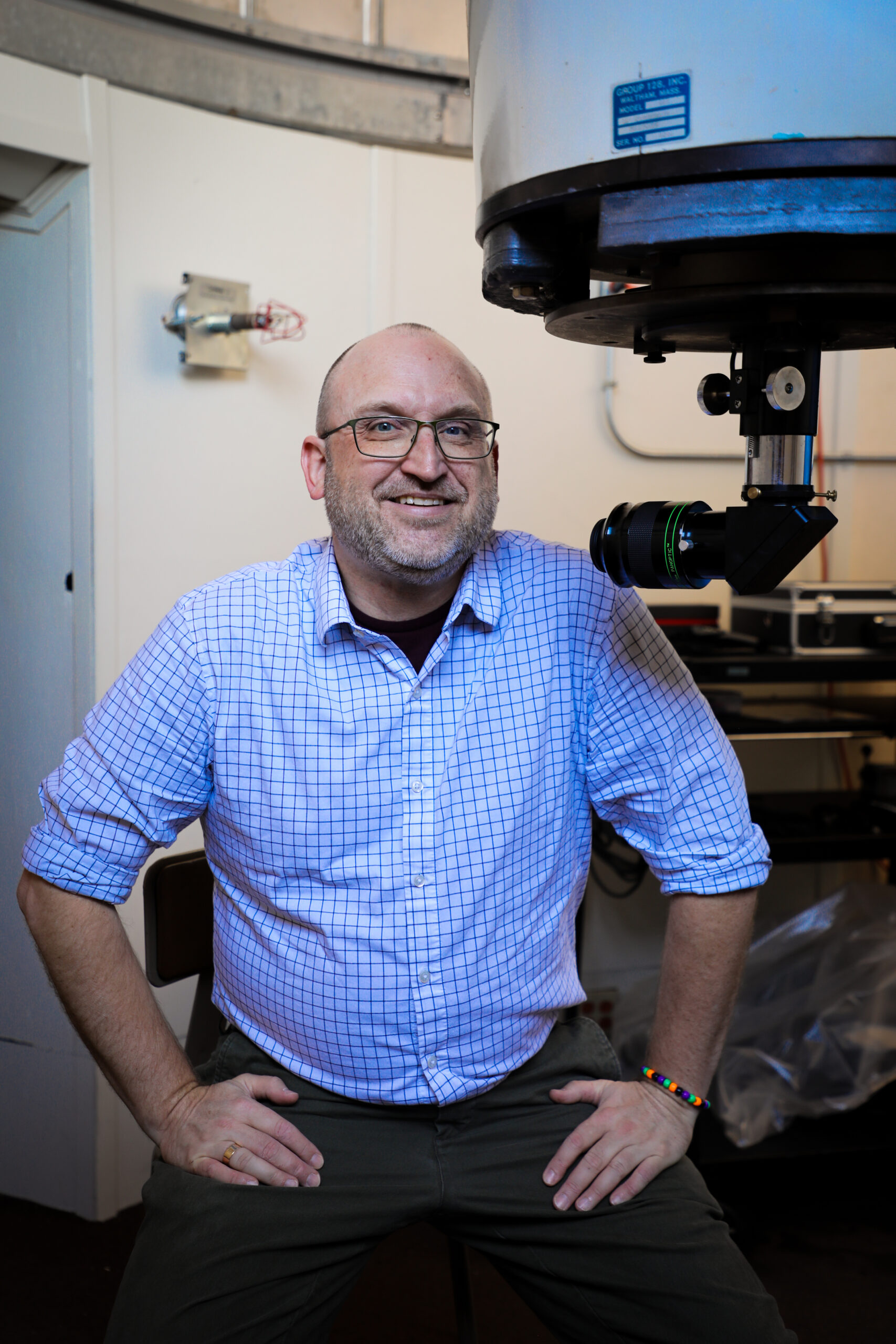
“I take very seriously that my responsibility as a signature course instructor, particularly as one who always teaches in the fall, is to introduce students to the college experience,” he says. “New students are able to meet friends through their discussion sections, and with the assignment to observe the night sky, they go out and explore the campus. The class also introduces students to a range of fields of study and to what the field of religious studies explores.”
Landau describes his approach to the religious studies aspects of the class as “rigorously skeptical,” one that questions the nature of belief while also teaching religious literacy. One way he does this is by teaching about how different religions have approached questions of outer space for thousands of years.
Landau likes to remind students, for instance, that the magi story provides little actual detail — we don’t know how many magi there were, where they were from, how they knew the appearance of the star signified Jesus’ birth, or what happened to them after they left with this astral knowledge — and that early believers filled in the blanks with their own interpretations.
He also points out that the word “magi” had multiple meanings, one of which is simply “astrologers,” which he notes would have been viewed with suspicion by orthodox Christians. Add to that the fact that the magi seemed to be non-Greco-Roman, and you get a sense of how complex the story must have been for early Christian believers.
“Early Christians were trying to hammer out whether magic or astrology is okay under any circumstances, and they were also trying to figure out who these individuals were,” Landau says. “You can think of some of the apocrypha almost as ancient Christian fan fiction, in the sense that there was a whole bunch of stuff that they were curious about that wasn’t really spelled out in the official writings.”
Landau’s class also goes back to Genesis 1 in the Hebrew Bible to unpack the text’s description of the “firmament” in the creation story. “I read Genesis out loud to the students and then invite them to come up and draw on the chalkboard what they think it actually looks like,” he says. What students inevitably figure out is that the description of the night sky in the Bible is totally pre-scientific, with two sections of water divided by a kind of solid sky dome. “If that was really how the universe was structured, space exploration as we know it would be impossible,” Landau notes. Students also probe what it means that so many translations of the Bible refer to the sky as the “heavens,” exploring our human associations with that word as referring to what happens after we die and how we might have come to associate the sky with that concept.
The class also looks at how Islam uses astronomical observation through its lunar calendar, and at the inherent ambiguity of marking a new month by the sighting of the new crescent moon. “How easy is it to see a super-thin crescent?” Landau asks his students. This question has caused controversies throughout Muslim communities around the world about when a new month actually starts, because the gold standard for hundreds of years has been visual confirmation of this thin crescent. “Now that we can say, scientifically, in terms of our astronomical calculations, we know when that crescent should be there,” says Landau, “it raises questions about human perception versus mathematical precision — do we trust what we see, or what the numbers tell us?” This conundrum, he says, is a great reminder to students that religious communities are not monolithic and that saying generally “what a given religion believes” tends to be a gross overgeneralization of many diverse and dynamic groups.
“Religion and Outer Space” is now in its sixth iteration, and since its inception Landau has tweaked the course to make sure it remains both academically rigorous and a lot of fun. During the pandemic he added what has come to be the course’s signature assignment: having students look up at the night sky with a pair of binoculars for 30 minutes per week and write about what they see. Not only does it teach students how to identify the constellations and planets (something many students have reported to be a fun party trick when they return home on winter break), but it also introduces first-year students to the UT campus.
For an additional fun factor, the class also begins the semester watching movies, including Contact and Interstellar, which, Landau says, gives students an overview of the vastness of outer space and questions of extraterrestrial contact. A common thread in those two films is, of course, occasional UT Austin professor Matthew McConaughey. “I’ve tried emailing a few people to get him in to guest lecture,” says Landau, “but no luck yet.”
One of Landau’s favorite parts of the course is talking about UFO phenomenon, which he describes as having a built in “giggle factor.” He likes to point out that whether one thinks these are actually alien spacecraft or something else entirely, there’s something going on in our night sky that can’t all be chalked up to hallucinations and classified military aircraft. “Human beings have seen weird stuff in the night sky for thousands of years, and it seems to be a fundamental reality of our human experience,” he says.
Beyond religious studies, “Religion and Outer Space” introduces students to the ethical dimensions of astronomy. They discuss issues like light pollution and how the proliferation of satellites limit our ability to see they sky. “I can tell you where to look for the Andromeda Galaxy,” Landau says, “but it’s harder to see now than ever before. The night sky itself is being markedly transformed by human activity.” This realization also points students toward religious, moral, and ethical implications involved in space exploration.
Zooming further out, Landau’s favorite part of teaching the class is just getting students to look up. “It helps us recognize our ‘planetariness,’” he says, and “reminds us we’re on a spinning orb, which is easy to forget just going about daily life.”
He calls out Deneb, a star 1,500 light years away in the constellation Cygnus. “It looks fainter than other stars around it, but only because it’s much farther away. If it were closer, it’d be as bright as the moon. The universe is vast beyond comprehension — and yet, the fact that we’re here, aware of it, makes us incredibly rare.”
That duality — insignificance and preciousness — is what keeps Landau gazing skyward. “Outer space is fundamentally religious,” he says. “It’s the abode of the gods, of mystery, of salvation.” Whether in scripture, science, or science fiction, the course brings its students to the same question: What does it mean to be human beneath the stars?