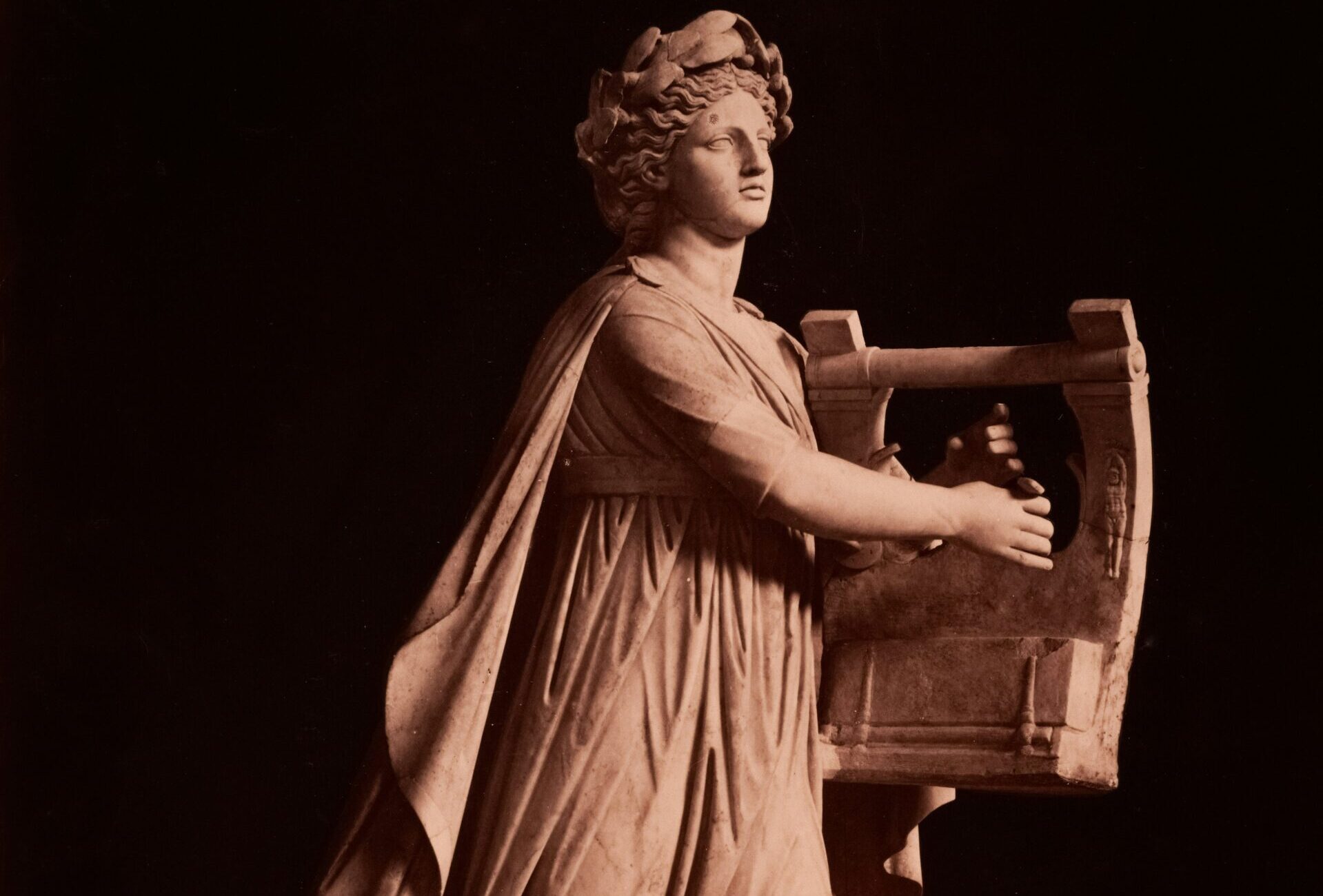
The ancient world was like ours: loud. People crowded into city centers, haggling in marketplaces and chiding their children. Armies in bronze armor clashed on battlefields. Traveling performers sang or chanted the works of Homer from memory to captivated audiences. And on stage at Athens’ religious festivals, performers in the great tragedies similarly sang or chanted the lines we still read today. This was no silent world of white marble and philosophical contemplation. Sound, and that closely related phenomenon, music, was everywhere.
But it’s one thing to know that the distant past was full of people who spoke, sang, beat drums, and strummed instruments — people who thought carefully about the sounds they heard and the sounds they created — and another thing entirely to experience what they experienced. What did it sound like, exactly? When a musician sat down to his lyre or his pipe, what did he play?
“We know a lot about ancient music theory,” says Sean Gurd, Floyd A. Cailloux Centennial Professor in Classics and chair of the classics department at UT Austin. “We know less about music practice. We know very precisely how ancient thinkers who thought about music constructed it as a theoretical entity. What we don’t know is the degree to which performers obeyed the rules.”
Gurd has spent much of his career thinking about how the ancients thought about music and performance. In his recent books, including 2016’s Dissonance: Auditory Aesthetics in Ancient Greece (Fordham University Press) and the forthcoming God’s Lyre: Music Naturalism in Greek Thought (Oxford University Press), Gurd connects ancient Greek sound to questions and theories of physics, theology, and the avant-garde. To classical thinkers, he argues, many of the categories we now use to separate and define various kinds of knowledge wouldn’t hold. Music was sound, art, math, something both natural and something to be controlled. It was political. It was part of what made you who you were.
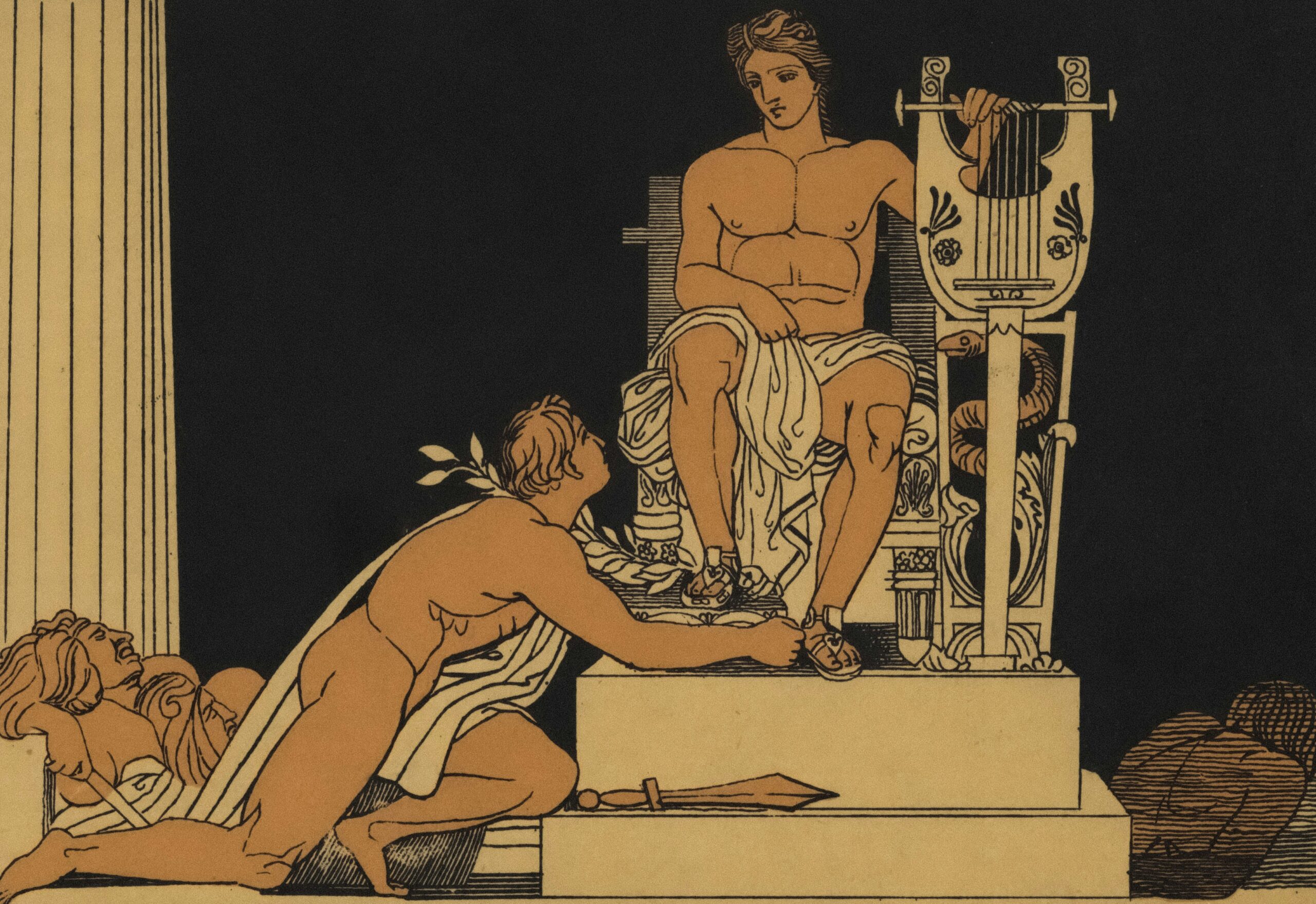
Orestes suppliant to Apollo, by The New York Public Library.
The context is important here. “When tragedy is invented as an art form in the late 6th century BCE, it drives musical innovation,” Gurd says. “Tragedy and comedy become the prestige musical forms in Athenian culture, and they’re strongly associated with the democracy.”
As Athenian democracy evolved, wobbled, fell, and was restored, it lost some of its shine, at least in the eyes of philosophers like Plato and Aristotle. So, too, did the music of Athens’ great theatrical forms.
“These folks were committed to the intellectual project, suspicious of the senses for other reasons, and suspicious of Athenian democracy,” Gurd explains. “So they started to ask questions about everything associated with it, including this music. And it’s in that context that you start to see explicit conversations about what music is, what it is for, when it’s good for people and when it’s not.”
These early theories of music ascribed a surprising amount of power to the art. Thinkers like Plato argued that exposure to certain kinds of music could fundamentally shape a human personality, and not just in its tastes. If some types of music are democratic, this argument goes, then it stands to reason that others are oligarchic or even tyrannical. If you expose someone to the wrong music, you may permanently damage their soul; you may make them a little tyrant, or someone happy to live under tyranny. By this thinking, what someone listened to was more than an expression of their aesthetic preference. Music could shape the core of who a person, or a state, could be.
Eventually, Gurd says, this line of thought was joined by others. “By the end of the 4th century, there are voices who basically say there’s good music and there’s bad music, but it doesn’t really make you a better or worse person,” he says. “It’s just inherently, or from an aesthetic point of view, better or worse.”
But though “good music” and “bad music” may suggest a certain simplicity, ancient music was anything but simple. This is where the math and astronomy come in. At some point relatively early on, ancient thinkers realized that the concords — sets of musical notes that sound pleasing together, such as an octave or a perfect fifth — were mathematically related.
Gurd explains it like this: Pretend for a moment that the ancients played guitar, if only because a guitar is easier to envision than a lyre and the principle is the same. If a player tightens a certain length of string along the guitar and strums it, they get one note, and if they then press down on the very center of that string, at the 12th fret, they get a second note an octave higher. If they then press two thirds of the way up the string, at the seventh fret, and strum, they get a fifth, and they get a fourth three quarters of the way up the string, at the fifth fret. It’s music, but it’s also ratios: two to one, three to two, and four to three.
“The major concords are string lengths that are in simple, natural number relationships with each other. That’s already pretty mind boggling,” Gurd says. “But if you take those numbers and add them up, you get the number 10, so this connects with the base-10 number system as well. And if you lay the numbers out as pebbles, you get an isosceles triangle. There’s all these little numerological things that come out of the concords that just blew their minds.”
From these mathematical relationships, early thinkers like Pythagoras extrapolated a model that they then projected onto the heavens. This is the source of the famous “music of the spheres,” “the idea that if the planets are moving in some kind of simple mathematical ratio to each other, then maybe there’s concords up there,” Gurd explains, “and then you get a debate over whether you can hear them.” Later astronomers like Ptolemy, author of both Almagest and The Harmonics, continued to pursue mathematics, astronomy, and music theory, seeing them not as highly differentiated fields but as a continuation of the same questions and reasoning.
Setting aside the music of the spheres for a moment, there’s still an obvious question. The math is all well and good, but what did this music actually sound like?
“The best analogs are probably classical Indian music and what is sometimes called classical Middle Eastern music,” Gurd says. “There are these traditions in India and the Near East that are like the ancient Greek approach to music, and what they have in common is that they have a large number of possible tunings, whereas Western music has one.”
We don’t have to be content with analogs, though. Enough written Greek music survives — a surprising amount, mostly on scraps of papyri the Victorians recovered from mummy wrappings — that scholars have been able to recreate and perform it. Now, in spaces like Gurd’s Ancient Music and Performance Lab, modern musicians can use reconstructed ancient instruments to breathe new life into music not heard for millennia. We may not be able to hear the music of the spheres, but we can hear the Platonic modes and hymns to Apollo much as they were originally intended to be played.
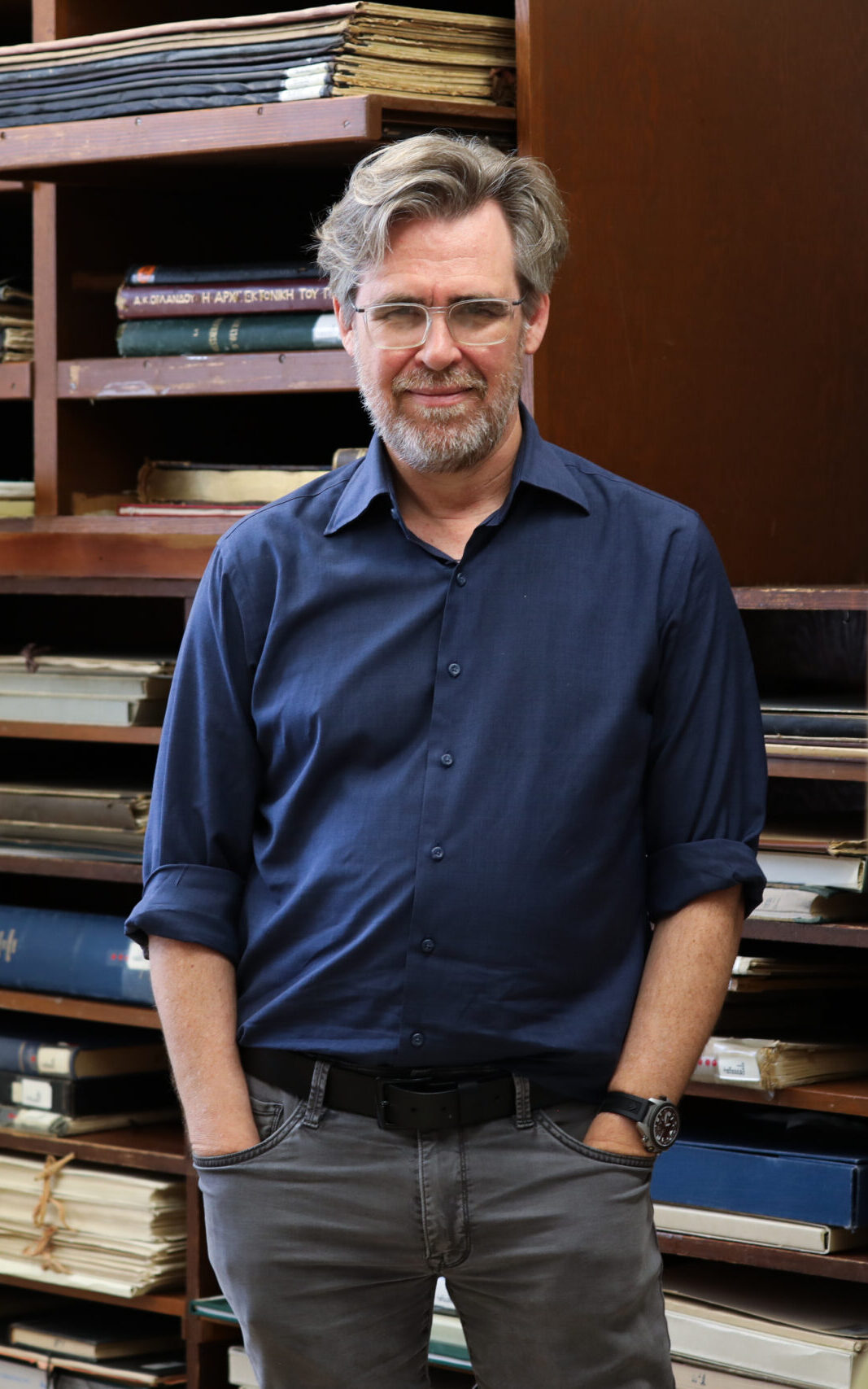
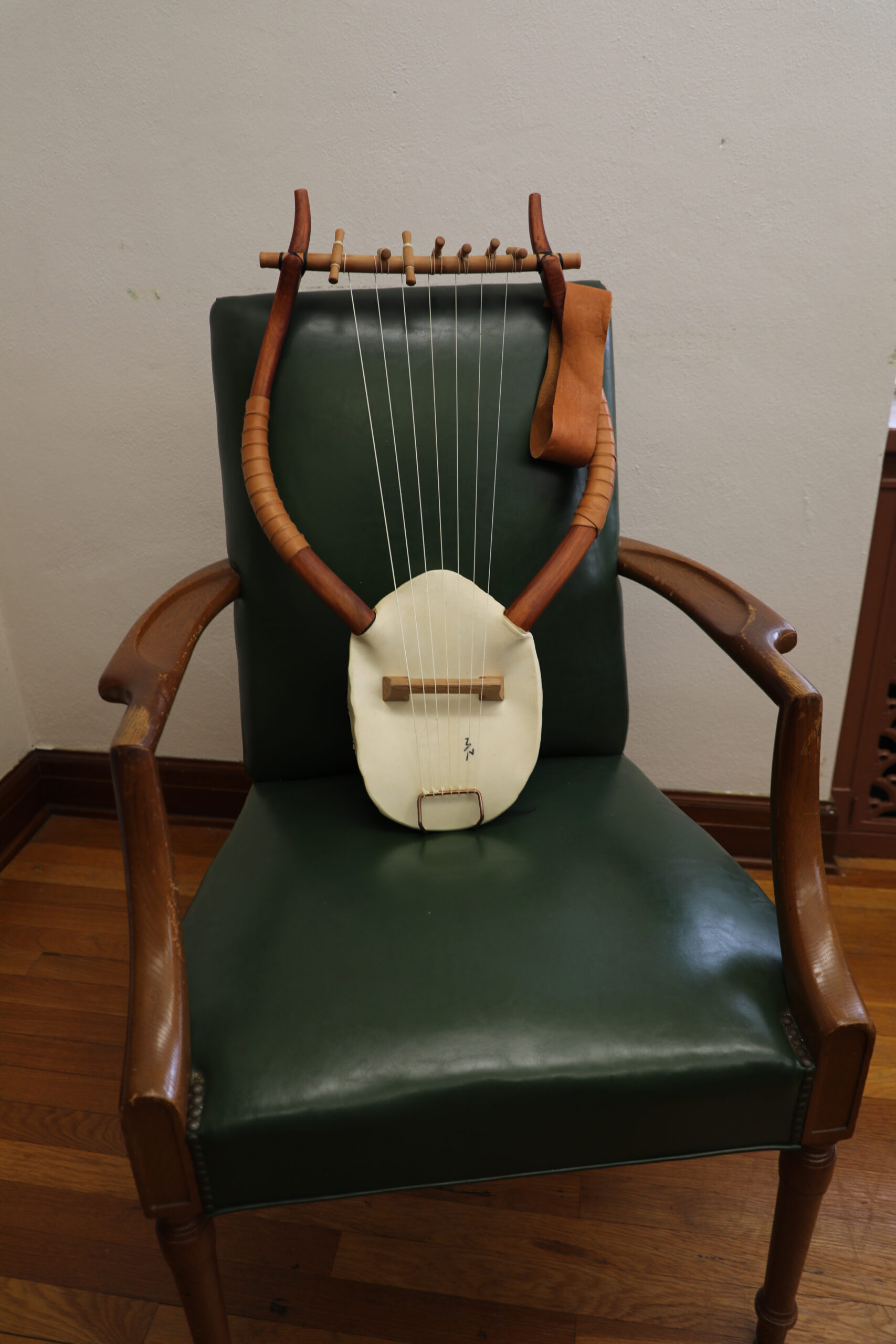
Performing this music is important not just for the experience of listening to it but for the experience of performing itself. As anyone who’s ever played an instrument or worked a craft knows, there are things you can only learn by doing. Music is one, Gurd says, and its highest Greek form, tragedy, is another.
“I’ve really convinced myself that the only kind of knowledge about a tragedy that matters to me is the ability to perform them in a coherent way,” he says. “This has had a couple of consequences, and one is that when I teach tragedy, it’s 100 percent performance.”
This model of teaching the classics of Greek theatre — think Aeschylus and Sophocles, The Trojan Women and Antigone — is a significant departure from the norm. The standard course on Greek tragedy has students reading at home, coming to class to hear their professor lecture or lead a discussion, and then writing an essay or series of essays analyzing the texts as literature. Gurd’s courses look nothing like this, but they do look a little bit like SNL. Using an improv curriculum, “the same they use at Second City,” he says, he teaches his liberal arts students the foundations of collaborative performance. Then they focus on working together to bring the tragedy to life.
The point isn’t to stage a professional play. Stages aren’t involved at all, in fact, and there are no audiences looking on, hoping to be transformed or at least entertained by art. Instead, the emphasis is placed squarely on the students’ experience and knowledge of the play as communicated through their performance. Over a semester they proceed through the improv curriculum and table reads of the tragedies until they’re ready for their final project: an entire tragedy, acted out in their classics classroom.
“The point is to get into this world and to tell a story in that space,” Gurd says. I believe very strongly that that is a legitimate kind of knowing. In order to understand tragedy, you have to think performatively.”
Both Gurd’s work on ancient music and ancient tragedy privilege “what’s beyond the words,” he says. Beyond the ancient musical theory lives something realer than the theory itself. Beyond the text of a play there is the play. The music and theatre that emerge from the words are composed of all the little nuances of our lives — the nerves of the performer, someone’s good hair day, the tuning that’s gone just a little flat. Or, in the case of modern musicians playing ancient music or undergraduate students playing Medea, the lifetime of training and self-belief (or self-doubt) that has to be adapted or overcome.
This process is largely, though by no means exclusively, a physical one. The hand plays the lyre, the breath fuels the flute and the voice. And to some ancient thinkers, Gurd says, this link between the musical and the physical was even more profound. It became not just an explanation of the mechanics of sound — though it was that, too — but a kind of theology, a theory of how the human and the divine interact. This is the subject of his upcoming book God’s Lyre, in which Gurd sets aside questions of modern performance to examine the connections ancient thinkers drew between music and physical or physiological events.
“It takes off from the idea that music is a physical modulation,” he explains. “There was a physiological model that was circulating in the ancient world that basically said that when you had emotions, your body heated up; that the feeling of having an emotion was a thermodynamic process. They also didn’t really understand pitch, or why some vocalized sounds were higher or lower. Then somebody connected these two ideas to argue that the human voice heating the air in your vocal tract would lead to higher pitches.”
This connection led to “a physiology of music,” Gurd says, “which basically said ‘music is what happens when your body heats up.’” The implications of this physiology are significant. It suggests that music isn’t an art one studies or develops but instead is something that happens naturally under certain conditions. A great singer isn’t just somebody who’s spent a lifetime practicing and honing their craft, these thinkers might say. They’re also someone who is able to control the heat of the air in their lungs and throat by managing their emotions.
The thinkers Gurd follows in God’s Lyre continue to develop this physiological model of music and connect it to the theological discussions prevalent at the time. “It is fair to say that some of these figures are actually saying that music brings you closer to God in ways that we still hear today,” Gurd says. “I like that idea because it’s natural philosophy, physiological science, but it’s also theology. We tend to keep those two things separate, but this is a tradition in which they go together. Here you’ve got a physical theory of the universe that becomes a theory of music and then becomes a theory of how making music can connect you with divinity, and it’s all physics.” And if you can play it for yourself, even better.