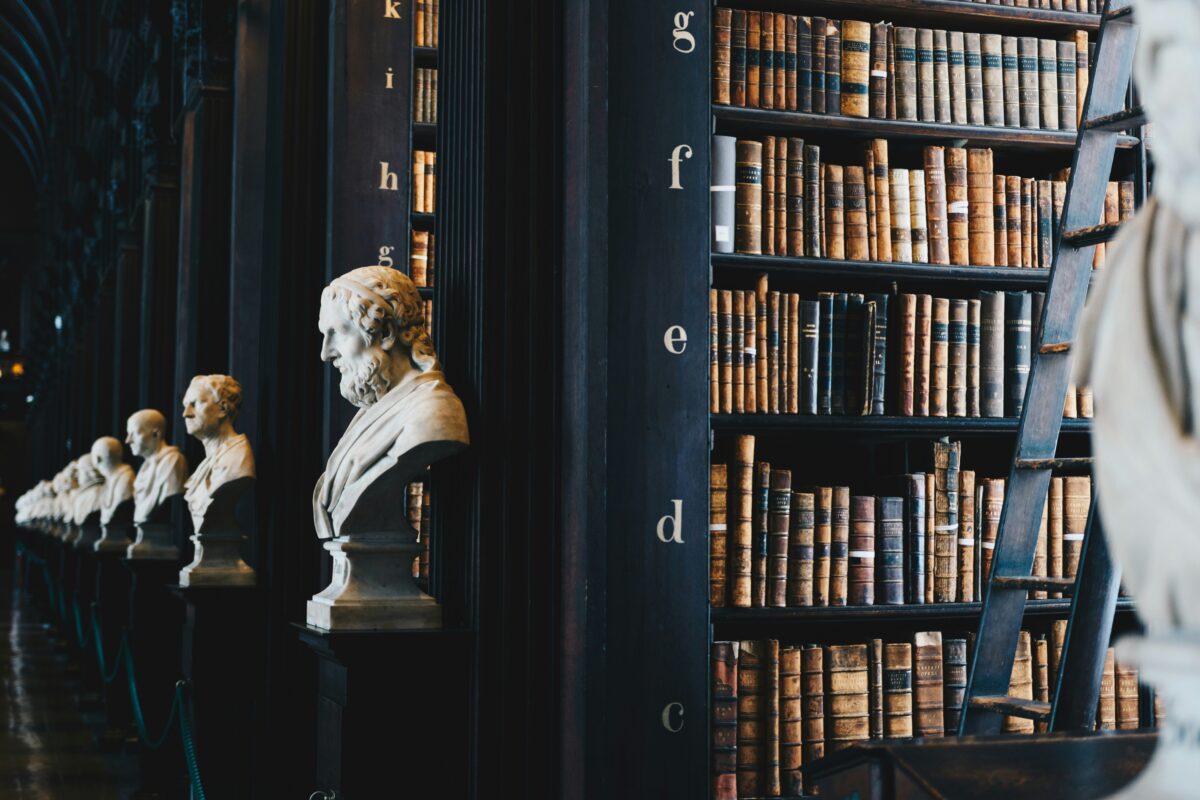
Consider two images, or visions, of the study of the liberal arts. One is of a bright young student looking intently at a beautifully burnished bookshelf. On the shelves are rows of books that are obviously part of a carefully curated series, all the same size and spun off from the same design template.
The other is that same student but in a big library. She’s looking up in wonder at a forest of brightly colored books surrounding her, each volume a portal into a wholly different world.
The first image we might call the “great books” vision of studying the liberal arts. The texts have been carefully chosen by the wisdom of the ages and the elders to provide the student a single curriculum she must absorb in order to become a cultivated and educated citizen of our society.
The second is what we might call the “abundance” vision of studying the liberal arts. The student is given access to the whole wide world of texts, cultures, ideas, and narratives, then encouraged to craft from these riches her own curriculum, a remix of her own tradition, guided by various mentors each offering a distinct perspective.
There’s a temptation to plot each of these visions on the contemporary partisan spectrum, with abundance on the left and great books on the right, but that framing confuses more than it clarifies. The great texts of the past aren’t so easily shoehorned into any contemporary political framework. That’s true whether you’re talking about major thinkers of the Western canon, many of whom were radical deconstructors of the orthodoxies of their era, or major thinkers of the non-Western canons. Was Karl Marx a conservative? Was the Buddha a liberal? Darwin? Nietzsche? Freud? Borges? Achebe? Naipaul?
Abundance, similarly, is not intrinsically a left-wing approach to learning, but rather a liberal one in the classical sense of the term. It’s opened up the curriculum to a lot of texts, courses, perspectives, and departments that have a more leftish flavor to them. It has also, however, been a conduit through which a more consumerist or free-market orientation toward education has seeped into the university.
For the university communications professional, the question isn’t which vision is better in the cosmic sense but rather which story, at any given moment, better captures the essence of what the university is doing. After World War II, for example, it’s easy to see why the abundance vision of the liberal arts made marketing sense. Thanks to the GI Bill and post-war economic expansion, the numbers and kinds of Americans going to college dramatically increased. This was mirrored in the expansion and diversification of the people who were teaching college and devising the curricula.
What had been an elite endeavor, oriented toward white men of means, became a mass phenomenon, encompassing more middle- and working class people, more people of color, and more women. In this context, liberal arts abundance made marketing sense. It spoke to people’s optimism. It aligned, conceptually, with the expansion of the consumer markets. It created space to accommodate people and populations who had been excluded from the old story. And in the context of material abundance, in an era when the prestige of the liberal arts remained high, this kind of expansion didn’t require a rejection of the great books approach to liberal arts education. It encompassed it. Students of all disciplinary and demographic stripes still enrolled in big survey courses on Shakespeare, ancient philosophy, American history, political theory, and the like, and many of them chose to major in traditional humanities disciplines with fairly traditional curricula.
When I was an undergraduate liberal arts student in the mid-1990s, this was the vibe. We enrolled in the big survey courses to get our informal core curriculum of the great books and thinkers, and then we spread out to our respective disciplines where we got more specialized knowledge. Even the STEM majors, most of the time, wanted to get their Shakespeare and Plato on the side. There didn’t seem to be a conflict between the two visions.
It feels different now, for a few reasons. One is that there are simply fewer students taking humanities courses. Another is that the cultural expectation that graduates of elite colleges should have at least a facsimile of knowledge of Moses, Plato, Shakespeare, Austen, Ellison, Morrison, and Rawls seems to have diminished below some critical threshold. An English professor at Duke told me last year that the department can’t fill their Shakespeare lecture survey courses anymore, so they’ve been eliminated. You can still study Shakespeare at Duke, but it will be in a small seminar room, seated almost exclusively next to other English majors, of whom there are many fewer than there used to be.
Instead of abundance, then, there is scarcity. And instead of the great books regime that preceded it, with its elite product developed for an elite customer base, there is fragmentation. And then, of course, there are the politics. Every choice being made, right now, about what and how to teach in the liberal arts is occurring within an intensely polarized, politicized context, with a lot of different actors with different agendas fighting to have influence.
We’re in a period of transition, in other words. Who are we? Who do we want to be? What should we hold on to, or go back to, and what should we move past and let go? Who will we be allowed to be?
And what tableau should we be painting? The burnished bookshelf? The vast library? A tiny free library? The cloud?