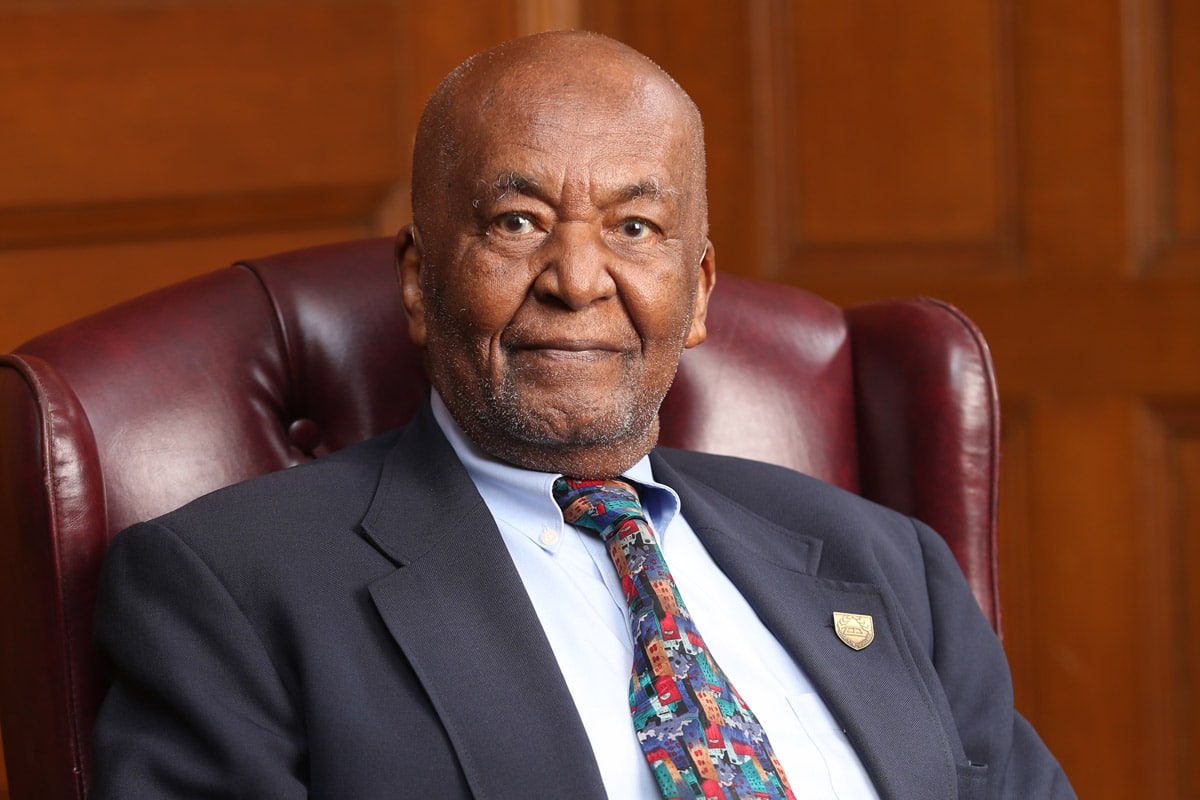
It’s near impossible to overstate — much less to summarize — the profound influence of psychologist and scholar Edmund Gordon on the field of educational research and policy. Gordon himself, who turns 105 this summer, says the primary concern driving his decades of work has been ensuring educational opportunities for disadvantaged students, whether that disadvantage is rooted in race, class, language, or gender.
“If injustice has been expressed in educational opportunity, I have been concerned,” he says.
That concern undergirds much of Gordon’s seminal work in the field. He’s widely credited with popularizing the concept of the “achievement gap,” which describes disparities in educational performance along socioeconomic, racial, and ethnic lines, and he’s addressed the effects of that gap in much of his work, playing key leadership roles in areas including early childhood education and educational assessment policy. In recent years, Gordon has developed a special relationship with the University of Texas at Austin’s College of Liberal Arts, where one of his sons teaches, supporting the school financially and through donations of artwork and of his personal papers.
Gordon grew up in Greensboro, North Carolina, the son of a physician and a teacher. While the community was segregated, Gordon says, he grew up relatively privileged, thanks to his father’s professional prominence. But while his parents developed his intellect and instilled in him an understanding of the importance of service, the local public schools did not teach him the study skills that he would need for future academic success. That deficit in his education became abundantly clear when he arrived at Howard University. “The task was to learn discipline-based knowledge. I wasn’t good [at that],” he recalls.
Fortunately, Gordon found a mentor in professor Alain LeRoy Locke, a philosopher and the first African American awarded a Rhodes Scholarship. “He took me under his wing and taught me how to be a student,” Gordon says. Locke pointed him to Mortimer J. Adler’s How to Read a Book, a guide to effective critical reading, and another book on vocabulary building. “I had a pretty good vocabulary, but it was a social vocabulary, rather than an academic one,” Gordon remembers. The book “taught me the origins of words in Greek and Latin and how you take a word apart to understand what it’s about.
“It was the kind of technical but routine aspects of intellective work that, if you’re not formally taught them, you don’t learn them — which, incidentally, is one of the problems with lower-class kids in school,” Gordon continues. “They’re not unintelligent, but they are not necessarily schooled in a lot of the routines, the tricks, the know-hows of academics that you get through academic socialization.”
Those educational experiences influenced Gordon’s later work, including his groundbreaking research on divergent learning styles, the achievement gap, and the need for supplementary educational opportunities for students from under-resourced backgrounds to help close it. In 1965, he was tapped by President Lyndon Johnson to help found a major element of Johnson’s War on Poverty: Head Start, the federal education program that provides early education and support services to low-income children. Decades later, he led the Gordon Commission, which brought together leading scholars to examine the state of educational assessment in the U.S. and develop recommendations for assessment models for the 21st century.
The author of hundreds of scholarly articles and close to 20 books, Gordon has held endowed professorships at Yale and Columbia and conducted research, taught, and spoken at leading universities across the country. That includes The University of Texas at Austin, with which he has a special personal relationship, through his son, Edmund T. “Ted” Gordon, a professor in the College of Liberal Arts’ African and African Diaspora Studies Department and the executive director of the university’s Contextualization and Commemoration Initiative.
Ted Gordon’s work at UT Austin resonates with the values that Edmund Gordon and his late wife, Susan Gitt Gordon, taught their children. “We are strong supporters of civil rights. We are strong supporters of social justice. We are strong supporters of African American culture,” Edmund Gordon says. Ted’s work inspired the couple to make several major donations to the university: Gordon donated his papers and other materials, covering decades of educational research, to the Black Diaspora Archive, and the Gordons also donated to the Blanton Museum of Art 23 drawings and paintings by their close friend Charles White, a renowned artist whose work chronicled Black life in America. “[White] was primarily interested in capturing in his graphic work what he would call the spirit, the soul of Black folk,” Gordon says. In 2015, UT Austin renamed its Black and Latino Studies Building the Gordon-White Building in honor of the Gordons, White, and his wife, Fran White, a teacher and activist.
UT Austin isn’t the only school to benefit from the Gordons’ generosity. Edmund Gordon counts among his mentors W.E.B. Du Bois, the pioneering Black sociologist, civil rights activist, and NAACP co-founder, whom Gordon met while pursuing his doctorate at Columbia University in the 1950s. In 1967, the Gordons purchased Du Bois’ childhood home in Great Barrington, Massachusetts, later donating it to the University of Massachusetts Amherst.
Anthropologist Whitney Battle-Baptiste, who received her doctorate at UT Austin and studied under Ted Gordon, is director of UMass’ W.E.B. Du Bois Center, which oversees the homesite. She says she has been influenced, as both a student and an educator, by Edmund Gordon’s groundbreaking work on the achievement gap and the societal assumptions and biases behind it. That work, Battle-Baptiste says, opened doors in higher education for countless students like her by demonstrating that opportunity is too often defined by demographics and by reinforcing “the sense that [we] also belong here. … Dr Gordon’s work helps to articulate that, in a language that can survive over generations.”
In recent years, Gordon’s work has focused on educational assessment. Test results, he argues, shouldn’t be used simply to classify students based on their scores; instead, it should be used to understand how students do — or don’t — learn and to use that understanding to improve teaching methods. A successful educational model, he says, depends on well-trained teachers who are capable of understanding the needs of individual learners.
“It’s not easy work. You’ve got to understand what’s going on in this kid’s mind and then find ways of mediating the learning, to match what’s happening there,” Gordon says. “But schooling has not really been much about matching learners. It’s about trying to fit them into a factory model for how we teach.” That general education model, he continues, would benefit from emulating the special education model, which aims to understand and meet the needs of individual learners.
“As long as the principal focus of schooling is discipline-based learning of somebody else’s knowledge, I think we’re going to miss a lot of kids,” he says. “Because they’re not necessarily motivated to learn somebody else’s knowledge. I suspect for most of them, if we could find what they were interested in, or even how they are going about trying to understand somebody else’s stuff, we would be much more effective in educating them. But education, in a sense, shoots past the targets. We are not addressing the needs of the kids who need it most.”