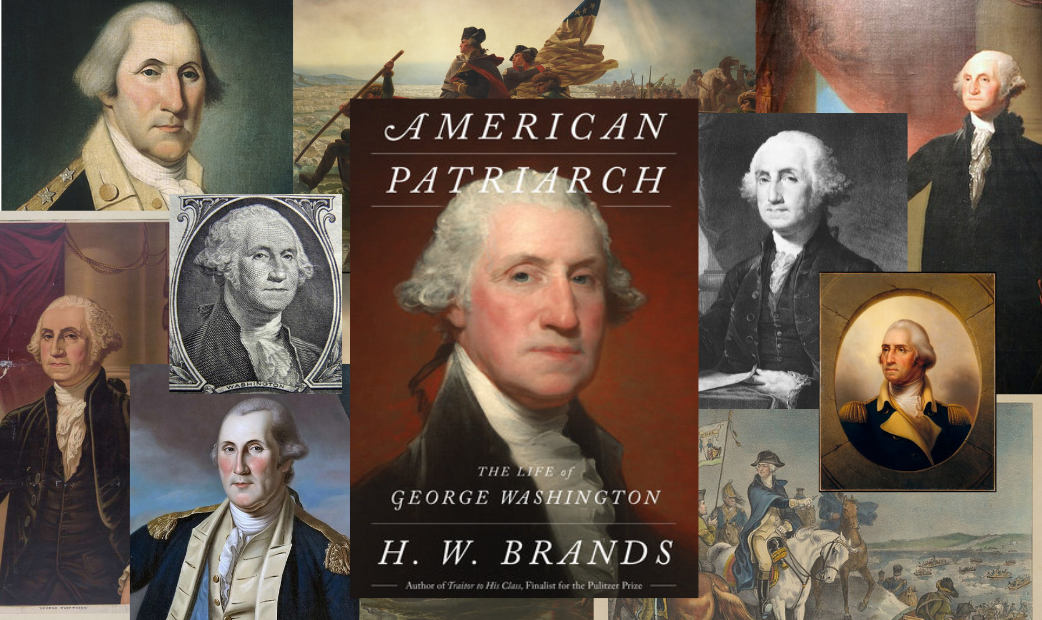
In honor of the 250th anniversary of the country’s founding, we’re sharing an interview with celebrated historian and biographer H.W. Brands about his latest subject, the one and only George Washington.
In his new book, American Patriarch: The Life of George Washington, Brands examines our first president’s leadership in the birth of America and the iconic status he continues to hold in the country today. The conversation below covers some of the same ground, as well as what remains unknowable about Washington more than two centuries after his death, what the U.S. might have looked like had he never risen to prominence, and the role of the historian as biographer.
Dr. Brands, thank you for joining us today. We’ll start with a question about the character of George Washington. Given all the work that you’ve done on American history and the founders, you were not unfamiliar with him before you started work on this biography. But in the process of really boring down on his life and times, what surprised you?
He was a better writer than I expected him to be. I knew a lot about Washington, but I’d never read lots of his letters in detail, and by 21st century standards, he tends to be a little bit long-winded. His sentences sometimes require silent editing, where I will go in and put in a period where he just has a dash or a semicolon. But, on the whole, he’s a very good writer. And I was surprised by the extent of his journal keeping. I was aware that there was a journal, but Washington recorded the actions of his life in great detail: “We planted oats in this corner of that farm, and we set up a new fence and a water mill over there,” this sort of thing. His diary says very little of, “Boy, I wonder what the meaning of life is,” or, “When I did this, it really tore me apart inside.” We don’t get a lot of Washington’s inner life, but we get a lot of Washington’s outer life.
In doing Washington’s biography, I was also reminded how precocious he was as a military leader. By the time he was in his early 20s, he was the commanding officer of the Virginia Militia. This is because, in the first place, he was good out of doors — you can tell this guy’s not going to be working in an office somewhere; he’s going to be spending his life out of doors. Secondly, and it’s hard to get an appreciation for this from the distance of two and a half centuries and just reading letters, but he apparently was a very good horseman. That’s really important if you’re a general, because in those days, generals galloped across the battlefield. It mattered that he could do that, and that he was a big, tall, strapping fellow. When you put him on the back of a horse, he was impressive.
Your comment on what’s hard to appreciate after centuries and just from reading someone’s journals and letters — a person’s physical presence, the way they moved through the world — hits on one of the biggest challenges of biography. What about Washington was particularly difficult for you to capture as a biographer?
I really don’t have a very detailed sense of what Washington’s personal presence was like, and that’s really important for a military commander, especially when we’re talking about an army that was, at its maximum, 15,000 or 16,000 men. And there’s another aspect of Washington’s success that I still can’t exactly account for — I don’t think anybody can account for it — and that’s good judgment. Washington was successful because he made sound decisions, but you really only know they’re sound decisions after the fact. It’s almost like a weather forecaster: Maybe it’s going to rain tomorrow, maybe it’s not. But if you’re in charge of running a military campaign, you have to get it right. If you’re the President of the United States and deciding whether the United States ought to enter a war between Britain and France, you make the judgment, and you hope you get it right. If you get it wrong, you’re a lousy president; if you get it right, you’re a good president.
Washington had this knack for making good decisions. Now, some of this is the survivor effect and after-the-fact bias, where we study him because he made the good decision. Still, you want to account for how it happened. And I would say this: People who knew him commented on the fact that he did not arrive at his conclusions swiftly. He was a slow thinker, in the sense that he took care. He consulted as many people as he could. He was very good at gathering information and reserving judgment to himself.
I will say this, too, and I don’t know exactly where this comes from — it’s a temperamental thing — but there was relatively little of his own ego in the decisions that he made for his army or for his country. I never got a sense that it had to be this way or Washington would feel unfulfilled or he would feel disrespected or something like that. He seemed to have his mind cleared in a way that he could consult the best interests of the army, the country, whatever it might be. Of course, it helped that he was rich and he was well-respected.
Were the ways in which Washington was a good general different from the ways that he was a good president? They’re two radically different jobs that call on different skills, and somehow he seemed to have been good at both of those things.
He was good as a soldier, as a general, because he was very good at making decisions, giving orders, and seeing that the orders were carried out. As president, he was good at making decisions, but he realized he couldn’t give orders to the people he would like to be able to order around. As a general, everybody in the army has to take your orders. As president, people in Congress, and certainly voters, don’t have to take your orders. Washington was much happier as a general precisely for that reason. And when he was general, he didn’t have to deal with regular public criticism the way anybody does in politics. As president, he didn’t respond publicly to that criticism, but it bothered him.
When I said Washington had little ego in his decisions, he also had little ego in becoming president. It was partly because he thought of himself as a general, and as a general, he had won his war, so he had all the reputation he ever wanted. He knew becoming president would only diminish his reputation in the eyes of most people, so he became president reluctantly, and he got out as soon as he reasonably could. He was going to leave after one term, but he was talked into taking another term, and then he left after that. But as president, he found himself subject to the kind of criticism that people in politics encounter, and he wasn’t comfortable with it. It really made him think, “Eh, I shouldn’t have done this,” and as soon as he could, he went back to Mount Vernon.
How surprising was it to the people in that time for Washington to choose to not run for a third term?
The Constitution, written in 1787, then specified no term limits on any federal office holders. No term limits on members of the House of Representatives, no term limits on members of the Senate, no term limits on federal judges, and no term limits on the president. So, nobody knew what was going to happen.
There was no particular expectation among the people who wrote the Constitution around whether a president would serve one term, two terms, or as many terms as could be. There were some, like Alexander Hamilton, who hoped that the presidency would become something like the papacy, where the individual is elected but then the expectation is that person will get elected again and again for life. At the time it seemed, to Hamilton anyway, that the United States was suffering from a lack of energy and stability at the center, at the executive branch. What Hamilton wanted was a president who was as strong as possible, so he said, “Maybe we can hope that it’ll be a president for life.”
Washington took no position on this, and nobody knew what his attitude was, because at the Constitutional Convention he took no position on anything. He accepted election as president of the convention, which he interpreted as presiding officer of the convention. But like the speaker of the British House of Commons, even today, that person doesn’t take part in the debates, just says, “Okay, your turn. Now, your turn. Out of order. Bang.” They don’t debate. And so, during all these debates, nobody knew what Washington’s position was.
It was assumed that because Washington made no effort to acquire the office, and because when he was asked, indeed implored, to accept the office, he was reluctant, that he wasn’t likely to make a life out of this. These days when somebody says, “Oh, no, no, no, I don’t want the job,” you know they don’t really mean that. But in those days, it was quite plausible, because the presidency then wasn’t what the presidency would become.
I should add that people recognized that, for Washington, the presidency was not the apex of his ambition. He’d already had the apex of his ambition. It was commanding general of the Continental Army, and he had won. He had all the laurels he wanted; the presidency was a victory lap. He was willing to do it, but no big deal. And as I mentioned, he wanted to get out after one term.
How widely was it known that Washington was reluctant as president?
That’s hard to say. Washington was someone who spoke only when absolutely necessary. He was not a particularly good public speaker, and he rarely spoke. In fact, Washington was a good example of the person who makes silence his friend, and people assumed that he was deeper than he was. When he said nothing at the Constitutional Convention, all those people who were arguing back and forth about what Congress ought to do and what the powers of Congress ought to be, all that stuff, they assumed that Washington had a broader and deeper grasp of everything than they did. And one of the reasons that Article II of the Constitution, which is about the executive branch, is so thin compared to Article I, which is the one about Congress, is because the convention had kind of run out of gas by then, and they all took comfort in looking over at George Washington and saying, “Well, he’s going to be the first president. Let him figure it out.”
When he did decide to leave after two terms, there was no weeping or gnashing of teeth in the streets. People went, “Okay, it’s time. He’s been there long enough.” And he didn’t leave for the purpose of establishing this precedent that everybody else would leave after, at most, two terms — he left because he was really fed up with politics — but it did have that effect. He died during what would’ve been his third term, so if instead he had accepted the third term and died in office, then the precedent wouldn’t have been a limited presidency. The precedent would’ve been a presidency for life, and there’s no telling what that would’ve meant for the evolution of American politics.
To broaden out a little bit from Washington the man to his legacy today: How important was it for us as a country that Washington was our first president? What might the U.S. have looked like had he not been around?
To answer that question requires the historian and the biographer to argue a counterfactual. What would happen if not Washington? And my general feeling about this is that there’s almost never anybody who is really indispensable. If Thomas Edison had never lived, we would have electric light. And if George Washington had never lived, there would be an independent country. We might call it the United States of America, we might not. It wouldn’t have occurred at the same time. Or, alternatively, if the Continental Congress had declared independence and Washington had been named head of the Continental Army and they lost the war, then there wouldn’t have been a United States then.
The way I put it is this: In 1776, European-dominated empires were common. There were empires elsewhere. By 1900, those empires had shrunk, and by 2000, the empires had largely gone away entirely. So, the United States today would not be still attached to Britain in the way that it was back in the 1700s whether Washington had lived or not. But something might have happened that Washington’s contemporary and sort of co-indispensable man, Benjamin Franklin, proposed as early as the 1750s. Franklin noticed that the population of the British American colonies was growing very rapidly, far more rapidly than the population of Britain was growing, and he projected forward to say, essentially, “Within a couple of generations, there will be as many Englishmen living in North America as there are in Britain and then Ireland. What the British Parliament needs to do is just take note of this and allow for the American pillar of this British Empire to grow into an equal status. Then we will have this British Empire that will span this corner the Atlantic, and it will go on forever and ever.”
Now, this didn’t happen because of the American Revolution, and then during the 19th century there was no prospect that anything like this would come about. But during the 20th century, the United States and Britain have been close allies. And if we include Canada, during most of this period, Canada has been good friends with the United States. So if the British had had more vision back then and said to America, “Okay, we’re going to allow you to advance from junior partner to equal partner,” then there might never have been a break at all.
What I was thinking as you were saying that is: Okay, we can say that the United States would have happened in some recognizable form, in the way that Canada did, for instance. At the same time, it’s the United States that has been a kind of ideological inspiration for the rest of the world. A lot of those decolonial movements were subsequent to it, and that may not have been the case if the American Revolution didn’t happen when it did.
You’re absolutely right, and it would’ve been very interesting if, for example, the model of modern revolutions against old regimes, revolution against aristocracy and monarchies, had been France instead of the United States. The French Revolution was somewhat influenced by the American Revolution, but there was enough going on in France that they didn’t require something 3,000 miles away to make it happen. And if the French model had been the one that was presented to the world, there’s no telling exactly what that would’ve meant. Perhaps the world would’ve been put off by the violence into which the French Revolution descended, whereas the American Revolution took place in an arena where the losers, the Loyalists, could leave, and so they didn’t get massacred in score settlings after the war. Who knows?
I would add one thing on this, though. Most Americans would probably say it’s a good thing that the United States became independent, and maybe a good thing that it happened when it did. But if one imagines a scenario where, let’s say, the Parliament in 1765 or 1770, instead of doubling down on its prerogatives and telling the Americans, “You’re going to obey or we’re going to make you obey,” changed its policy so that there wasn’t a revolution, then the United States might have been spared some of the problems of its own historical development.
I’m thinking of two problems in particular. One is the problem of our federal system, where we have states and we have a central government. We have states because when this revolution broke out, the United States of America was construed as plural states, and each one was a sovereign entity because each had a direct relationship to Britain that it didn’t have to the other states. Some people like our federal system, but there are definite problems with it. The other possibility is even deeper: The United States might have ended slavery differently and more easily than it did, because slavery was ended in the British Empire 30 years before it ended in the United States. So, it might have happened sooner than it did, and it might have averted the American Civil War.
Or that’s when we would have had the American Revolution.
Exactly.
Sorry to be cynical about it. But that segues directly into my next question, which is: Can you tell us about Washington’s complicated relationship to slavery?
Washington, like many slave owners before the American Revolution, gave little thought to the ethics of owning slaves. He believed that there were things in the world that were pleasant and things in the world that were unpleasant, and he owned a bunch of slaves.
Now, its important to note, for Washington’s own intellectual development on the subject and also for his own actions: Most of the slaves that worked on the Mount Vernon plantation, Washington did not own. They had come to his marriage through his wife, who was a widow of a very wealthy guy named Daniel Custis, and he left her hundreds of slaves. Except, here’s the complication even to that: Martha Custis Washington didn’t own those slaves either. They were held in trust for her children, so she couldn’t have freed the slaves, and this was fairly common. Think about the way most people today don’t actually own their houses; instead they take out a mortgage, and the bank owns the house. If I was all of a sudden feeling very charitable, I couldn’t just give away my house and give the proceeds to the poor because my creditors, the bank, wouldn’t let me.
Anyway, Washington didn’t think much at all morally about slavery before the American Revolution, and, I would add, neither did almost anybody else. There were a few people, a few Quakers and a few Baptists, who said, “This is not such a good idea.” But by and large, it was just part of life. But once the Declaration of Independence says all men are created equal, and Washington tells his soldiers “the Declaration says we’re fighting for freedom and for equality,” then he realizes, wait a minute, I’m the head of this army fighting for freedom and equality, and I’ve got hundreds of people that have to answer to me, and they’re not free or equal. He begins to see that there is this contradiction here.
I see no evidence, or very little evidence, that Washington thought that slavery was a sin in any kind of religious or moral sense, but he thought it was sort of a civic sin and that it was going to undermine the credibility of small R republican politics in the United States. So, he asked himself, “How can we end this?” and he thought about it for the country as a whole, but he realized that this was something that was going to take time.
It was also quite possible for people in the 1780s and 1790s to believe that slavery was dying. It’s easy to criticize the Constitutional Convention of 1787 for not dealing head-on with the issue of slavery, but it’s a little bit unfair because, from their perspective, slavery was beginning to be outlawed. It had been outlawed in several Northern states, and there was this feeling that it’s probably going to be outlawed among the Southern states, and so if we don’t make too big a deal of it, it’ll go away of its own.
So, while Washington was president, he began to think, “We have to do something about this.” And he began thinking of how he could sell off some of the property at Mount Vernon in a way that would free the slaves. Then, when he died, he arranged that the slaves that he actually did own would be freed upon the death of Martha, and the reason for that delay was that his slaves and Martha’s slaves were all mixed together. They were intermarried, they had families, and for half of them to be freed and the other half to be remained enslaved would disrupt lives and break up families. So that’s the evolution of his thinking on it.
If people are going to read two books on George Washington, one of them being yours, what is the other? What was the most important to you in writing this book?
I’m going to confess something that is maybe a bit unusual for my approach to history, and that is: When I decide to write about George Washington, for example, I make a point of not reading potentially competing biographies.
The reason for this is, first of all, the thing that interests me in history is not what historians have to say about history. It’s what the actors in history had to say about themselves. I got hooked on history when I was in college and shortly afterwards by reading old diaries, collection of letters, the journals of trips across the American West, and stuff like this, and the immediacy of what historians call the primary documents was really crucial to me. In fact, I would say my primary mission in writing and teaching history is to allow my readers and my students to see what the world looked like to the people back then, not to hear what Brands has to say about them. There’s some of that, inevitably, but for the most part, I want the reader of this book to see what George Washington’s world looked like to him. I tell my students and tell audiences that the superpower of the historian is the ability to see the world through other eyes, and this is what historians do all the time. This is the way we do what we do.
So, I tend to avoid other biographers, partly because I like the immediacy of the primary sources themselves, but also I don’t want to feel as though I am writing either against an interpretation of somebody else or in favor of an interpretation of somebody else. I want to come at it myself.
But, since you asked the question, I will tell you what was deeply formative to me in writing about George Washington. When I was a kid, my father — he was a businessman, not an academic at all, but he had an interest in the world and he occasionally read history books while he was working — in his home office, up on a bookshelf, he had a collection of a multi-volume biography of George Washington written by a Virginian named Douglas Freeman, who was a full-time journalist and part-time biographer. And my dad would point to those books and say, “Billy, I’ve read all those books, and I can tell you what George Washington had for breakfast every day of his life.” I was impressed, and I worked my way through the volumes, and I thought, “Well, this is an interesting guy. It’s an interesting time.” And when I started writing about Washington, I did think, “well, I’m not going to write so much. I’m not going to tell you what he had for breakfast.” That’s more than we need to know 250 years later. But I was impressed that here’s a big story, a big canvas, and so there’s a big story to tell.
So that’s the book, I would say. Get that one. It’s probably out of print, but you can get it used. And then mine, of course.