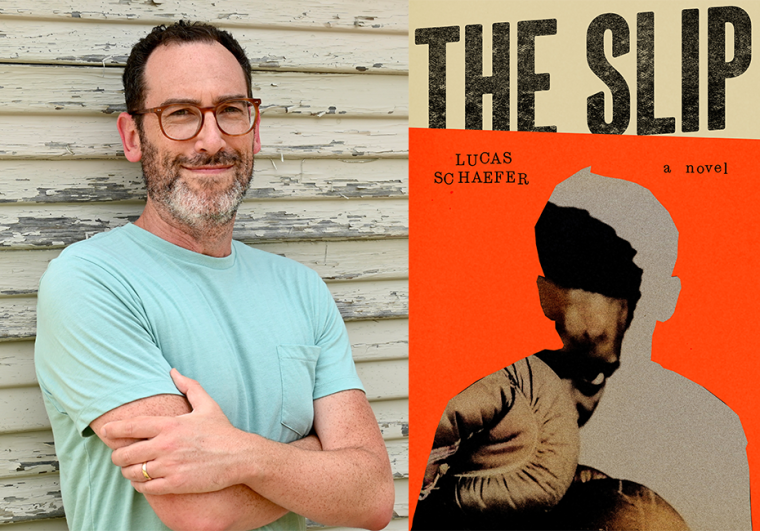
Lucas Schaefer graduated from UT’s New Writers Project in 2015. I attended the same program, in the same genre (fiction), graduating in 2009. Our paths crossed in an interesting way: Last summer Lucas published his debut novel, The Slip, which takes its inspiration from Lord’s Boxing Gym in Austin. Around the same time, I published a guest essay in the New York Times about turning to the gym during a time of mourning. That piece gave way to a podcast, Secretly Sporty, where I interview creatives about the role that fitness plays in their lives. Lucas was a natural fit.
The Slip has proven to be a formidable debut. It won the Kirkus Prize and was featured on both the Washington Post’s 10 Best Books of the Year and the New York Times Book Review’s 100 Notable Books list.
Lucas and I met up at Austin’s Violet Crown Coffee Shop to chat. We talked about his earliest impressions of Austin, his experience in the writing program, what he learned from each of his instructors, and which places in Austin he’d recommend to new arrivals.
Our conversation has been edited for length and clarity.
You began your MFA at the New Writers Project in 2013, but you moved to Austin back in 2006. What inspired the move?
I was living in New York and was sort of aspiring to write, but not really writing, and not making enough money. I had a professor at Duke who had spent formative professional years in Austin who’d said to me, “you should give Austin a try.” I don’t think he was thinking “you’ll spend the next 20 years of your life here.” It was, at the time, a place that was easy to just pop into and start a life.
What were your first impressions of Austin?
I was struck by how low key it was. I rented an apartment at 1616 West Sixth Street. It’s still there, right before Mopac. It was not a luxury situation, but it was $650 a month.
I had a friend who ran a nonprofit here, and Bill Clinton was the guest of honor at a fundraiser for this nonprofit. It was a daytime fundraiser, but I was like – this is the president; I should probably wear a suit. So I showed up in a dark suit, and people thought I was in the Secret Service. There were people in flip flops, there were people in Hawaiian shirts. I was like, “okay, you’re not in New York anymore. This is a different situation.” And I thought, “this is good.”
The first year, I went to the Texas Book Festival, and one of the big events was Gore Vidal at the Paramount. That sort of event in the Northeast, you’d need a ticket; it would probably cost something. I remember I was just walking around this festival for the first time and heard someone talking about the event, and I said, “How do I go to that? Oh, you just go?” And it was crowded, but there was no line to get in. I don’t think there was any security. It was just: walk into the Paramount and listen to Gore Vidal for an hour; walk out.
The Slip was inspired by your early sessions at Lord’s Boxing Gym on Lamar, before you started at the writing program. How did you find the gym? And what were your first impressions of it?
When I first arrived in Austin, I didn’t know anyone. I went to Whole Foods and saw a catalogue for Informal Classes, which were these classes that used to be offered to the community through UT, and was like, maybe I’ll take a class. I saw there was this boxing class being offered at Lord’s Boxing Gym. I don’t know if the phrase “old school” was used, but there was something implying it was not 24 Hour Fitness. It was out of character for me, but it was also out of character for me to be living in Texas. So I just thought, hey, this will be cool. It was Tuesday and Thursday nights and then Saturday mornings for six weeks. I went to the first class; it was a lot of newcomers, but then also the gym regulars. And I just liked it right away.
There was a warehouse in front of the gym that sold medical supplies, and so sometimes you’d be out front jump-roping and the medical supplies guys would be fooling around. You’d see someone doing a wheelie in a wheelchair or fencing with crutches. It was just this big scene of characters. I didn’t know anything about Austin, and the gym was a real melting pot atmosphere. There were people from every part of Austin: every race, every religion, every age, every profession; the mix of professional boxers with amateur boxers, as well as people who had no idea what they were doing.
I made a lot of my good friends at the gym. We would go out to dinner after class. Saturdays there was sparring – I wouldn’t spar, but you could stay after class and watch sparring and learn from that.
I lived in North Campus for a while, close to the gym. Then in 2011 I moved south and started dating Greg [Marshall, then a Michener Fellow]. I stopped going to the gym in 2011 and then I didn’t start the New Writers Project until 2013. But at no point when I was going to the gym was I saying, “I’m going to write about the gym.” I wasn’t there as an anthropologist.
What questions did you start with when you did sit down to write The Slip?
As a writer, the questions that interest me are: How do we all live together? How do people who are from different backgrounds or have different perspectives or have nothing ostensibly in common live together? How do we get along? Is that possible? Is that a worthy goal? I think some writers are very invested in family — I’m interested in community and institutions that bring disparate people together. I knew that about myself as a writer, because I think that’s what I’m interested in reading, and the gym just seemed like an obvious place to start working through these questions.
Tell me a little bit about your time at the New Writers Project. Which professors did you work with, and what did you learn from each?
Oscar Cásares was my thesis advisor. He was great. There’s a subplot of my book that relates to the border and to immigration. And in addition to him being my thesis advisor, I did a conference course with him (basically an independent study) on border literature. He provided this amazing syllabus of fiction about the border and essays about the border. And he’s a short story writer as well as a novelist, so in terms of structure, he had a real eye for making connections between characters and strengthening them.
Every first-year fiction student would take a workshop with Elizabeth McCracken. From her, I learned a lot about writing about the body. In her new craft book, she talks about how a lot of the body language that writers use actually means nothing — like “a chill up the spine,” these sort of clichés. And she really taught me how to physicalize these characters in a unique way.
Cristina García was someone who encouraged me to lean into the more maximalist version of the book. She was a really inspiring teacher. She had a very “you can go anywhere in your writing” quality. I remember at one point I had all these characters and threads, and it was not coming together. She pointed to the bookshelf in the Dobie House and she said, “Do you know the difference between what you’re working on and all of these books on this bookshelf? They finished. They finished. You have to finish.”
And Alex Chee: One thing he always said was that the easiest way to destroy a story is through an unmade decision. So I learned to swing for the fences. “Okay, this isn’t working – let’s go in a different direction.”
Who were the writers, beyond the program, who felt like big influences or are big touchstones for you?
Zadie Smith. The first time I read White Teeth, the first time I read NW, I was like, this is my wheelhouse. I listened to an old interview with her recently, and she was talking about how there are some writers who are outward-facing, and some are inward, and she’s an outward-facing writer. She’s not writing autofiction. I think that’s what appeals to me.
In grad school, Alex Chee introduced me to Edward P. Jones, who I had not read before. The way he manipulates time was very influential for me — understanding that you can go through years in a page, or take a long time to describe a short time. He had a way of writing about someone’s entire life succinctly that I vibed with.
And Jennifer Egan — specifically A Visit from the Goon Squad. That was sort of the original idea for my book, drawing inspiration from this book that’s interconnected stories about the music community. I said, “I’m gonna do something similar with this boxing community.”
Which three places would you recommend a new writer visit right away upon moving to Austin?
I do feel like Barton Springs is kind of vintage Austin, or maybe Hippie Hollow if you’re into that. A swimming hole. I would say a boxing gym is a great place to see a lot of different sides of Austin. There are other boxing gyms, but I don’t want to say any one will do because I think Lord’s has a special history in Austin. With boxing there’s not a huge financial barrier to entry, and I think a boxing gym brings out different types of people for that reason. This is getting very Secretly Sporty coded.
The third one — and this was really important for the book — but a great place for anyone moving to Austin, especially writers, is the Austin History Center, which is run by the Austin Public Library. It’s an amazing resource. Among other things, I believe they have every yearbook ever of any Austin school, so if you’re a writer and you need a name, you can just pick one out of a yearbook. They have this catalog of thousands of different topics, and you can just go through them all. They have pictures, newspaper clippings. They have these amazing boxes of treasure.
You’re working on a new novel, right?
Yes.
Is it going to be set in Austin?
I’m trying intentionally to have it be set elsewhere. We’ll see if I can succeed. I love Austin as a subject, but I think I said what I have to say about Austin in The Slip. And if I do two in a row in Austin, I’m sort of saying, “Okay, I’m Mr. Austin.”
Are the questions you’re asking in this new novel similar to those you engaged in The Slip?
I think they’re similar. But The Slip is Clinton-era, and now I’m exploring more of the 9/11 Iraq War era, continuing to move slowly forward. I find it hard to write about the present day. What I learned with The Slip is you can write about the present while using the near past. I mean, you can write about the present using the far past, but I’m not writing The Crucible here. I really learned with that project that going back 25-30 years, to a time when I was alive, was really good. Because one of the questions in the back of my mind was, “What happened from 1998 to 2014 — which are the years when The Slip is set — that got us to the present?” So that’s something I’ll continue with, using the recent past to talk about the present.
Sebastian J. Langdell is a writer of fiction and nonfiction and an associate professor of English at Baylor University. His work has appeared in The New York Times, The LA Review of Books, and the Oxford History of Poetry in English, among other venues. He has been awarded fellowships from the National Endowment for the Humanities and the Huntington Library. He is also the host of the award-winning arts & fitness podcast, Secretly Sporty.