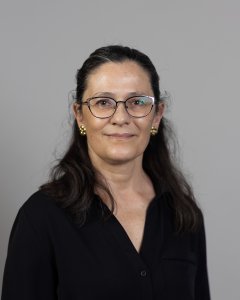
Cinzia Russi is a historical linguist whose primary focus is on Italian and the Romance languages. She is also the interim chair of the newly formed Department of European and Eurasian Studies at UT Austin that combines the previous departments of French and Italian, Germanic studies, and Slavic and Eurasian studies. Her primary research field is historical (socio)linguistics with a focus on (morpho)syntax and the development of Italian discourse. In her spare research time, she studies the language of contemporary Italian crime fiction.
With the fall semester — and the official launch of the European and Eurasian Studies department — just around the corner, we thought this would be an interesting time to talk with Russi about her new position and her plans for the coming year. So, earlier this month I caught up with her to talk language, departmental and European culture, and the parallels between crime fiction and academia.
First off, Cinzia, thank you for stepping up in this moment to chair this department. But in addition to being a new department chair, you’re also a longtime researcher and faculty member here at UT. Can you tell us about your field of research?
My field is historical linguistics, which looks at how languages change over time. And since the late ’90s and early 2000s, research in historical linguistics has also incorporated methodologies of sociolinguistics. Basically, linguists have started to look at language change alongside considerations of social and cultural factors like age, gender, social status, and all these other dynamics. It’s called socio-historical linguistic or historical sociolinguistics, and it’s its own sub-discipline of linguistics. That’s where I work.
I’m also interested in all the social and cultural aspects of language, and I work with a lot of data. For instance, for one of my current projects, I’ve been using data from the Opera del Vocabolario Italiano [a research institute of the Italian National Research Council].
When you say “language change,” what do you mean?
I look mainly at Italian and Romance languages and their evolution from their origins in Latin up to the modern day, and I reconstruct or hypothesize patterns of change.
There are aspects of language change that are almost universal — patterns that you see happening over and over again — and this is called grammaticalization. For example, you have a content word, like the verb “will” in English, that originally had its own lexical meaning. But now you have “I will do something,” where that “will” is basically just signaling future tense; it’s a grammatical marker that doesn’t mean “want” or “desire” any more. These types of changes are very common across languages.
So, there are some things like that that are the same in many languages. Individual languages also have their own unique trajectories, depending on factors like contact with other languages and social and cultural aspects.
Romance languages are fascinating because there really is no answer to how many there are once you enter into the murky territory of regional dialects and variations. My husband and I come from two towns that are 20 kilometers apart. Our dialects have a lot in common, but still, especially at the level of the lexicon, there are many differences. An Italian dialect from Sicily and an Italian dialect from Piedmont are essentially completely different languages, and their speakers cannot understand each other. And then there are the histories of the main countries that had enormous importance for the codification of the language. So in Romance language you have the core category of the group, like French or Italian, and then you have everything else at the periphery that shows so many differences and allows you to understand the culture and how culture and society may have shaped each individual dialect.
Drawing on this idea of the links between languages: You are the new chair of a new department that encompasses languages and cultures well beyond the Romance languages. How are you linking them in your mind? How are you envisioning the disciplines feeding off of and informing one another?
What is exciting to me is that this peculiar situation of dialects is also something that is present in Germanic and Slavic languages. I think we have a lot of potential as a new department to discuss all these aspects, which are all linked to culture, society, the use of the different registers or dialects in literature and by different authors, and how the trends change. There is a lot that makes us similar. And language, culture, and society go together. You cannot divorce language from the people who speak it. So, to me, language is the first building block for anything you want to study in the humanities and the social sciences.
Parts of Europe are very tight in terms of density of population, so there is also the issue of contact with different languages and many new things to explore that involve language but also are pertinent to other areas. I think, as faculty, we could really do something very nice that shows and highlights how all our different fields are these primary building blocks.
Are there any examples already in linguistic scholarship of these particular language groups — the Slavic languages and the Romance languages — in comparison, or is this brand-new territory that your new department is covering?
I haven’t looked at it much specifically, but in historical linguistics it’s common to compare. While I was finishing my Ph.D. many years ago, there was this wave of research that became very strong for a while that explored parallels between Romance languages and Bantu languages. It happens a lot in linguistics. So, there are people who have been contrasting Romance languages and other language families.
Maybe your new department is on the verge of a breakthrough.
Yes, I was excited to find out that there are several linguists in every language area. I already knew my linguist colleagues in the former Germanic studies department, and I found out that there are several in the former Slavic and Eurasian department. It’s been great meeting them, and I look forward to getting to know them better and working with them.
As a linguist, what aspect of language is most interesting to you? What do you think are the most interesting connections between all the Romance languages?
As a cognitive linguist, metaphor and metonymy have always been interesting topics for me. These are concepts that have been shown to be linked to thought. They’re not just figures of speech that we use in literature or in fancy communicative settings when we want to be artistic. It’s basically every-day speech. At UT, how many of us say “the tower” when we’re really referring to the president or the administration? That’s a metonymy we use all the time. Another common example would be something like “I love Dostoevsky” where “Dostoevsky” actually refers to his works.
I created a course two years ago called “Metaphor Across Languages, Cultures and Time” because there is a whole body of research that investigates how metaphor and some metonymy, at least from a cognitive point of view, have these universal aspects that are true across languages because they’re directly linked to cognition. For example, “anger is heat” — she’s smoldering, her blood’s boiling — is considered a universal metaphor because when you feel anger, your body temperature rises; it’s a universal, physical response.
At the same time, there are a lot of differences in individual languages, individual societies, individual cultures that add to the process of metaphor or metonymy formation. It’s a beautiful combination. There are also a handful of issues or areas of the Romance languages that continue to receive attention, like unstressed pronouns or other structures, because it seems that we cannot find a proper explanation of all these phenomena.
And the political and social situations in Europe are changing. They are less closed, so it will be interesting to see what happens at the cultural and linguistic levels in the coming years. We continue to pursue a revival of dialects, reintroducing and giving people the opportunity to learn their dialect if they want. This is important at the community level because it requires effort from the whole town or the whole region. And the countries and the languages that are not Romance-related are still gravitating into this changing Europe and changing Eurasia. So, I think a lot of new things can be pursued.
Your comments about a changing Europe make me think of a hotel my family recently stayed at in Amsterdam. There was a small group of Ukrainians working there who had left Ukraine during the war. They spoke Ukrainian to each other, of course, but they had all learned Dutch just in the past few years, and then they all also learned English to talk to tourists.
That makes me think of all the current research on the influences of immigrant languages on the local language and vice versa. I have a colleague at Exeter who works in this. He studies multilingualism and language contact in immigrant Igbo-Nigerian communities in the Italian region of Veneto. Italy has a lot of immigration, and it’s interesting how groups of immigrants from different geographical areas tend to form certain classes of workers. And some of these jobs have important social and economic repercussions. For example, many women who come from Ukraine, Moldova, and Romania systematically do work that is called badante, which comes from the verb badare, which means to take care of somebody. So badante means the person who takes care. In Italy they work for elderly people who are no longer independent and who don’t have family who want to live with them. So there is this person who takes care of them and can also become a kind of companion. Badante is a neologism. It didn’t exist before, but now it exists in this current society. And the workers’ languages mix with the Italian of their elderly clients. And Albanian men are often in construction, so if you want to find a construction worker, it helps to speak Albanian.
You mentioned the contemporary political and social environment in Europe and a widespread interest in the revival of dialects. But is the mixing of languages in Europe as a result of more open borders also having the opposite effect, where languages become more similar rather than more distinct?
Yes! And you have to keep in mind always that English is very powerful. Italy loves English. You’d be surprised at the number of Anglicisms that have entered the language lately. So this is a very pertinent question. We’re going back towards rediscovering our ancestral languages and showing how they are totally fine, they’re beautiful, they’re perfectly functional, but at the same time there is the opposite force. Do young people want to rediscover the dialect or are they not interested? A sociolinguist would approach these questions with experiments and surveys, and take into account all the different social variables and see what happens.
In addition to your sociolinguistics, I’m also interested in your study of Italian crime fiction. What drew you to that topic, and how does it relate to your linguistic studies?
In 1994, my sister sent me a book from Italy for my birthday by an emerging author, Andrea Camilleri, that was a work of crime fiction called La forma dell’acqua, or The Shape of Water. I loved it. The story was nice; the detective was an interesting character. But what I liked most was the way he wrote parts of it in Sicilian, or a dialect very like Sicilian. It was something very new, very original. At first, I thought the Sicilian words or structures were sprinkled here and there to make it more exciting or exotic, but then I realized there was something more. I started looking at whether he was using the Sicilian strategically, at specific points or with specific characters. That’s been done for a long time to signal social status and things like that. But this was different. The most interesting thing was that he created a dialect for the novel based off his own local dialect. He modified it to make it his own to the point that people named his language Camillerese. And this book made him incredibly famous, but literary critics haven’t really appreciated Camilleri’s language. They basically claim that Camilleri was just trying to reach an audience of non-refined readers. But then his books were translated into over 30 languages, he became this huge phenomenon, and I think the literary critics didn’t really like that. They think he was making literature too common, watering it down. But I think it was brilliant.
I also look at other contemporary authors who write crime fiction and use dialect in their books. I’m fascinated by the way they use language and try to see how they use language for which purposes.
What’s a book that you would recommend for someone who has never read in the genre but is interested in it?
I would still recommend La forma dell’acqua because it’s really a beautiful book. But there are two authors who are very popular now and I like them both. One is Antonio Manzini, and the other is Maurizio de Giovanni. They both use regional dialects in their books. Manzini writes about this policeman who is not so pure: he breaks the law, he smokes marijuana every day or otherwise he cannot control himself. He’s a dark, pessimistic character. He lost his wife because somebody was shooting at him but missed and killed her instead.
De Giovanni, on the other hand, has a series that takes place in Naples in the 1930s during the Fascist era. He writes beautifully about the city and he’s great at making you visualize the smells, the atmosphere. It’s a common thing that all these main characters are dark, with problems or trauma. But de Giovanni’s main character is a nobleman who decided to be a police officer, and he has the ability to see the last moments of people who died tragically. He’s this character who’s suffering deeply, and he goes around Naples and he’ll see something like a small child with their skull broken because they fell under a carriage, and he’s haunted by this.
What parallels, if any, do you see between Italian crime fiction and building a new academic department? Hopefully it’s not just dark murder and chaos.
A detective, in my view, has the extremely important qualities of attention to detail and investigation. For both jobs, you have to really uncover and look for things, and you have to have a good understanding of humans and different kinds of personalities. They also both require a lot of research, and hopefully a lot of collaboration too. They’re both like solving a puzzle. You have all these little pieces, contributions from everybody, that can be difficult to assemble, but once you put them together they’ll form a beautiful image. Hopefully it’s like that, and no crime!