Many things age — people and animals, of course, but also houses, cheeses, and intangible things like policies and cultures. Languages and dialects age too, some to the point of death or extinction. UT linguist Hans C. Boas is trying to do something about that: to prevent the death, specifically, of Texas German, a dialect he describes as the most diverse “heritage” language — a language learned primarily at home rather than within the external community — he has encountered in his career.
Boas first came upon Texas German in August 2001 while driving east — moving from Berkeley to his new home at UT Austin — when he stopped in Fredericksburg, Texas, for a meal and a pint after a long day on the road.
“I heard these German speakers in Fredericksburg, and I asked them ‘What is this? Where are you from?’ And they said, ‘Whoa, we’re from here,’” Boas remembers. But no sooner had he been introduced to the dialect than he learned it was fading. “Next thing I know is it’s dying out, and I thought, I’ve got to do something to preserve it,” he says.
Thus was born the Texas German Dialect Project — begun as a joint venture of UT’s Department of Germanic Studies and the Linguistics Research Center and generously supported by an anonymous donor — which researches not only how the dialect developed and what makes it so special but also why it’s dying and what can be done to preserve it.
But what is Texas German, exactly? And why didn’t Boas, a native of Germany, immediately recognize it? It helps to first understand what a dialect is. Boas explains that languages consist of multiple distinct variations, which usually start out regionally. But there are also social, ethnic, religious, and other types of variations, too.
“Usually, you consider dialects to belong to the same language if they’re mutually intelligible,” Boas says. “In the case of English, for example, you’d say that British English and North American English are mutually intelligible; they belong to the same language. Australian English is also English, but there are some varieties of Australian English that are so different from North American English that when they play movies in U.S. theaters where Australians of that particular dialect speak, they have to put in subtitles because they’re extremely difficult, if not impossible, for American audiences to understand. Technically, those Australian English dialects would be considered different languages.”
Languages can evolve quite far from their common roots. Take the contemporary Romance languages, for example, all of which started out as some variety of Latin over 2,000 years ago and then developed in different ways. Similarly, Old High German and Old English were more-or-less the same language until the Normans, the Vikings, and a whole bunch of other people got mixed in through war, conquest, and trade.
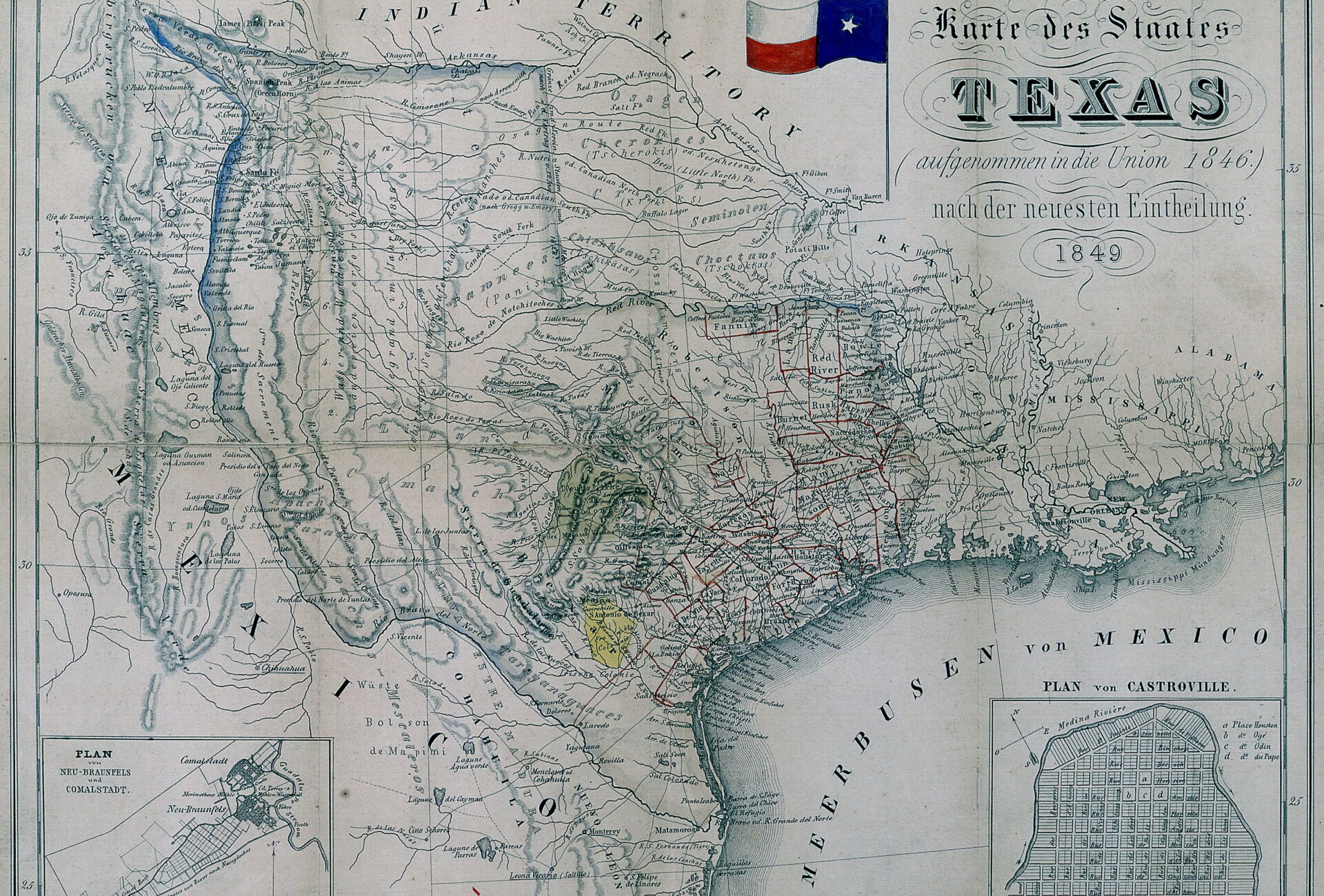
Where does Texas German fit into this? Relatively young as far as dialects go, its roots trace back to the 1830s, when German-speaking immigrants from all over Europe began settling across central Texas fleeing political instability and seeking opportunities for a better life. These immigrants brought their different regional German dialects with them, some of which were close to mutually unintelligible. But as these new Texans began talking to each other out of necessity and proximity, over time, speakers from generation to generation mixed and leveled out these dialectal differences, and eventually their speech began to blend into something new.
Because this all happened here in America, away from German’s linguistic origins, Texas German is categorized by linguists as a New World dialect, which typically arises when multiple dialects from different regions collide in a colonial settlement, as opposed to one dialect from a single region evolving on its own. Gradually, the differences smooth out, and a new, hybrid way of speaking emerges. And poof, you have Texas German.

Other New World dialects, such as New Zealand English and Québécois French, differ from Texas German because they continued to evolve in development and grew to be widely used. These are called focused New World dialects. But Texas German doesn’t qualify as a focused dialect because it didn’t go through all these phases of development. Instead, just as it was approaching its final phase of formation, Texas German abruptly stopped evolving and immediately started dying off due to the political fallout from World War I.
When the U.S. entered the war against Germany, Boas explains, anti-German sentiment swept the country. “Laws were passed that basically forbade the teaching of any other language besides English in public schools and that removed the status and the educational aspect of the German language. People still spoke their dialect at home, but they didn’t have any institutional support,” Boas says. “Because of the widespread anti-German discrimination, anything German was relegated to the private domain, and at school or in the public sphere, everything would be in English.”
The effects were swift and lasting. In the 1920s and 1930s, the dialect saw further decline when many of the German newspapers in Texas went out of business or switched to English. World War II was another hit to the prestige of German. Many German-language churches switched first to mixed language services and then, by the 1950s and 1960s, to services exclusively in English. This was really the last phase where Texas German was still being passed on to the next generation.
“Back then, the way to be a ‘good American’ or a ‘good Texan’ was to be a monolingual English speaker,” says Boas. “Most Texas German parents made a conscious decision not to pass on their language, their culture, and their way of doing things because they thought it would cause the next generation a disadvantage.”
Texas Germans went so far as to label their own way of speaking as a corrupt or “incorrect” version of its language of origin. They even have a term for it: Deutschverderber, “corrupter of German.” “Linguistically speaking,” says Boas, “this is completely bogus.”
A large part of the intrigue of Texas German stems from this unusual background — its many origins, short history, and abrupt arrest — which makes it unique not only in Texas but globally. Linguists like to discover patterns and generalizations, Boas explains, but it’s difficult to generalize about Texas German because so many remnants of the original German donor dialects are still floating around in its current state. Over the past 25 years, Boas and his team have interviewed and recorded the speech of over 900 Texas German speakers and report that, astonishingly, no two speakers sound even closely alike.
“Texas German is a combination of dialectal varieties, almost at the individual level,” says Boas. “Because of its level of variation, it’s really pushing the boundary of what a linguistic system can do, and I’ve only found this is Texas German. I would argue that Texas German is probably the most interesting German dialect in the world, period.”
Even within families, Boas reports, you can have a mother that speaks one way, a father another, and six or seven children who grew up in the same household and all speak differently. Typically, the oldest children in a given family are relatively fluent while the youngest are not. The way individual family members produce their sounds range from more German-like to more English-like and everything in between. Many grammatical constructions, like word order and the placement of finite verbs, differ from person to person. The types of nouns they use vary. These are just some examples where you would expect to find very similar, if not exactly the same, data in one family, but the outcomes are very different.
As one might imagine, this not only makes it hard to archive and document the dialect, it also makes Texas German hard to preserve. The same intense degree of linguistic variation that makes the dialect so fascinating is also what makes it so hard to capture in general terms. Boas and his team have come up with some generalizations and patterns on a vague level, but where other languages feature hundreds or thousands of generally applicable rules, Texas German has only dozens.
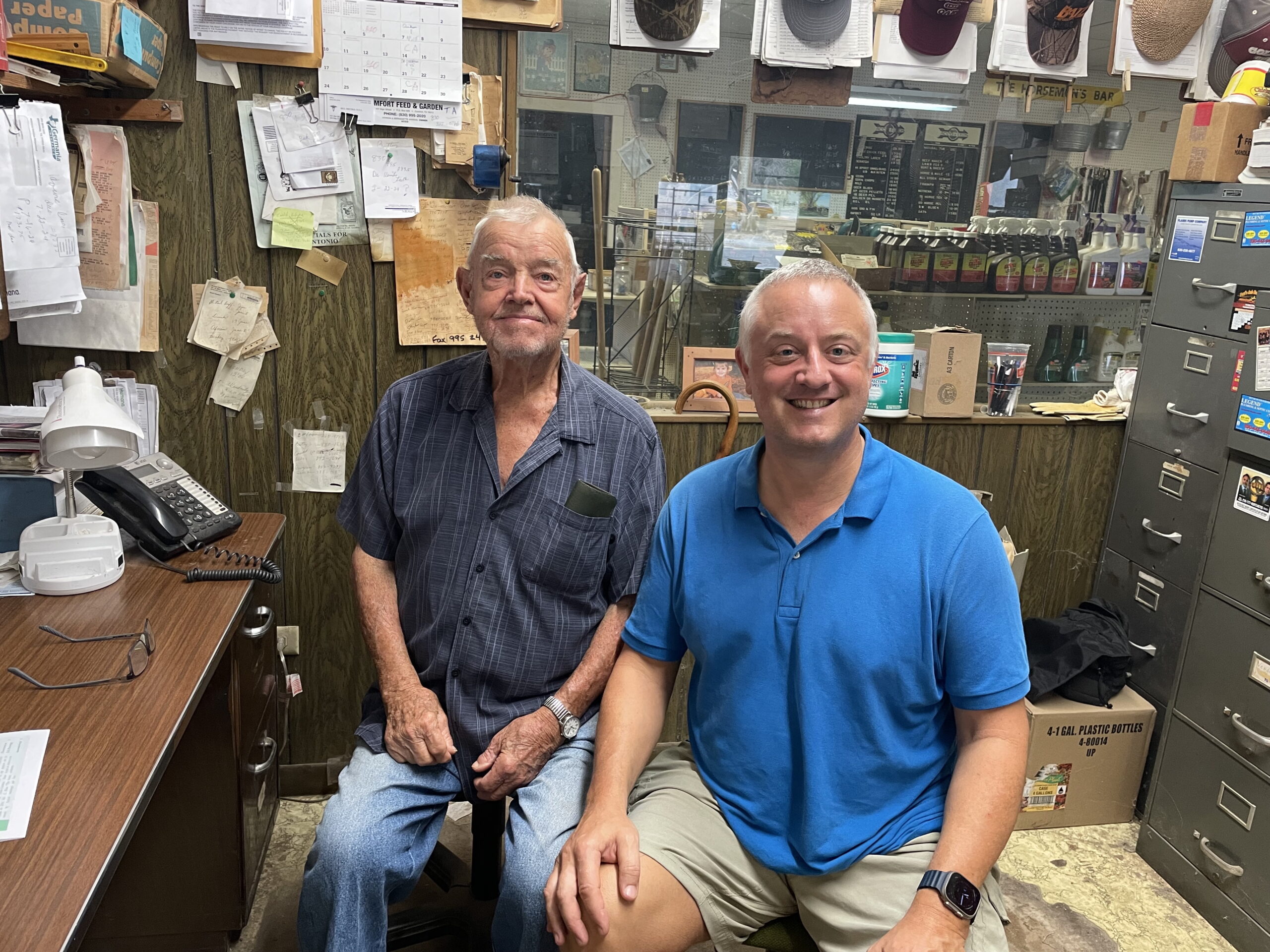
To document as much of this fascinating variation as possible, TGDP faculty and students have methodically visited the remaining German speakers in their Central Texas homes and places of work — recording their speech and interviewing them about their lives — and they have complied and archived everything to be publicly available.
Why? For one, Boas projects that the dialect will be dead within the next 10 years, and once that happens, all that will be left are recordings and documents. “If you dig up a dinosaur bone,” he says, “it doesn’t matter if you do it today or in 10 years, but once the last living white rhino dies, you can’t study it anymore.”
Perhaps more importantly, though, the act of capturing someone’s linguistic profile in an audio recording gets at more than just language. It preserves part of a larger picture of identity, and in the case of Texas German, it contributes an important snapshot of Texas history. It’s a real paradox, Boas explains, because most of the people he’s interviewed, despite their willingness to let the language die, seem to be very proud of their identities. They even identify themselves first as Texas German before they say they are American or Texan.
“To lose Texas German would mean losing an identity, a way of thinking, of viewing the world, and an important part of Texas history and Texas culture,” says Boas. Considering that 15% of Texas’ population today has German or German-speaking roots, it’s easy to see how foundational the Texas German experience is to the history and culture of the state. And that foundation can be seen mainfest in Texas arts, education, architecture, politics, and cuisine. “Imagine a Texas barbeque without potato salad, coleslaw, and sausage!” says Boas. “It’s all connected.”
Boas’s archive has already attracted more than just linguists. He’s been contacted by historians, anthropologists, religious studies scholars, sociologists, and even composers, all interested in using his unique set of data to do their own research on this significant ethnic and cultural group in Texas.
Texas Germans weren’t the only impactful immigrants to the region, though. Boas notes that there is a ton of crossover with the food and music and architecture of the Czechs, Swedes, Poles, Norwegians, Danes, and, of course, Mexicans in Texas.
So, while Texas German is unique as a heritage language, it’s part of a larger multilingual and cultural fabric that’s active only in Texas, a living record of adaptation and identity, for now still spoken in kitchens and remembered in songs. And there’s more to be done before the dialect is gone. Boas notes that Texas’ German-language newspapers still haven’t yet been systematically studied, and neither have the archives of the Texas German churches, towns, singing societies, shooting clubs, and so on — all of which are handwritten in German and tell the history of local communities from Fredericksburg to San Antonio to Houston and everywhere in between.
Boas and his team have painstakingly done their share of the work, interview by interview, for over two decades “to make them available to anyone who wants to listen to them so that they’re safe for generations to come, before it’s too late,” he says. And there’s more to come as TGDP expands, with a grant from the Volkswagen Foundation, to use artificial intelligence and new technical tools to analyze even older historical handwritten documents in Texas German from the 1870s and 1880s to reconstruct the already-phased-out spoken Texas German of that time.
The Texas German Dialect project turns 25 this fall and will be celebrating as you might expect: with sausages, beer, and polka music at Austin’s Scholz Garten.
To learn more about TGDP and its work, and to hear recordings and read stories of Texas German speakers, visit tgdp.org