In 2023, national crime statistics started doing something that caught some people by surprise: going down, fast. By the following year, the murder rate had hit a 30-year low. And it wasn’t just killings that were declining. Many cities were seeing similarly dramatic drops in nearly every category of crime.
The trend wasn’t a blip. In 2025, New Orleans had its lowest number of murders since the 1970s, while New York City recorded its lowest number of shootings ever (or at least since it began keeping records a few decades ago). In cities as distinct as El Paso and Salt Lake City, there were half as many murders in 2025 as there were in 2019. People wanting to make sense of the dramatic shift turned to crime analyst Jeff Asher to help them understand what was going on — and, more importantly, why.
Asher, who graduated from UT Austin in 2006 with a B.A. in government, has built a career on sifting through the muddle of data on murders, assaults, and muggings, and producing clear, thoughtful analysis. It’s a striking approach in the field of criminal justice, where emotions run high and decisions are often driven by what’s politically palatable, rather than by what works. Thanks to his Jeff-Alytics Substack newsletter and podcast, not to mention his regular contributions to publications like The New York Times and FiveThirtyEight, Asher has become a reliable source on reasoned analysis of criminal justice trends. Last year, Nobel laureate and former New York Times columnist Paul Krugman called Asher “my go-to guy, and I think a lot of people’s go-to guy, on crime statistics.”
Asher credits his time at UT for setting him on the course he’s on, both socially and professionally. “It was beyond life-changing,” said Asher. “My college friends are still my closest friends. I got to watch Vince Young win two Rose Bowls, and I got mentorship and an internship in Austin that put me firmly on the path to my career goals.”
Asher also remains grateful to the university for supporting him and his family during and after Hurricane Katrina, which hit his hometown of New Orleans just after he’d returned to Austin for his senior year. “My folks were evacuated,” he remembered. “We didn’t know how damaged our house was or when their life could resume back in New Orleans, and the support from the school was immediate and impactful. It makes loyalty to Texas so easy for me.”

After graduating, Asher moved to D.C. and got a master’s in security policy studies at George Washington University. He started his professional life at the Department of Defense before going on to work as a CIA analyst. Working at “the agency,” as Asher still calls it, was not as action-packed as television might have you believe, but it was nonetheless deeply satisfying. While working on Russian counterintelligence projects, he honed his ability to separate signal from noise and to communicate his findings in concise, persuasive writing.
In 2013, Asher left the CIA to return to his native New Orleans with his now-wife. (The couple has four young children.) His stint in wonky, data-driven D.C. made him see his hometown in a new light. Policy in New Orleans was “anecdote driven,” he said. “It was very, ‘Let’s do the thing we’ve done before, or the thing that the loudest voice in the room is suggesting we do.’” The New Orleans Police Department hadn’t had a crime analyst in decades. Asher began working with the city, and later with the Jefferson Parish Sheriff’s Office, to provide the kind of data-driven information that could enable dispassionate, evidence-based solutions to the city’s crime problem. In 2019, he started a consultancy firm, AH Datalytics, which has helped bring criminal justice insights to jurisdictions both large (the island of Puerto Rico) and small (the village of Hazel Crest in Illinois).
The public’s ideas for how to best combat crime tend to be “policing-oriented,” Asher said. “You know, ‘We need more police, we need to pay our police better, we need more technology for our police.’” But while law enforcement plays a significant role, analytics show that “other solutions could be more efficient and more effective,” according to Asher. The role of the analyst is to help identify and evaluate those solutions. An analyst, according to Asher, has “the ability to dispassionately and correctly evaluate complex situations and provide analysis to policymakers who can then make a more informed decision, rather than an anecdote- or feeling-based decision.”
When violent crime spiked during the COVID-19 pandemic and then plummeted afterward, baffled journalists and policy-makers turned to analysts like Asher for an explanation. After carefully reviewing the data, Asher came to a conclusion that cut against politically driven arguments from both parties. “The first issue is that the decline in crime is everywhere, so while your city-wide midnight basketball program is great, that’s not driving national trends,” he said.
Conservatives tend to argue that hiring more police officers will help combat lawbreaking, but that didn’t seem to be the case here; the plummeting crime rates happened at a time when most big cities had fewer police officers than they did prior to the pandemic. Nor could you credit the kinds of gun control policies that liberals tend to favor; murder and assault rates were dropping in places without such regulations.
“A lot of times from the left you’ll hear that you have to fix the root causes of crime, but we know we didn’t fix education, we didn’t fix poverty,” Asher said. “I’m all for reducing poverty and improving education, those are great goals — but they shouldn’t be treated as prerequisites for violence reduction.”
The explanation that Asher settled on was both novel and persuasive. He believes that a major contributing factor to the decline in crime was the massive influx of money that flowed to communities during the pandemic years. Even though those funds weren’t necessarily earmarked for public safety, they likely had a beneficial effect. Cities repaired roads and fixed streetlights, both of which have been shown to have a beneficial effect on crime. Others funded addiction services or crisis response teams. Taken as a whole, this significant spending on community improvement collectively helped put a damper on crime, particularly violent crime.
For a more granular look at crime trends, Asher created the Real-Time Crime Index (RTCI), a publicly-available tool that allows users to easily visualize criminal justice trends. “It sounds easy, it sounds obvious,” Asher said, “but when I started doing this work publicly a decade ago, there was no ability to do this — to evaluate crime trends in a fast manner.” That’s because nationwide crime data is reported in an annual report put out by the FBI in October, sometimes many months after the actual offenses have occurred. Tired of waiting for that report every year, Asher built the RTCI, which aggregates the information from hundreds of law enforcement agencies. (Some provide their data directly to Asher; in other cases, the RTCI scrapes websites for publicly available information.)
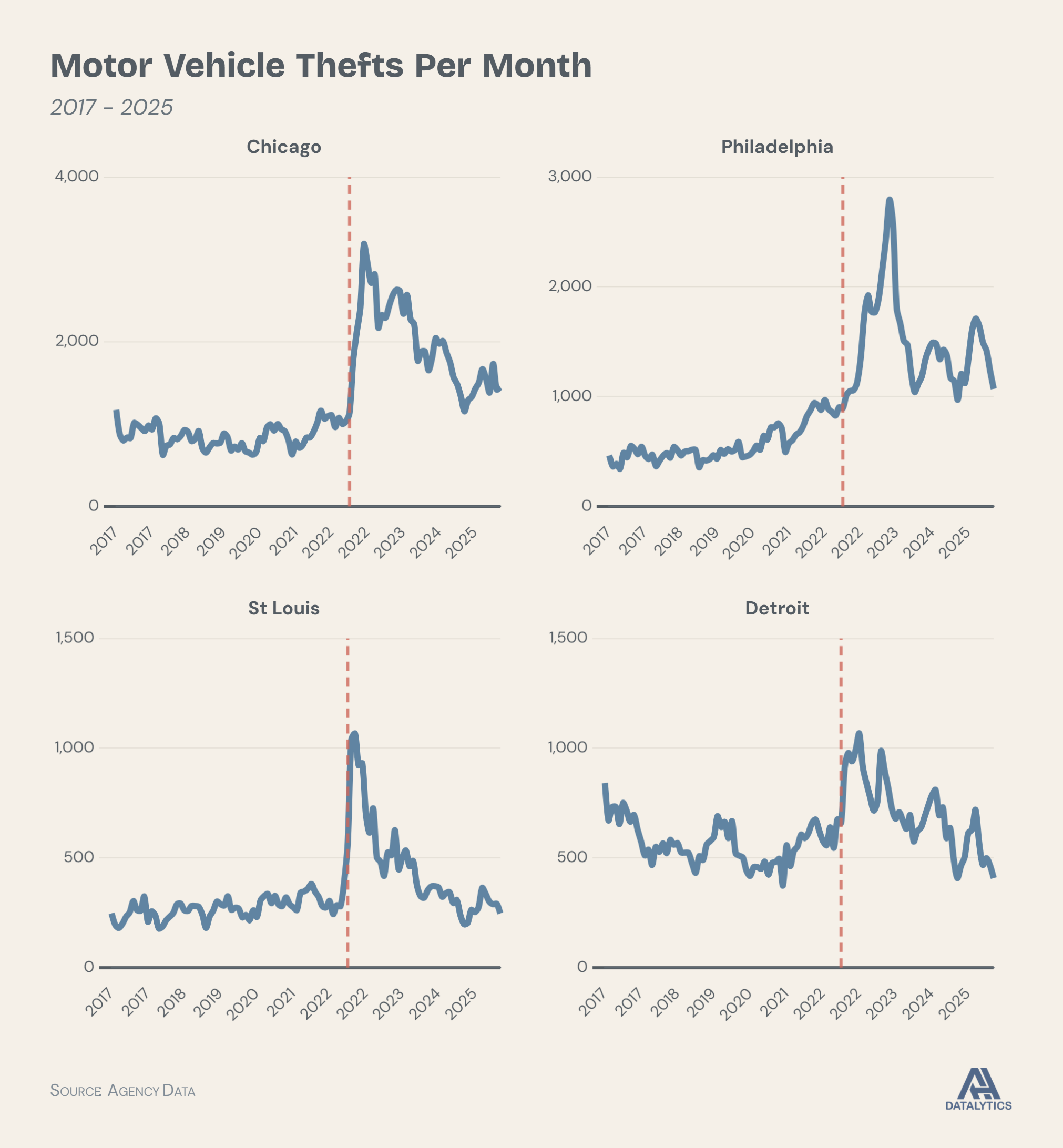
The result is an easy-to-use tool that provides much more up-to-date information. “We built a tool that was cited by the Biden White House in January and by the Trump White House in December,” Asher said. “That means neither of them sees it as a biased source, and that means the world to an analyst.”
AH Datalytics just released an updated version of the RTCI this summer. It now includes information about clearance rates — how many crimes get solved — as well as a wealth of historical data dating back to 1930. It’s also going to soon deploy an AI-powered chatbot that will allow users to interact with the tool in a conversational manner.
“Instead of clicking on a table, you just say, ‘I want a graph of all the robberies in Charlotte, North Carolina, per month since 2016.’ Or take something like carjackings, which the FBI doesn’t formally track. But by definition, a carjacking is a robbery where a vehicle is stolen — and we can actually calculate how many of these occurred in a given city in a given month.”
Asher regularly publishes his insights and analysis on his Substack newsletter Jeff-alytics. Recent subjects include a debunking of a viral story about an uptick in marital murders via poison, and an analysis of the dangers of police car chases. On his podcast, also called Jeff-alytics, he interviews people with skin in the game, such as New Orleans Mayor Helena Moreno and FBI Assistant Director Tim Ferguson. Through his own writing about criminal justice, Asher strives to provide an informed, well-reasoned counter-point to a media environment that, for various reasons, is full of sloppy analysis. As an example, he points to a recent story in the New York Post that credited San Francisco’s rapidly declining crime rate to the city’s tough-on-crime prosecutor.
“But that doesn’t really add up,” Asher said. “They switched prosecutors in 2022, and then a year and a half later, crime started falling. But if it’s solely due to a tough-on-crime prosecutor, then what’s happening in Philly, where it’s falling even more to even more historic levels?”
Part of the problem is that the media’s coverage of crime tends to be driven by anecdotes rather than data, with a focus on dramatic, upsetting stories — something that’s particularly true when it comes to local news. “The media doesn’t cover the planes that land, and you don’t see news articles about how there were no robberies last week,” Asher said. This is one reason why Americans consistently report believing that crime is on the upswing, even during periods when exactly the opposite is true. Last year, market research firm YouGov asked respondents about their perception of murder rates. Most believed that murder rates in U.S. cities have increased since 1990 and 2020. (There were around 9.4 murders per 100,000 residents in 1990; 7.8 in 2020; and 4 in 2025.)
In an era marked by mistrust of experts, when high-level officials in the government dismiss data they don’t like as “fake,” Asher finds it more important than ever to be honest about his own limitations. “I express analytic uncertainty,” he said. “You know, ‘What does the data actually show? What are the weaknesses in the data? How confident can we be in this assessment?’ All of these things that I learned working with the CIA. It’s important, because we’re dealing with very imperfect data, while trying to understand the present and predict the future.” Being clear about what he doesn’t know can, counter-intuitively, help engender trust among his readers, he believes.
It’s too soon to say for sure, but Asher sees some signs that the great crime decline that began in 2023 might be waning. The pandemic-era emergency spending has dried up, and many cities are facing drastic budget cuts under the current administration. But no matter what direction the murder rate goes, Asher will be there watching and trying to help people make sense out of it all. “Crime exists, crime is bad, crime is not solved,” he said. “But crime is getting better, and we should understand why it’s getting better, and do more of the things that are causing it to get better.”