
The year 2012 marked a milestone in human history: the birth of 146 million babies across the globe.
That was more births than in any previous year and likely more than we will see in any year to come. Global population, which today stands at 8 billion people, will likely continue to grow for another few decades, rising to perhaps 9 or 10 billion. But if
current trends continue, that population peak will be followed, relatively rapidly, by a sharp drop.
In their new book, After the Spike: Population, Progress, and the Case for People (Simon & Schuster, 2025), University of Texas at Austin economists Dean Spears and Michael Geruso urge readers against kneejerk assumptions about what this change will mean.
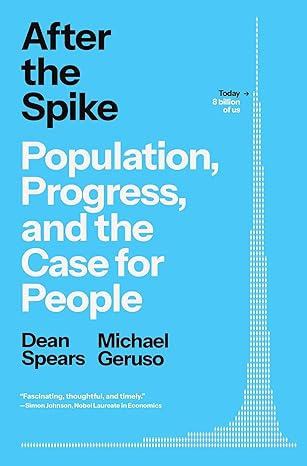
The two longtime colleagues and friends decided to tackle the subject in part because there seemed to be so many misperceptions about what’s going on, including from many people who, if they’ve thought about the topic at all, have it wholly backwards: They think that we’re on the path to overpopulation.
“It became really clear to us that there was a lot of misunderstanding about the present, about the past, and about the likely possibilities for the future,” Geruso says.
One of those misunderstandings is the belief that the effects of depopulation — meaning, in simplest terms, that each generation will be smaller than the previous one — are limited to just some countries or regions. Rather, the researchers argue, depopulation is a global issue with global implications. Two-thirds of the world’s population live in countries where the total fertility rate is already below “replacement level” — fewer than two births per every two adults — and most of the remaining countries are headed in that direction. In the U.S., the figure is 1.6 births for every two adults. Across Europe, it’s 1.4. Even in the world’s two most populated nations, India and China, it is below two births per two adults.
“Depopulation will matter for everyone, everywhere,” Spears and Geruso write.
Another assumption they tackle is that depopulation is something to welcome. After all, fewer people on the planet will mean fewer problems, right? Fewer people competing for limited resources. Fewer people creating environmental harms.
Not quite, say the researchers, who track present-day misconceptions about human populations to ecologist Paul Ehrlich’s 1968 book The Population Bomb. Ehrlich argued that the then-growing global population would result in widespread famine. His book, with its dire warnings of mass starvation and food riots, helped spur the “zero population growth” movement, whose proponents believed the only way to stave off this bleak future was to dramatically cut birth rates.
“For decades,” says Geruso, “the concern that many of us heard about was overpopulation, this concern that there’s not enough food or material resources to go around to satisfy the needs of all the people on the planet. Those ideas have persisted despite the fact that, decade after decade after decade, these ideas have been proven wrong.”
The researchers point out that, in the decades since Ehrlich’s book was first published, food production has increased steadily on every continent at a rate faster than the population increase. And while human-created environmental harms are serious problems, Spears and Geruso say, falling birth rates will not solve them. In recent decades, even as the population has grown, once-daunting environmental threats such as acid rain, lead pollution, and the depletion of the ozone layer have all been mitigated thanks to human-led policy and technological progress. It stands to reason, they argue, that we should mount the response to today’s pressing threats, such as greenhouse gas emissions, in the same way. Indeed, they write, the average individual lifetime carbon footprint peaked with people born in the 1970s and is now shrinking.
Why, then, has this anxiety about population-fueled scarcity endured? “I think part of the answer is that there’s a real appeal, or I might even say seduction, to zero-sum thinking,” Geruso says. “The thinking that if someone else is getting something, it must mean that I’m getting less. If another person is consuming food resources, energy resources, any sort of natural resource, then it must mean that there’s less left for everybody else. Those ideas have proven to be very persuasive and seductive to people, but often, and especially when it comes to population economics, that mode of thinking leads you in entirely the wrong direction, at odds with the facts.”
In After the Spike, Spears and Geruso counter these ideas with, as the subtitle of their book states, a case for people and for a future in which population is stabilized rather than either indefinitely declining or increasing.
“There’s not a very strong case that depopulation is going to solve any of our problems, make the world fairer, or address climate change and poverty,” Spears says. In fact, he says, we stand to lose something very important in a depopulating future: people.
“People are a win-win,” he says. “Their lives are good for them and good for you. One of the most important consequences of global depopulation is the most immediate and the most obvious one: that there would be fewer people, there would be fewer lives. There would be less of whatever makes lives good — less reading good magazines, less finding a new book, less of the morning cup of coffee, of a birthday party, of a trampoline park, of whatever it is that you find enjoyable.”
On a more practical level, fewer people also means fewer minds working to invent, problem-solve, and move society forward. It’s no coincidence, Geruso says, that the period of greatest human population growth has also been a period of global progress on numerous fronts. Over the time of rapid population growth, global poverty rates have declined. Life expectancies and educational attainment have increased. In fact, they argue, most major markers of human development are better today than they ever were in the past.
“That progress,” says Spears, “has been dependent on people to produce it. We should think of ourselves as lucky to get to live on a planet with 8 billion other people, at a time when many billions have come before us making the progress that we now get to enjoy.”
While Spears and Geruso argue for the benefits of population stabilization, they make quite clear their belief that individual decisions about family size are complex and deeply personal, sharing their own families’ journeys, including struggles with infertility and the heartbreak of miscarriage, to illustrate that point.
“One of the reasons that we wrote about our own experiences is to show that these decisions are not easy for us either,” Geruso says. “These things are complicated, and they’re intertwined not just with our own wants and desires and constraints, but we’re making these decisions in the context of the societies that we’re living in.”
After the Spike quite deliberately does not offer pat prescriptions for how to “fix” the problem of depopulation. “It was easy to decide not to claim that we have all the answers, because we don’t have all the answers,” Spears says. “Global depopulation is too new for anybody to have all the answers.”
There’s little evidence, for example, that any existing policies aimed at making parenthood more affordable actually work to enduringly raise birth rates. Sweden, which has some of the world’s most generous family policies, offers families free healthcare, heavily subsidized daycare, and lengthy parental leaves, but has a birth rate comparable to the decidedly less-generous U.S. That’s the case as well in the other Scandinavian countries, with their similarly robust family policies.
Low fertility isn’t a symptom of unaffordability, Spears and Geruso say. Nor is there a consensus among social scientists about other potential explanations. While there are plenty of theories — dropping marriage rates, feminism, capitalism, Western individualism, access to contraception and abortion, a decline in religion or “traditional” values, social media — there’s no simple explanation for the trend. After all, birth rates are historically low in both rich and poor countries, Eastern and Western societies, secular and religious communities. “Low birth rates are too big of a global change to be tidy,” they write. “We’ll have to do without a grand theory.”
But that doesn’t mean we should ignore the issue or pretend matters will automatically reverse, they argue. Now, while global population decline is a couple of generations away, it’s imperative to begin thinking about what sorts of changes to our economies, societies, and politics may lead fertility rates to someday rise. As a model, Spears points to the first scientists to raise alarms about the threat of climate change in the 1960s, whose work planted the seeds for solutions that would have been inconceivable at the time but are now being adopted. “That’s not something that happened spontaneously,” he says. “Progress doesn’t happen automatically. People have to achieve it,” through social movements, scientific advances, and responsive policy.
“Climate pioneers six decades ago didn’t have all the answers, but it’s a good thing that they didn’t give up back then,” Spears says. “That suggests that it’d be a good thing if we don’t give up, either. We have the time for humanity to learn more, to discover more, to do the social science, to do the ethical thinking, to do the political movement-building, to do the social movement-building. We have decades. That means we should get going, get talking, get thinking, get reading. That’s what this book is trying to bring people to do.”