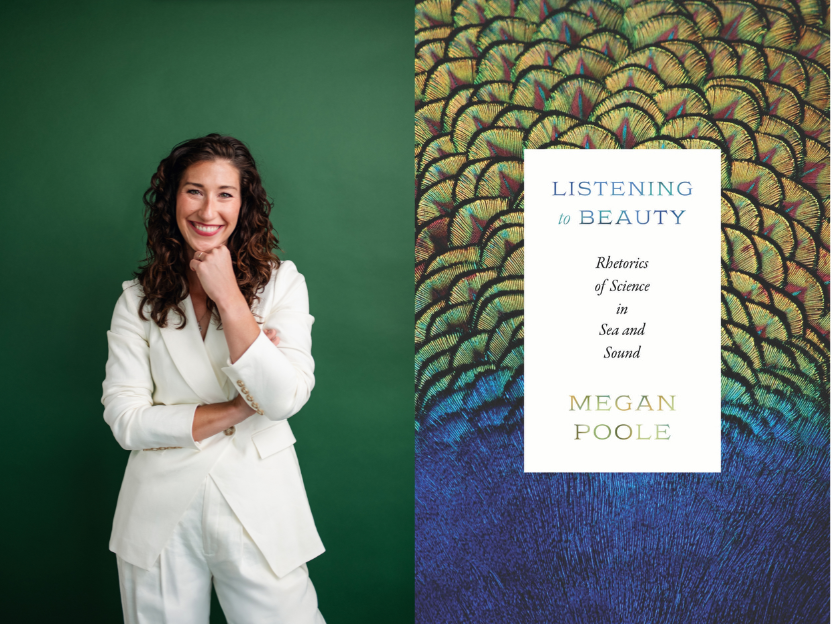
In her book Listening to Beauty: Rhetorics of Science in Sea and Sound, assistant professor of rhetoric Megan Poole examines what happens when researchers step outside of the scientific method and approach their subjects through the senses and subjective feeling.
The book is organized around interviews with influential biologists who study a variety of animal species —from whales to elephants, birds, and spiders — and who share a common desire to understand their subjects through more than just measurable data. By immersing themselves in the world of these animals, these scientists attempt to put aside their human biases to listen and observe without expectations and allow their research to be guided by the beauty of nature. Throughout the book, Poole makes a case for valuing different ways of knowing and for allowing rationality to coexist with wonder.
I spoke with Poole recently about beauty and science; the value of slower, less conventional ways of learning; and how the push to make science more productive may be stifling creativity. A lightly edited and condensed version of that conversation is below, and you can learn more about Poole’s work here.
Thanks for talking with me. Can you start by describing the terms “beauty” and “listening” as used in the book? Because you use them more expansively than just to mean something aesthetically pleasing and hearing a sound.
Let me start with listening, because how the book ended up being about listening surprised me. I did not plan to write a book about listening. This book started as my dissertation, and there I was trying to find moments when academic science shifted paradigms to value non-traditional ways of knowing. I only did two interviews for the dissertation, with Katy Payne and Rick Prum. And it was only after I gathered the greater expanse of interviews for the book that listening became something I couldn’t avoid, and Katy Payne became the center of the book because every scientist I talked to had a story of how Katy had informed their way of being or knowing. And when I went back to her interview, I realized that she was teaching me how to listen.
Listening is more than just ear work. Listening is full-bodied work. It’s a sensory enterprise that I define as deeply aesthetic in the sense that I think true deep listening, as the scientists are teaching me in the book and I’m trying to teach readers to respect, influences how your body is comported in the world. And this comportment changes how you receive messages from the environment, which then asks you and teaches you to attend differently. Listening cracks open new ways of knowing. If you’re truly listening, you are challenging yourself to value other knowledges. Listening is about learning something you didn’t know.
Beauty’s tricky, and everybody warned me not to write a book about beauty. One of my favorite reviewer comments was, “Are we allowed to like beauty again?” Beauty has a harmful history, and that version of beauty is inextricable from the history of aesthetics. What is considered beauty has been very raced, classed, and gendered, but beauty itself is more expansive. I think there’s a difference between beauty and the beautiful, and it’s more than just an adjective switch. The beautiful is a marker we can attach to an object, which means we can put in a museum; we can observe and evaluate the aesthetics of something that is beautiful and we can negotiate whether it is pleasing. But beauty itself is more of a mode — beauty as a way of being or noticing. The Navajo have a saying when they say goodbye, it’s “walk in beauty.” That’s not the same as “be beautiful.”
That description of beauty reminded me of your discussion of Barthes’ use of the term “punctum,” which is the quality that grabs the viewer but is impossible to articulate or interpret. When Barthes uses that term, it’s to talk about photographs, but you apply it to nature.
Barthes described it as what sticks with you long after you’ve left. Beauty and the beautiful is in a museum but it’s also in nature. You leave coastal prairie grasses, and it’s how you remember the wind on your face. It’s the sound you remember hearing from the blades of the grass crashing together. Beauty is what lingers. And Barthes’ point is that it wouldn’t linger if we could say exactly what work it was doing in us and to us. So, in that sense, it’s the ineffable.
That makes sense for art, but how do you get from that sense of, “I know it, but I can’t verbalize it” to something that can be used in scientific inquiry?
I think what the book is talking about is beauty as a method, and Christina Sharpe is credited for saying as much. For me, beauty is what convinces the scientists to stay obsessed with their subjects of inquiry for so long. These scientists aren’t able to answer their hypotheses for years. There’s a lot of trial and error, and there’s a lot of frustration in running the data. And beauty is something that allows the scientists that I interviewed to sustain their line of inquiry, to stay with the not knowing.
We don’t talk about the not-knowing enough in research and academia. It is a frustrating enterprise because you’re asking questions you don’t have an answer to, and that’s true for our students too. Are we teaching them how to be with that discomfort? Finding some sort of feeling like beauty or joy can allow you to sustain and be with the discomfort long enough to learn.
But how do you get to some sort of pragmatic data that you can publish in an academic journal? In rhetoric we talk about the beginning stages of research as the invention stage. So, when I’m talking about beauty, I’m talking mainly about the invention stage. How scientists move outside of that invention to the objectivity required for publication is something I didn’t study intensively. But they do talk about needing to set aside their subjectivity and set aside seeing their subjects as beautiful in order to move to the science, which I think is a fascinating divide.
The scientific process that you describe in the book is what I, possibly too romantically, imagined all of science to be like: That it’s founded in curiosity and observation, and that a scientist stays in that space for whatever amount of time it takes before eventually moving to hypothesis testing and everything else. But from the discussions you had, it seems that, at least in our present era, that kind of approach is more the exception than the rule. So, what changed? Or was science never really like my romanticized vision?
The scientists I interviewed point specifically to two areas, one having to do with how science is funded and the second with K-12 education. The K-12 education issue I think is the more important one. We have a very product-driven education model. As early as elementary school, students are asked to set aside their creativity and move to learning things for a test. Room for curiosity, room for failure, that’s such a privilege. Who has the time and money to think and fail and be with beauty? So, I think time has changed with how we’ve commodified it and with the need to be so productive.
I do think that has gotten more intensive as science has gone on. Science is now funded through grants. You have to always be applying for some kind of funding to sustain your research, so you can’t be asking off-the-wall questions because you have to be quite sure that you can get this money. And it’s not just your livelihood on the line: You have your graduate students, and your post-docs, and the animals you’re trying to protect and conserve.
One of the quotes in the book that resonated with me was a scientist who described her process as listening “without an agenda.” This seems like perfect advice but also really hard advice to follow.
Laura May-Collado talks about making her students listen and about how much her students hate enduring what she calls the “pain of listening.” I’ve been thinking a lot about that as a teacher, and what I gather is that for someone to be able to listen freely, without an agenda, and to be able to explore and to just lean into their curiosity, there has to be some structure supporting them. So, I as a teacher will structure and control a classroom in such a way that you can be a chaotic thinker and listener. And then someone has to do that for me so that I as a researcher at some point can lean into the chaos of inquiry and listen without an agenda. I think it’s so important to get outside of the linear ways of thinking we’ve been handed.
Anthropomorphizing comes up a few times in the book. In the first instance, Payne warns against projecting human qualities like longing onto whale songs. But when it comes up again in the chapter about the elephants, those researchers are embracing anthropomorphizing as a corrective to the purely descriptive methodologies of behavioral science. How does one find a balance between not making assumptions and not like limiting imagination?
This is still a huge controversy. In some circles, if you anthropomorphize you have done a scientific wrong and you cannot be taken seriously as a researcher. I think it’s a question of when can you be highly subjective? When can you lean into imagination? When do you need to be hyper objective, and when do you need to look at your data more critically? It’s in the “when” that you strike the balance.
This also points to how science or any intellectual enterprise has to be a community-driven practice. You need someone there to check your interpretation. If where you end up through your anthropomorphizing misunderstands that organism or that ecology or that environment, then there’s a potential harm there that we need to interrogate. But why should any one person need to be responsible for that? Thinking is a communal act, so be in community.
And some of these scientists I see as trying to be in community with the subjects they’re studying. In order to build that empathy with a non-human animal — an elephant, a whale — there’s a heavy degree of anthropomorphizing. Just figuring out where the whale is going to swim next is trying to get in their head. That’s a form of anthropomorphism. Is that a harm? Not necessarily.
The people you talk to are using beauty as an entry point for understanding nature and for spurring conservation efforts. How does beauty function within those two different but overlapping goals? And how important is rhetoric to conservation?
I think it was Peter Wrege who said that humans will not act for conservation efforts unless they can go through a person: a Jane Goodall or a Katy Payne. I don’t want him to be right, but most days I think he is. If I’m thinking about our social media scrolling culture, people are attracted to reels and selfies of people in nature. I don’t know that a video of waves lapping on the shore would go as viral as someone riding the wave.
Do humans need to go through other humans in order to get their entry point into nature to care and conserve? One famous rhetorician defines rhetoric as the study of human motivation. And we tend to study how humans are motivated by other humans, or by other language, or by capital, or by value opportunity. I was more interested in the opposite, which was how is the environment of the elephant, or the whale, or the black rail, or the whooping crane persuading me? When does that land or those animals influence us and get us motivated to think or act differently? And that’s where listening became the important wedge. What can motivate us to listen? What can compel our listening? And it’s more than just other humans, and that’s why I want to resist what Wrege is saying. I hope he’s wrong. I hope we don’t have to go through other humans and be explicitly persuaded and influenced in such a humanistic, hierarchical, rationalistic way to change our behavior. I hope we can see a whooping crane, a five-foot-tall bird, fly through the sky and be convinced to conserve that habitat. I hope beauty can compel our listening. Some days I do worry, though.
It’s interesting that you say “motivation,” because I always thought of rhetoric as more about persuasion.
Its most traditional definition is the study of persuasion: how we persuade others and how we are persuaded. The rhetoric of science is how scientists persuade other scientists, or how scientists try to persuade the public, and how the public is persuaded by science or not. I was studying how the environment persuades the scientist. But I like motivation because it’s a little more expansive, and I think motivation can come through the senses. I say that I study rhetoric at the level of the senses. How are we persuaded by the senses more than by logic?
You say toward the end of the book that, “Meaning and communicating such meaning is not always the point” of the kind of deep listening these scientists engage in. As someone whose job is to figure out how to communicate meaning, I find that both fascinating and frustrating. Did you feel that frustration at all in writing a book about the limits of communicating meaning?
Yeah. To your point about what rhetoric is, my insecurities about a book like this are: why did I write a book about rhetoric if the whole enterprise of the book is saying that the point might not be to make an argument or to land a definitive meaning? Now the question that I would maybe turn your question into is: Is listening always an early invention tool or can it be where we’re trying to go? Maybe that’s what you’re picking up on as a tension in the book, that I want listening to be an end and I’m asking why it can’t be enough, why beauty can’t be enough, why we have to turn it into something, why we have to produce something from it.
You mentioned that listening wasn’t your starting point in writing this book but that it emerged from the interviews. What was your starting point? What were you hoping to find?
I was wanting to find these moments when science has valued non-traditional ways of knowing. Then I said, “Well, beauty would crack that open, because science is allergic to beauty.” They won’t touch it, or when they do touch it, it’s always controversial. And the first time that I could find beauty used in the journal Science was the whale song piece, so then Katy Payne, who figured out that whales weren’t just making sounds but singing, became the first person that I interviewed.
I think what I learned is that science is always valuing non-traditional ways of knowing, and that there isn’t room for that in the publications. So now it’s kind of a question of: Why is there not more room? Why is there not more room to talk about the messy part of science? Why do we want science to be so neat? It’s more a question of how we consume science than how science itself is produced.
I’ve always found it frustrating in science journalism that every piece on even a tiny study has to be presented as though the study conclusively proves something. It’s trying to make science into something it isn’t.
Science reporting treats science as a purely question-answer enterprise. I have a question about what’s going to make me lose weight. Here’s the answer. I have a question about if it’s bad that I drink eight cups of coffee a day. Here’s the answer. We want these easy answers, these definitive things that will change the linearity of our lives or prove something. We’re uncomfortable with living our questions.
In the conclusion of the book, one of the scientists you’re interviewing asks why you’re studying beauty. Can you talk about your answer and what you learned while writing this book?
I think what the book and these interviews with these scientists taught me was why I was actually doing this, which was that I don’t trust nature’s beauty. Both the intro and conclusion of the book deal with the Louisiana hurricanes I experienced, and last year was the 20-year anniversary of Hurricane Katrina. For that anniversary a magazine asked me to write a retrospective of the hurricane that destroyed my hometown a few weeks later. I had not interrogated it until then, and I realized that I’m always waiting for nature to show its ugly side. I know nature not to be beautiful, and I think in this book I was trying to reintroduce myself to nature’s beauty or to learn from people who were appreciating it.
In a lot of ways, this was the book I needed to teach me what book I really want to write, which is about what we’re all now facing in climate crisis. Our relationship with nature is contentious and she’s pushing back, and she should. I think in an ideal world, beauty could be what turns our attention and asks us to change our behavior and to live in a better relation with nature.