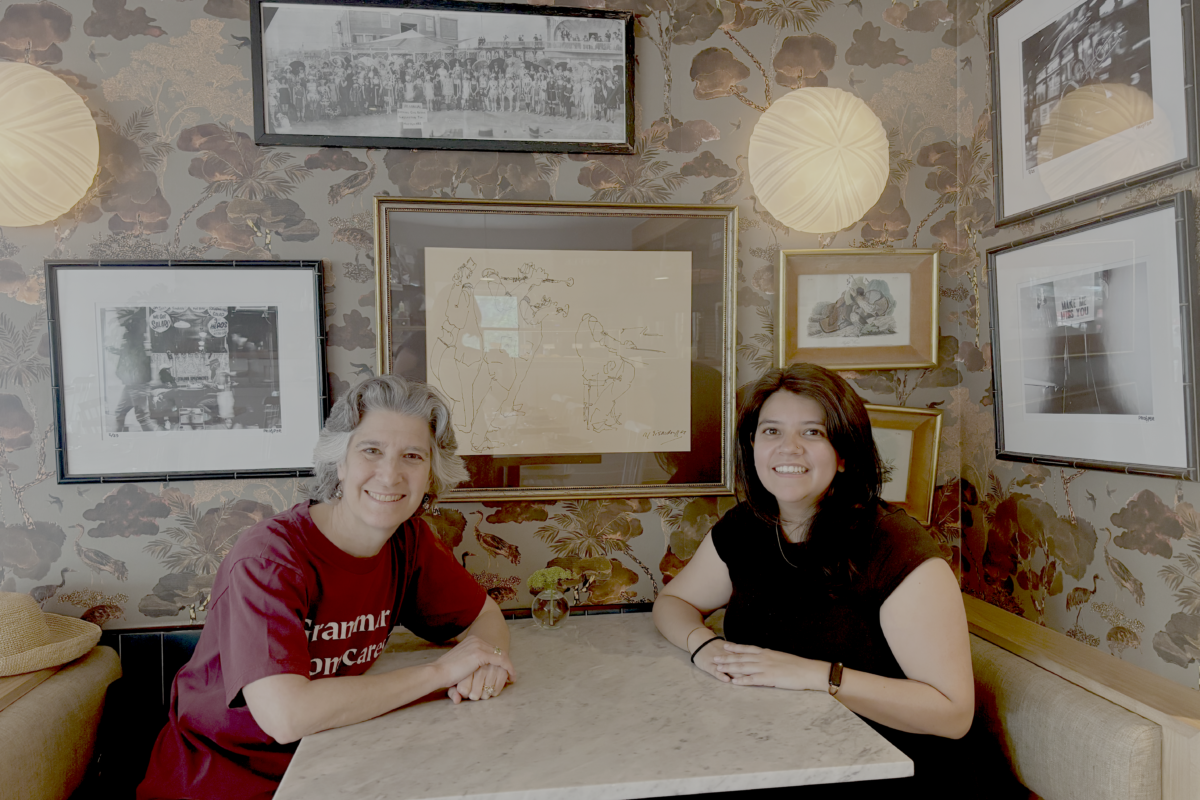
Zeltzyn Rubi Sanchez Lozoya talks with Deborah Beck about her long career in academia
With hindsight, the past becomes a timeline, a sequence of moments that can easily smooth over the setbacks and failures now comfortably behind us. But talking with Deborah Beck, a professor of classics at UT Austin, about her long and accomplished career was a reminder that success rarely follows a straight line. Careers may eventually tell a coherent story, but they are shaped by uncertainty, detours, and the gradual process of figuring out what matters most.
I first met Deborah through a College of Liberal Arts program that trains faculty to share their expertise with nonacademic audiences, and we quickly became friends. As a new faculty member still learning the ropes, talking with someone so unapologetically herself was a breath of fresh air. Deborah’s candor made the unwritten rules of academic life less mysterious. As I got to know her better, it was easy to see why she’s been recognized by the university for both her teaching and her mentorship.
At the end of the spring semester, I sat with Deborah to talk about her career, the importance of learning from failure, and what makes a good mentor. We also talked about what success means, how to define it, and how to pursue it — even when it means embracing the detours along the way. What follows is an edited version of our conversation.
– Zeltzyn Rubi Sanchez Lozoya
Zeltzyn Rubi Sanchez Lozoya: To start us off, Deborah, I’m interested in how you came to your academic career. In your university bio you mention that what first brought you to classics was reading the D’Aulaires’ collections of Greek myths as a child and a wonderful Latin teacher in high school. How did you go from these early influences to a career as a classics professor?
Deborah Beck: I came back to classics after working for a couple of years in a completely different field. I was living in Washington, D.C., which I loved. I went out to dinner with my best friend from high school, who was then a student at the School of Advanced International Studies at Johns Hopkins. We were probably talking about foreign policy or war or something like that, and somehow Thucydides came up. In the middle of the conversation, it occurred to me that I was much more interested in Thucydides than I was in most of the things that I did on a day-to-day basis in my job. Long story short, at the end of that week, I
showed up at a testing site at 6 a.m. with a check in my hand to take the GRE. I took the test, applied to graduate school, and less than three months after that conversation I was in.
Why did I go back and why did I stick it out? It’s the right place for me. It’s the fullest overlap between my skills, the things I enjoy, the things I find socially useful, and what the job is. And I think that knowledge that this is the right place for me is what
kept me from giving up later, during various periods of fairly substantial adversity. I came to UT from a tenure denial, for example. But I knew that this was what I wanted to do, and I was eventually promoted with tenure here.
This makes me think of something we’ve talked about before: about showing set-backs, or results that you wouldn’t call
successful. Why do you think it’s important to model failure?
I think it’s important to model failure because that’s one of the best ways to learn. Our students really need that. They’ve been so massaged into thinking that they have to be factories of success. We have no public discourse that makes room for constructive admissions of failure: “Oh, that didn’t work? Then do something else.” Or even, “I was wrong and I changed my mind.” None of those are normal parts of our public discourse, and yet everybody knows from their own experiences that failure happens. You have to meet failures instead of running away from them or things are not going to get better — at work, in your relationship with your family, with your friends.
The willingness to admit failure and to say “I was wrong” is a strength of character that everyone needs and that we don’t really talk about teaching or modeling. Once I finally did get tenure, I could say: “All right, now that I don’t have to meet someone else’s
expectations all the time, what do I want to be when I grow up?” I wanted to be someone who could help other people be the best version of themselves. I think one of the ways you become a better version of yourself is to learn from your mistakes.
I agree that’s very important. Because, especially in grad school, everybody is pretending that they are doing fine, that they’re doing all of the things they’re “supposed” to be doing, reading 1,000 pages a week, etc. It was very liberating when I finally met someone who said, “I just watched a lot of Netflix yesterday.”
I totally agree. I was incredibly naive as a grad student in the sense that I just kind of went about my business and that was fine. But when I work with grad students at UT, I spend a lot of time saying, “We’re real humans here, people!” And I spend a lot
of time disambiguating how you did on your exam versus your worth as a human being.
I’ve been sharing my own writing with students as part of my graduate seminars for about 10 years. The first time I did it, I intended to share a finished draft, but I didn’t finish it by the time they needed it. What I gave them instead was a draft full of brackets that said “insert better word here.” And it turned out, unsurprisingly, that was way more useful to them than a completed draft would’ve been, so now I intentionally always give them draft work. I ask for their feedback. I talk about my own process. I talk about failing, not as failures in the sense of “this is bad that it happened,” but “this didn’t go well and then I did this and it went better the next time.”
The other thing I think is important to do — especially, but not only, for grad students — is to make sure that they’re in touch with the reason that they are here in the first place, which is their love for the material.
Looking back on your career, what is one piece of advice that you would give your younger self when you were starting out? And what would you tell younger scholars that are entering the academy now?
I never tell people “don’t go to grad school.” But I do try to make sure that they understand that they may be doing it the same way that people hike the Appalachian Trail, which is an analogy that a colleague gave to me that I really like. Nobody goes on the Appalachian Trail because they want to become a member of the Forest Service or a professional mountaineer. They do it because it’s an experience that they want to have in their life. There’s more opportunity to become a classics professor than there is to become a mountaineer at the end of the Appalachian Trail, but you should think of it in the same way. It has to have intrinsic value for you. You shouldn’t do it if at the end you’re going to feel like you wasted your time if it doesn’t lead into a conventional
academic professor job. The other thing I tell prospective students is to ask themselves, “What else am I preparing myself to do, either instead of or in addition to becoming a college professor?”
I would give completely different advice to myself as a young person. I think I had a much more one-dimensional view of what classics was and what being a professor was when I finished grad school than I do now. I wonder what I would’ve seen and experienced as a young professor if I’d had a more capacious view of the field earlier.
What is one thing that you’re doing now that surprises you?
I never thought I would write opinion essays for newspapers. I thought professors had their glasses on the end of their nose and they wrote these elegant and dispassionate learned tomes that other learned people with their glasses on their noses read. But as
time goes on, I’m more interested in forms of communication that anybody can understand.
A media relations colleague taught me how to write an op-ed. For eight years I worked with him, sending him drafts that he’d edit before sending them out. They would get rejected by 58 newspapers, but one would take it. That’s how I got into writing opinion essays. And I find that kind of writing, where you have to say something complicated in a way that anybody can understand it, fundamentally both more interesting and more socially useful than saying something very academic.
In addition to your work with graduate students, you have also received the Dean’s Faculty Mentoring Award in recognition of your mentorship of other faculty members. What do you think makes a great mentor? Can you speak more about this kind of relationship?
A good mentor is someone who helps you be the best version of yourself. I think it’s important that the mentor not want everybody to be little carbon copies of themself. Some mentors, their definition of success is the only one, and that’s not the way.
I think my mentorship arises from two things. One is my first tenure denial. That arose in part out of a failure of mentorship, and I want to be the mentor that I wish I had had during that process.
The other is that my late mother was very interested in and very good at mentoring young people. She was a lawyer with a long, fancy title — essentially she was the lawyer for the Massachusetts budget. She read the entire budget every year; she thought that was fun. And she would often have interns who worked in her office and in the governor’s office, and she would find them fun things to do. They had a great time, they adored her, and they stayed in touch with her after. Then the governor of Massachusetts appointed her to be a judge and she had clerks she would mentor. So I grew up with this as a model of a thing that you do in
the workplace.
To a lot of people, having a mentor sounds like having somebody do some work for you, open doors, etc. What would you say to them?
I don’t think a mentor’s job is to necessarily open doors for you. I think a mentor’s job is to make sure you know where the doors are. It’s more like having an academic translator; it’s kind of a halfway house between teaching and colleagueship where you make some things explicit. A lot of mentoring is the hidden curriculum of what we do. Some of it is the kind of personal stuff that we’ve been talking about, of helping people be the best version of themselves. And part of that is knowing who you are and how you go about being that person.
And I don’t think most people should only have one mentor, because different mentors are good for different things. For most of us, one mentor over time isn’t going to make any sense; as we progress through life and through our field, our mentorship needs
change. Maybe someone who used to be a mentor becomes a friend, or someone who used to be a friend becomes a mentor, or someone who was a colleague becomes a mentee. All different kinds of things happen. Mentoring is a fluid relationship.
How do you find a good mentor? What makes someone a good mentor?
A good mentor is someone who can help me answer my questions, but that doesn’t mean they have the answers to all the questions. Someone who, after I’ve talked to them, I feel comfortable that I’m in the right place. Sometimes when you talk to people, you end up feeling very insecure and kind of tentative afterwards. That’s the opposite of a good mentor.
Mentorship seems to require an attuned sense of guidance, since different people need different kinds of support. I’ve found it’s often easier to give general advice than it is to give advice to one individual specifically, but that’s what mentorship of the kind you’re describing requires.
I think that is actually another aspect of being a good mentor: Don’t give advice as much as possible. I try not to give advice. Instead I listen when people talk and I try as much as possible to just reflect back to them: “This is what it sounds to me like you said.” In research, one of the most helpful things to do is to say your idea to lots of people and see what you get back. Mentoring is like that. What I want to be doing is not giving advice or pushing people in any particular direction but helping them hear what they themselves have said.
It’s like you said earlier: To be a good mentor is not to have cookie-cutter versions of yourself. There are many different models of success in an academic career, even if there are certain shared milestones, like publishing a book or getting tenure. What does success look like to you?
It looks like a substantial overlap in the Venn diagram between who you are as a person, what you want to be about, and what you’re doing with your professional life. And that could really look like anything. One of our graduate students got a degree in
classical archeology, and then he went to work in some relevant capacity for the Royal Canadian Mounted Police. And I was like, that is the coolest thing I ever heard! So, success comes in different flavors for different people at different stages in their life.
By this definition, do you feel successful?
I do. But I’m not really chasing success as an outcome. Increasingly, I’ve come to think that success is about satisfaction with the process rather than the result. And I feel like my process is a good process.
What does the future look like for you?
What the future looks like is a function of how the conditions in higher education in Texas evolve, and I don’t know what that will be. But if my fairy godmother comes and I get to just do what I want to do, I’ll figure out what’s the right balance for me between writing things that are aimed at a general audience and continuing to talk with and write for an audience of academics. I’m in an evolving conversation with myself and with the field about what my place is. What do I have to offer? What do I want to offer? What is incumbent on me to offer? When I write for the public, it’s like expressing myself in a mashup of voices I already have. It’s like using all the elements of my voice, just recombined and pointed in a different direction. I’m now looking at where to aim in the future.
Deborah Beck is the Christie and Stanley E. Adams, Jr. Centennial Professor in Liberal Arts. Her research focuses on how classical epic poetry, particularly Homer’s Iliad and Odyssey, tells a good story that connects emotionally with its audience. For her latest project, she is writing a book about four passionate women artists, their art, and their fans through the ages. The book discusses Sappho, Hildegard of Bingen, Emily Dickinson, and Frida Kahlo. You can follow her journey on Substack and at fourhorsewomen.substack.com and on Instagram.
Zeltzyn Rubi Sanchez Lozoya is an assistant professor of instruction in UT Austin’s Department of Asian Studies. Her research specializes in world cinema, primarily Indian cinema and film cultures; streaming platforms; and women filmmakers. Her first book, Female Lead: India’s Women Filmmakers in the Age of Netflix, was published in July 2026. She is also the host of the film podcast Watch Next.
Beck and Lozoya first met through the College of Liberal Arts’ Public Intellectuals Program before reuniting in the recording studio to discuss the myth of Orpheus and Eurydice as reimagined in the film Portrait of a Lady on Fire. You can listen to their conversation on Episode 4 of Watch Next wherever you get your podcasts.