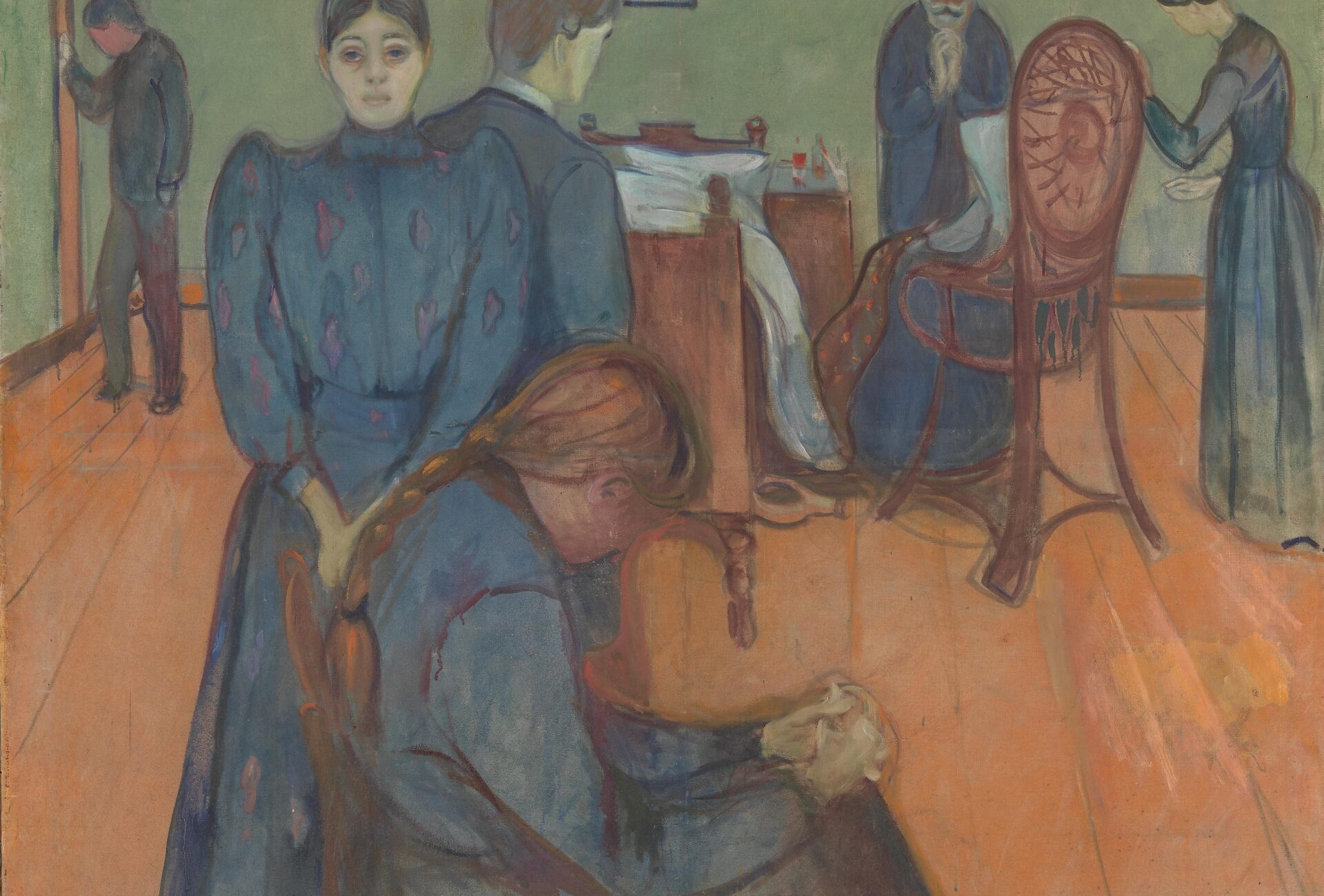
For two years, Dagoberto Cortez quietly watched and listened as patients at a cancer clinic in Madison, Wisconsin, talked to their oncologists about their terminal lung cancer.
His goal, as a graduate student in sociology, was to better understand how both the doctors and patients confronted, or sometimes didn’t confront, the painful realities of disease and death.
Now an assistant professor of sociology at UT Austin finishing up his book on the topic (provisionally titled Discussing Death), Cortez came to the subject somewhat circuitously. He grew up in California’s Napa Valley, in a family bound up in the farmworkers’ rights movements, and arrived at the University of Wisconsin intending to study environmental sociology and social movements.
There he took a course with sociologist Douglas Maynard, one of the country’s leading practitioners of “conversation analysis,” a highly technical and painstaking method of coding and then dissecting conversations in order to discern (often hidden) patterns and themes.
When Maynard needed a research assistant to help do this kind of analysis, he asked Cortez, in part because he’d been told by a fellow professor that Cortez was an unusually skilled poker player. He seemed to have the kind of analytical brain, in other words, well suited to conversational analysis.
Cortez agreed to take on the project, and it ended up confronting him with a problem that would dramatically shift the arc of his career: The research team had collected 128 recorded conversations between oncologists and patients with terminal lung cancer, but there was astonishingly little direct conversation about death and dying. By one count it came up all of three times in the whole set of recordings.
On the one hand, says Cortez, this absence seemed to confirm the discipline’s standard narrative about how doctors dealt with death talk, which was that they avoided it as much as possible. On the other hand, the more time he spent with the conversations, the more convinced he became that the researchers had missed something. There was just too little about the topic, even given its difficulty. There had to be more.
“It annoyed me that we didn’t find what we were looking for,” Cortez says. He rewrote his dissertation proposal and went to find it himself, this time making sure he’d be present in the room as the conversations were happening, to make sure nothing was missed.
He had the good fortune to have access to the university’s health system, where both research and teaching were integral to its mission and operations. That meant that the doctors, many of whom were conducting research themselves, were unusually open to being observed by a sociologist. The patients, accustomed to medical students and residents being in the room with their attending physician, also didn’t bat an eye when they were asked to sign off on one more person in the room.
“Most of them,” Cortez remembers, “were like, ‘Stop talking, I’ll sign it.’”
Over the next 24 months, he recorded and observed the patient-doctor interactions as well the doctor-doctor interactions between appointments, as they debriefed and decompressed in the break room. Being there in person meant that he didn’t just collect audio to be coded but was also able to feel his way into what was going on more intuitively, allowing him to layer ethnographic analysis on top of the conversation analysis.
“Dagoberto has two qualities that don’t always show up in the same person,” says Maynard. “He has the intense discipline and focus to do conversation analysis, and he also has the patience and warmth to sit in the room with doctors and patients as they’re having these conversations.”
The conclusion Cortez ultimately came to from all this study was a subtle but significant revision of the sociological consensus about death and dying talk in clinical settings. Such talk is far more present than the field had recognized, he concluded, but it often happens indirectly, implicitly, and cumulatively, so that rather than the direct conversations we often see on TV — where patients are told outright that they’re going to die, or they have weeks or months to live — the information instead tends to seep in, for most patients, at a pace that is easier for them to emotionally assimilate. Doctors, he found, have built up a whole repertoire of strategies for communicating the reality of impending death in this way.
One move, which Cortez describes in his paper “Invoking Incurability,” is to keep returning to the simple fact, both within a single visit and across visits, that the disease will not be cured. “Incurable,” he points out, is a pretty flexible word. It means something different on the day of diagnosis than it does in a month or a year, and so it invites patients into an ongoing dialogue that shifts as the disease and various treatments for it change.
In one visit Cortez recorded, for instance, an oncologist tells “Bruce,” a 65-year-old man with stage IV cancer, that the newest scans show the disease has spread:
Dr. B: When a cancer spreads from one place to another place through the bloodstream, we might be able to control it, maybe help find more time, but not make it go away.
Bruce: Right, I understand that.
Dr. B: So it means that it’s incurable. … This is the thing that threatens your life.
The doctor doesn’t say “dying” or “death,” but Bruce slowly gets it. A few conversational turns later, when Bruce pushes for a hard number, the doctor confesses, “If I knew exactly how long for you, I would be honest with you. But I don’t.” By then, Bruce has gotten the point. “I know my days are numbered,” he says, “and I’d like to make the most out of ‘em.”
In another moment observed by Cortez, Dr. S tells “Marge,” whose cancer had eaten a baseball-sized hole through her pelvic bone, that the progression has reached the point where it “doesn’t allow you to get better.” The conversation then shifts to what to do next and how to think about it.
Dr. S: So it’s not giving up, but sort of accepting, in a way, but also focusing on different goals.
Marge: Mm hmm.
Dr. S: And that would be going with hospice.
Marge: Right.
Marge had come to the appointment with three of her grown children. She looks at them. “Okay,” she says. “That’s kind of what we wanted to know.” The language is highly euphemistic but the meaning isn’t vague. Everyone knows exactly what’s being communicated.
Another rhetorical move Cortez describes is what he calls a “what-this-means inquiry.” After delivering bad news about the latest set of blood work, for instance, a doctor will say: “Do you want to talk about what that means?” The question is a way of doing two things at once. It signals to the patient the fact that there’s something difficult that needs to be addressed while also handing the patient some of the power to determine how, and how quickly, the conversation should unfold. Once death is on the table, Cortez found, “patients actually guide the conversation way more than we think.” They indicate what they want to know, and how much, and when, and it’s up to the doctors to discern how to respect those signals while also making sure they’re not evading the truth.
Another strategy that many doctors have developed is to respond to perhaps the hardest question they get from patients — how much time do I have? — by shifting the conversation from numbers to priorities. Instead of giving a timeline they can’t really stand behind, since there’s so much uncertainty, they’ll say something like: “You may not be able to fly in a couple of months, so if you’ve always meant to get to Hawaii, now is a good time to do it.”
“Rather than thinking about goals medically,” Cortez says, “you start thinking about it in terms of their life.”
It’s an intrinsically messy process, and one that doesn’t always work out well. Cortez followed one man across three visits in a single month. The cancer had reached his brain, which signaled the end of any good options for further treatment, but the patient wanted to stay on the chemotherapy that, until that point, had been staving off some of the progression of the cancer in his lungs. The doctor tells him, gently, that the chemo can’t do anything about the cancer in his brain, which means that anything it can do for his lungs is now irrelevant. It’s time to think about hospice. The man won’t have it. He wants to look for another clinical trial, something outside the box. “What you were on was outside the box,” the doctor finally tells him. “There’s no box.” The man changed clinics, Cortez says, and was dead within five months.
Given all this complexity, Cortez has more sympathy for how doctors talk around and into the topic of dying than perhaps has been the norm in his profession. If he has a critique, it’s of the system rather than the people within it. “It’s about the institution creating more space for doctors to have these conversations,” he says, “and changing how we train doctors to actually focus on them.” Right now, he says, there’s not much education for medical students and young doctors on how to negotiate these hard conversations. There’s no class that teaches someone how to “invoke incurability,” when to deploy a “what-this-means inquiry,” or how to reframe questions of time into questions of life priorities.
But no matter how good the training or how much time doctors are given to talk to their patients, says Cortez, it will always be hard. Reflecting on his experience observing end-of-life conversations, his thoughts are less about the unusual intensity of the work than about the privilege of being given access to such intimate encounters.
“If you’re a loved one, you’re in there with someone who’s dying,” says Cortez. “If you’re the patient, you’re dying. And if you’re the doctor, you have to tell this person they’re dying. I was, by far, doing the easiest job.”