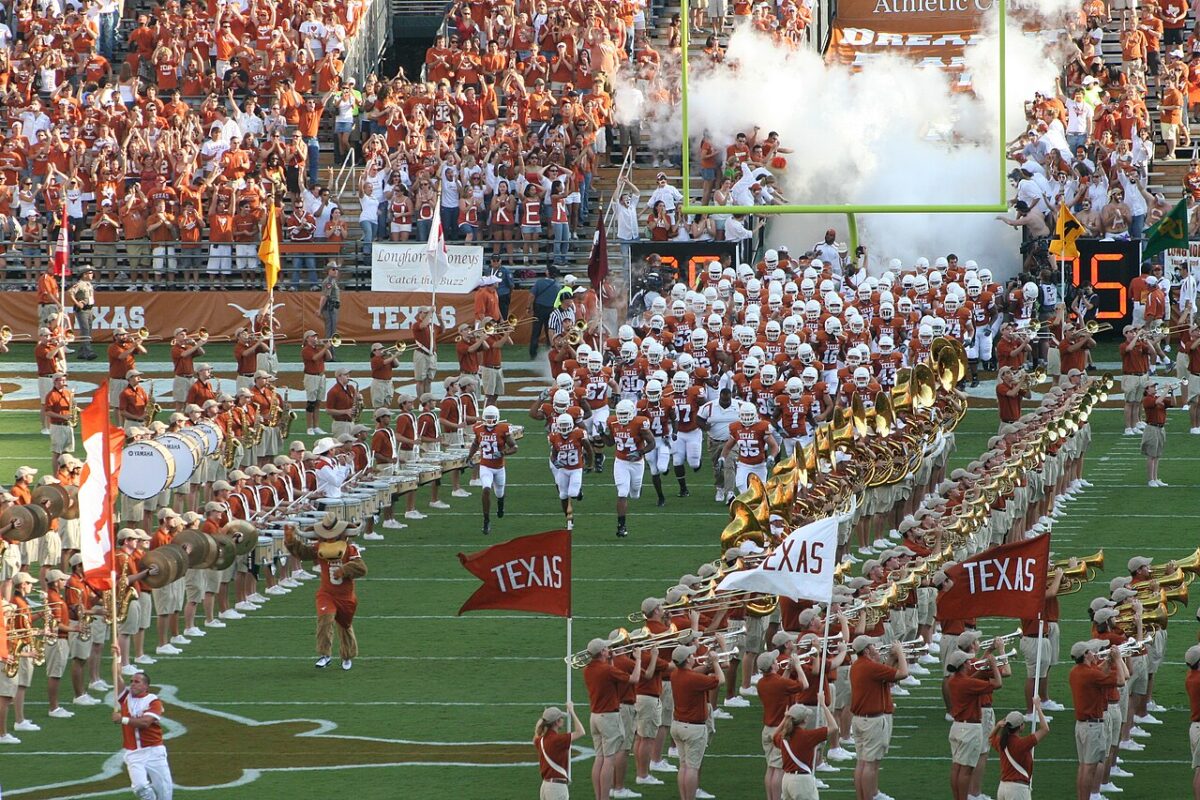
On any given fall Saturday, millions of fans across the U.S. gather in stadiums, at sports bars, and in front of living room TVs to watch college football. But for Leonard N. Moore, the George Littlefield Professor of American History at The University of Texas at Austin, our collective fascination with football is about much more than entertainment. A parent of a college football player, Moore teaches the popular course “The History of College Football,” which uses the game to examine American regionalism, education, race, politics, masculinity, and money. Those themes are also woven throughout his two ongoing book projects, Touchdown Jesus: Notre Dame and the Making of Modern College Football and The Ghosts of Bear Bryant: Race, Money, and College Football’s Obsession with Winning.
A few days before this year’s Texas-OU rivalry game, Moore sat down with Texas Monthly columnist David “The Texanist” Courtney to talk about football’s near-religious hold on the South, what educators owe student athletes, and why the debates over NIL and the transfer portal say as much about labor as they do about sports.
The interview has been edited for length and clarity.
David Courtney: Thank you, Dr. Moore, for being here. To get started, can you tell us a little more about yourself and how you found your way to academia and to Austin?
Leonard Moore: I’m from Cleveland, Ohio. I tell people it’s the best city in the world, although nobody believes me. I guess my claim to fame is I went to the same high school as the Kelce brothers. And the community we grew up in — about 35% Black, 30% Orthodox Jewish, and about the balance white — really shaped me. Growing up we were playing tackle football and shirts and skins basketball with my Jewish brothers, and the yarmulkes never fell off. It was just this rich community, and it shaped me because a lot of my Jewish friends growing up, their grandparents were Holocaust survivors. Cleveland Heights was a hotbed for American Jewry after World War II.
I went to Jackson State as an undergrad. I wasn’t a very good high school student at all — I tell people my typical report card in high school was four Cs and two Ds — but I was a good kid. I never got in trouble, school just wasn’t really engaging. So I went to Jackson State, a historically Black college in Mississippi, and that’s when I had a transformative experience with a history professor. He turned my life around, and I left there and went and got a Ph.D. at Ohio State at the age of 26.
My first job out of grad school was at LSU, and I specifically went there because at Ohio State I had started tutoring athletes. I knew I wanted to go somewhere where I could have an impact on that population.
I was at LSU for nine years, and I was minding my business. We were firmly settled in Baton Rouge with three kids. And then I get a call from The University of Texas in 2006, and I was brought over to Texas in 2007. I have been here ever since and have never thought about leaving.
Courtney: You mentioned you have three kids. This may be a good time to mention the other, perhaps more famous, Leonard Moore.
Moore: We have three kids, and they all played Division I sports. My oldest daughter played basketball at North Texas. My other daughter, who’s probably the most talented athlete in the family, is finishing up her last semester at Jackson State now. She went there to play volleyball, quit the volleyball team, and joined the cheer team. And then I have my youngest, my son, who plays football at Notre Dame. If you ever watch the Fighting Irish, he’s number 15, and I would say over the last two years I’ve become Leonard Moore’s father. We have the same name, and now people know me from him.
So, I would say that when I look at college football, I look at it from three perspectives: As a professor; as a practitioner, because I’ve done a lot with football programs from a mentoring and life skills perspective over the last 25 years; and now as a parent. I have a three-dimensional view of how this thing looks.
Courtney: Here’s a big question from a million miles out: If you encountered, say, a Martian, and you needed to explain the United States to them using only college football as your lens, what would you say?
Moore: The first thing I would tell them would be to go to the Texas-OU game in Dallas, and let’s talk after. Now, I have to admit, I was a latecomer to how dope the Texas-OU rivalry is. I always thought nothing’s better than Michigan-Ohio State, and I believed that until I went to the Cotton Bowl and witnessed it in person. I’ve never seen anything like it before. It’s hard to explain to outsiders, but if you’re going to send somebody to one college football game who knows nothing about it, I would send them to Dallas, because I think that is where you see the entire operation in action for those four or five hours.
Courtney: Following up on that, what is it about that game or college football more generally that reveals something about the U.S. that Americans tend to overlook or not think about? Whether that’s race, politics, both, or something else.
Moore: I like to look at college football from a regional perspective. It’s funny, people in the South think that everybody else across the country should stop what they’re doing on Saturday and go to a game. I saw an Instagram post not too long ago where someone posted a picture of the Rose Bowl that was about 80% empty for a UCLA game, and this SEC writer, Ross Dellenger, was like, “Look how ridiculous this is.” And I’m like, bro, that’s Pasadena, California. You’ve got the beach 10 minutes away. You got the mountains 15 minutes away. People have other things to do. But in the South, football’s become sort of like religion.
This thing we call college football and the hysteria around it has been like this since the late 19th century. Even from its earliest days, this sport does something to people that no other entity in American culture does. And if you think about Texas, you think about the South, the center of college football is the center of the social calendar. All year people are talking about the fall.
You talked about the mixture of race and politics, and I predicted back in the spring that certain politicians would attempt to use SEC football to boost their candidacy. Now we’ve seen President Trump at the Texas-Tennessee game. He’s announced that he’ll be at the Georgia-Alabama game. So, particularly in the South, you see this connection between politics and football, going back to Huey P. Long in Louisiana, and even now the current governor of Louisiana, who was running the football program there in Baton Rouge. So it is a unique entity.
Courtney: Why is it football rather than any other college sport, or sports in general?
Moore: The reason is because it’s connected with — and I’m not a gender studies academic — but it’s connected with masculinity. Look at how we use military terminology when describing football. We call the quarterback the field general, the defense blitzed, all this kind of stuff, right? And now if you combine that with these military flyovers we’re seeing at the beginning of games, it’s like we’re at war. You see the intersection of all this stuff, and it means so much to people.
Courtney: Yeah, the spectacle with the flyovers is really something these days. It’s a little bit of a sensory overload.
Moore: Well, you talk about the spectacle: One of the things that I get frustrated by is that — and every school does this — they have the players get off the bus and walk through these tunnels of fans and all that, and they get a police escort to the game or to the airport. As a professor and as a parent, I don’t like any of that, because when you’re doing this to 18 and 19-year-olds, they think you’re cheering for them. No, people are cheering for the jersey. And what I remind people is that the fan experience never changes, but there are real people up under those helmets. So I’ve been trying to work with coaches and athletic directors to say, “Man, you gotta pull back the spectacle. We have to pull this back.” And that’s just one part of the spectacle you see on Saturday, but in many ways it’s seven days a week.
Courtney: What do you think the origin of that is? When did it start escalating? Because it feels like it’s a pretty modern phenomenon.
Moore: I think when you have this obsession with winning at a state university, in many ways it feels like the state’s collective self-esteem is on the line every Saturday. It’s like you’re fighting for the state.
Then we take it from a regional perspective. I talk a lot in my class about this SEC regionalism. Ten or 15 years ago, you would be at a game and fans would just start chanting, “SEC, SEC.” And if I’m a fan of Alabama, I don’t care about Georgia or Tennessee. But when an SEC team plays a team outside the South, it becomes like we’re fighting the Civil War again. And although I may be a fan of Georgia or Tennessee, if Alabama is playing Michigan, I’m not going to cheer for those Yankees. I want Alabama to win, because I want them to represent the South.
Courtney: I’ve heard that chant before, of course, but I’ve never thought about it in that way. But you’re right. No one chants “Big Ten, Big Ten” up in the Midwest.
So the culture of football, as you touched on there, is different in the South. But there’s always been that long debate on whether Texas is part of the South or whether we’re the Southwest. You spent a long time at LSU, which is undeniably in the South. Did you see any striking differences between the culture of football at LSU and in Austin?
Moore: I’ll tell you a story. I got to LSU as an assistant professor. I had just turned 27. My colleague and I were going to tailgate and go to the game, and I said, “Well, I’m gonna get on campus early. I’ll get some work done for a few hours, then we can hang out the rest of the day, all right?”
I get to campus around 11, and my office is right by the library. So I decide to go to the library, but it’s pitch black in there, and I’m pulling on the doors when this security guard says, “Can I help you?” I said, “Man, is the library closed?” He said, “Of course it’s closed. We have a football game today.”
That same day I decided to walk around campus. I walked around by all the fraternity houses and the sorority houses. I saw how the women had on these sundresses, and how all the frat guys had on these polo shirts and khakis. And I’m like, “Why are they dressed like they’re going to church?” Then I realized they were going to church. This was their religion. And then I went down by the tailgating, and here’s where it gets interesting. If you ever get a chance to go to LSU for a game, please go. But if you’re going to walk through the tailgating areas, don’t take any minors with you.
So I’m walking through the tailgating piece, and I start seeing these purple and gold Confederate flags like, what in the world? But you may see a purple and gold Confederate flag on the top of a RV, but when you’re walking by, they’re like, “Hey, sir, do you want some jambalaya? You want some gumbo?”
It’s all this stuff that was just crazy to me. You get all this mixed up in one, and then you have white fans, Black players, which is another dynamic.
Courtney: And when you came to Austin, it was a little more chill?
Moore: Well, it used to be chill. I think UT in the last six or seven years has embraced this win-at-all-costs philosophy. I’ve seen the transformation. I think there used to be a sense at Texas that, well, yes, we’d like to win a national championship, and we’ll probably make a run every five, six, seven years and get one every now and then. But there wasn’t all this energy placed behind just winning a national championship like I see now.
Courtney: On to one of the hot topics of the day: I’m curious to get your take on how the rise of social media, NIL deals and the transfer portal, conference realignments and all that has affected the game.
Moore: It hasn’t affected the money. I mean, the stadiums are full. Schools are charging more and more for tickets. The TV contracts are getting bigger. The coaches’ contracts are getting larger. And people like to describe college football now as the Wild, Wild West. But what I say is that we better be careful using that terminology, because it seems as if it only became the Wild, Wild West when the labor started getting paid. And I want to remind people that the NCAA came up with the term “student athlete” in the 1950s after a court case so students who played ball couldn’t sue for workers’ compensation. Even now, if a scholarship athlete gets hurt, they have 180 days after their last eligibility date to get any surgery done, but on day 181, you’re on your own.
In terms of new legislation people are trying to pass, I don’t think Congress should be getting involved in college football or college sports. I think the system is working fine, but I think some people cannot stomach it. And it’s not just the fact that these young men are getting money. I think critics’ biggest issue is the level of power that student athletes have now, where they can transfer schools and things of that nature.
If it were up to me, the only thing that needs to be reformed is the transfer portal, because we have thousands of kids who will never graduate. Let me give you a quick example of what I mean. Let’s say I play football at Notre Dame, and I transfer to Texas after my third year. In my mind I have two semesters of school left, because Texas may accept all my credits. However, Texas has a 60-credit hour residency requirement. You have to do 60 credit hours at Texas before you can get a degree. So we have people transferring after their junior year thinking that they have one year left of school, and then they learn they have to do a lot more. So I do think we need transfer portal restrictions. Other than that, I think the system is working well.
Courtney: Talking about student athletes and the term “student athlete,” you also hear universities talk about how students come first. It’s almost a cliché, that the athlete is a student first. How credible is that? Are they really students first for these schools, or are they athletes? Are they more like university employees or professional athletes or a little of all the above?
Moore: Maybe all of the above. But let me say this: I think college football players at a place like Texas are some of the smartest people on campus. They take the same classes as everybody else. There are no separate classes just for athletes. And they’re up every day at 5:00, 5:30 in the morning, and they typically don’t get back to their apartment until 7:00 or 8:00 o’clock at night. And those kids who play football at Texas, they perform in public. Give me a valedictorian from any high school. They can flunk a chemistry class in private, get an F on a paper, and nobody will ever know. But these athletes are performing publicly in front of 100,000 at the game and 12 to 13 million more watching a game like Ohio State-Texas. And if they mess up, that’s going to be looped on social media for the next week.
And I don’t think we realize the intellectual component of the game. When you watch a football game, the average football play is four and a half seconds. That’s when they’re moving, and there are about 100 or 120 plays throughout the whole game. So a typical football game, just in action, is 14 minutes long. Now follow me. If Notre Dame or Texas wins the national championship on January 25th, those coaches will give their guys 10 days off, and before they leave that national championship locker room they’re going to say, “Okay, y’all, we’ll see y’all February 5th to get started on next year.” They are practicing February, March, April, June, July, all for a few minutes of competition. And the pressure these young men are under, the average person cannot conceive it.