When you spot your first grey hair, you have two basic options. You can fight it (dyeing, biohacking, some other elaborate pretense to defy or deny the reality of aging) or you can endeavor to accept it. Either way, you have a choice to make. But what practitioners of South Asia’s oldest religious traditions might tell you is that choosing either option is missing the point.
Three ancient spiritual traditions of India — Hinduism, Buddhism, and Jainism — share a view of aging that doesn’t have an exact equivalent in most Western religious or secular frameworks. In these traditions, the focus for the elderly should be neither defiance nor acceptance but withdrawal. “There is a shared ideal of disengagement from worldly commitments,” says Donald R. Davis, Jr., professor and chair of the Department of Asian Studies at The University of Texas at Austin.
Davis, who has spent years studying and teaching about the religious traditions of India, outlines how these traditions begin from a different premise than their Western counterparts. “It’s an ideal that works against the background of or in the context of reincarnation,” says Davis. “It’s not a YOLO world in South Asia.”
The frame sees human life as one episode in a much longer cycle of rebirth, filled with constant change and inevitable suffering and propelled toward a salvific state. “The rebirth process is the context that you have to live within, but it’s also the thing that you’re trying to escape from,” says Davis. “You are trying to be liberated to a point where your soul is no longer being reborn in this world of death, birth, and suffering.”

Where the Indic traditions diverge from each other is in the paths they offer toward liberation from that cycle of death and rebirth. This divergence can also be seen in their approaches or responses to the human experience of aging.
In Hinduism, Davis says, there’s an emphasis on a relationship with the divine, and an understanding of aging as spiritual growth is built into the religion’s architecture. The idealized four stages of life trace a path from early learning through family and work and, eventually, toward deliberate withdrawal from all of it. When the hair begins to grey, when grandchildren arrive, and when the obligations of family life begin to feel fulfilled rather than pressing, that’s when Hindu tradition encourages the beginning of withdrawal. Death is not an ending but a transition, and its quality depends entirely on how well a person has prepared for it in this life.
Buddhism’s approach is slightly different. “Within the Buddhist context, it’s about an appreciation of impermanence,” explains Davis. “The idea is that anything that you try to hold onto and grasp is an attachment that keeps you bound to this world.” Under this line of thinking, we suffer because we expect life to stay still. As we accept old age, with our slowing bodies and departing peers, the simple truths of impermanence become clearer.
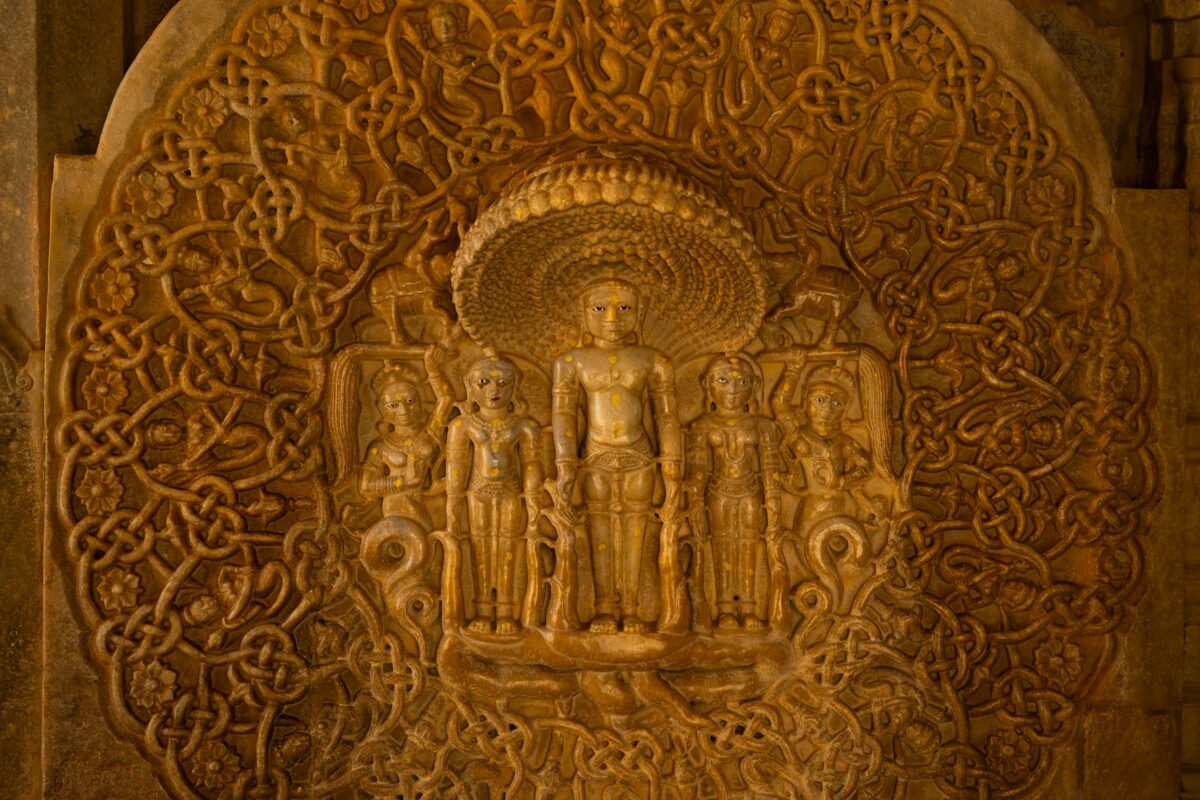
Finally there’s Jainism, one of the world’s oldest living religions and one that’s seen a recent increase in attention in the U.S. as a subject of serious academic inquiry. In July 2025, UT’s College of Liberal Arts established the Tirthankar Sumatinath Distinguished Professorship in Jain Studies, funded by donors from the Jain community across Texas and the U.S.
Jainism approaches old age as a question of what to do with a body that can no longer serve the religion’s ideals. It reveres a strict ascetic practice which advocates for the literal withdrawal from all kinds of interaction with the world in pursuit of the Jain central organizing principle of nonviolence. This principle, ahimsa, means something more than political pacifism or veganism, Davis says. Rather, it is an orientation toward a universe in which every living being, down to the smallest microorganism, has a soul. To cause harm to any of those souls, even accidentally, is to accumulate karma, which is understood in Jainism as something with its own physical presence.
Davis has a way of explaining this to students: “The world exists of life and stuff. You’re trying to make sure that the stuff gets away from the life, because you want to let life emerge and stuff go by the wayside.” Karma, in the Jain tradition, is what keeps the soul bound to a cycle of death, birth, and suffering. The goal of a good life isn’t to have “good” karma, it’s to have accrued as little karma as possible and, ultimately, to eliminate it altogether.
What this looks like in practice, Davis says, is a kind of hyper-carefulness that begins with what you put in your mouth. Nuns, monks, and devout Jains observe strict vegetarianism as a baseline. Beyond that, they also avoid other foods —honey, alcohol, and even plants that grow underground, including potatoes, carrots, onions, and garlic — because harvesting or producing these causes injury to small organisms.
Beyond what they eat, monastic Jains move carefully through the world — sweeping the ground before they sit, speaking deliberately, limiting unnecessary movement — all in service of the same principle of nonviolence. It’s worth noting that for most Jains — who are, by and large, active participants in the world — the practice of ahimsa stops well short of the monastic extreme, Davis says. But the goal for all practicing Jains is a life of increasing restraint. By steadily shrinking one’s footprint in a universe teeming with souls, one creates space and bounty for others. And for the Jain monk or nun, or simply the devout layperson who has spent their later years drawing closer to the tradition’s highest ideals, the question eventually becomes what to do when the body itself can no longer serve that ideal.
What Jainism offers, in the rite of sallekhana, is a version of a good death. Davis describes this ritual of voluntary death as the deliberate, gradual fasting unto death undertaken by a Jain renunciant or, occasionally, by a devout lay practitioner. A rare practice, sallekhana is a long, conscious, and communally witnessed process of progressive withdrawal from food and water, undertaken only when life’s obligations have been fulfilled and the soul is prepared to release its last worldly attachment: the body itself.
With reference to the work of former UT faculty member Claire Maes, Davis compares sallekhana to a practice known in Western medical ethics as Voluntarily Stopping Eating and Drinking (VSED), or the decision to deliberately refuse all food and fluid as a way of determining the terms of one’s own death. “Both the Jain and VSED communities are insistent that this is not suicide,” Davis says. “And, for the Jains, that claim is something like 2,000 years old. They understood how it would be perceived even in their earliest texts and were adamant that this was not that.”
Of course, the analogy has its limits. In VSED, the central value is autonomy: the individual’s right to determine the terms of their death. In sallekhana, the central value is nonviolence. “In a way, the sallekhana ritual crystallizes the principles of nonviolence,” Davis says. “It’s to say, ‘I’m not interacting with the world anymore. I’m not taking food and drink,’ which would cause some kind of incidental violence just by the process of consumption.” To die by sallekhana is not to do something. It is the absence of doing anything.
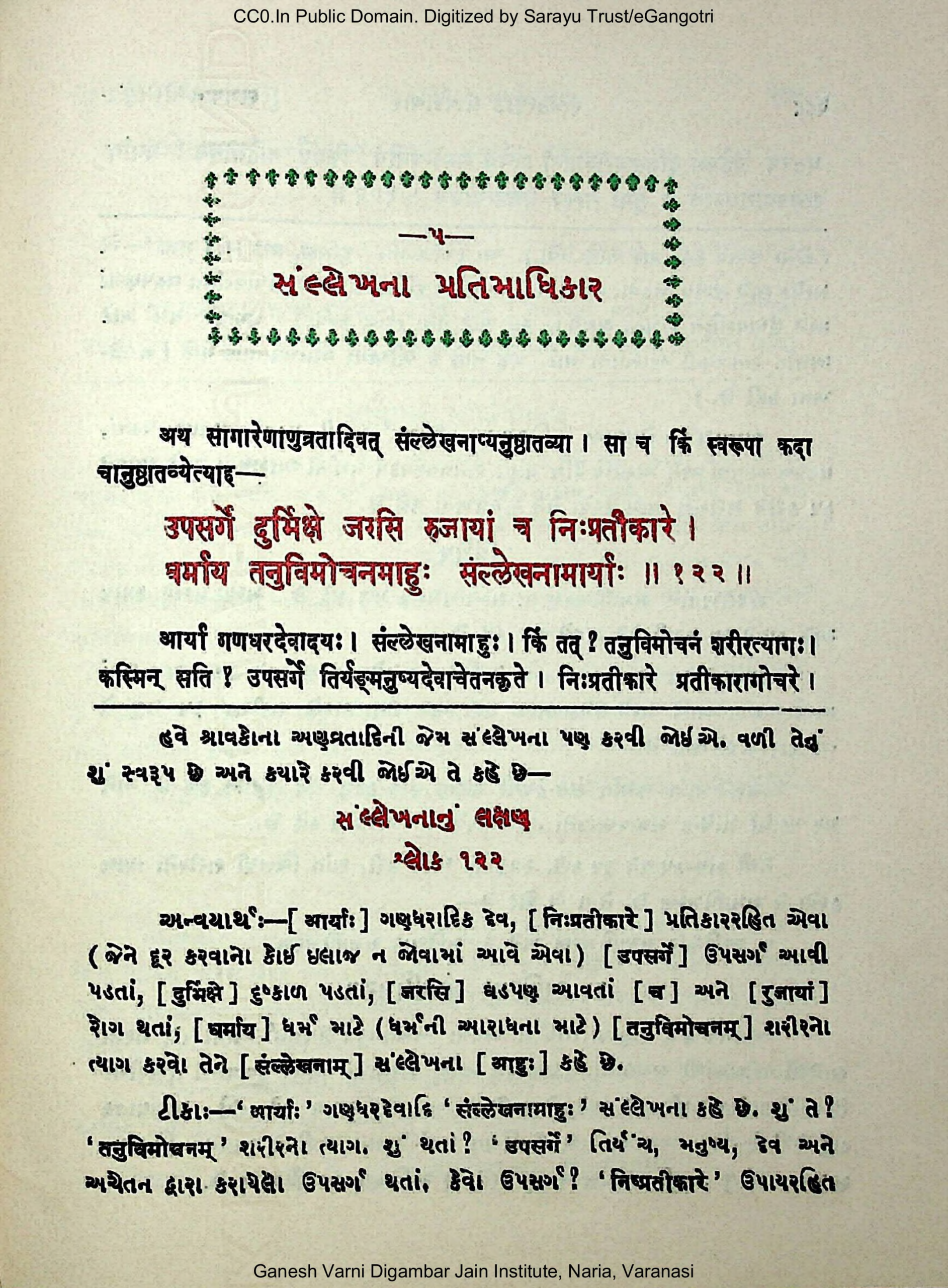
Davis, who has completed a translation of a sixth-century Sanskrit text called the Ratnakaraṇḍakaśrāvakācāra, “The Repository of the Three Jewels for the Jain Laity,” finds the rite described there with a precision that makes its internal logic clear. “One should first abandon grief, fear, despair, affection, strong emotions, and timidity,” the text instructs. “He should then muster up his courage and power and ease his mind with the everlasting scriptures.” The text is equally specific about what disqualifies a death as sallekhana: longing for life, longing for death, fear, remembering friends and loved ones, wishing for personal desires in the next life. It is not, in other words, a response to despair. It is a death undertaken only once all worldly commitments have been set aside.
None of this has been obvious to Indian courts. In 2015, the Rajasthan High Court ruled sallekhana illegal, classifying it as a form of suicide under the Indian Penal Code. The Jain community mounted a rapid and unified challenge, and the Supreme Court stayed the ruling within weeks. But the episode exposed something that Davis describes as genuinely unresolved. The Indian constitutional framework, developed since independence to recognize the country’s extraordinary religious diversity, protects practices that are “essential” to a given religion. But who defines what is or isn’t essential?
“The practices of different religious communities have a very strong place,” Davis explains, “and if practices are seen to be ‘essential’ then that practice is going to be legitimate, regardless of whether other communities agree with it or not.” But, he says, sallekhana sits in a grey area. “It’s clearly an ancient and important practice for the Jain community. But is it ‘essential’ in legal terms given that it’s not required of anyone?”
Sallekhana remains culturally in the space between law and faith. But what the legal controversy makes visible is a collision that runs deeper than any court can adjudicate. Most legal systems tend to treat the living body as the highest value and to see any intentional hastening of its death as requiring extraordinary justification. That is also, more-or-less, how most of us think about a good death: late, painless, on our own terms. Indic traditions, and Jainism most starkly, begin from something close to the opposite. They see this life as one episode in an enormous span of existence. The body is an instrument, not an identity — and it is certainly not life. A good death is one you have spent a lifetime earning.
You don’t have to accept the metaphysics to find something in that worth sitting with. These traditions have a coherent answer to the question most of us hesitate to ask: What is a life actually for? When life has a direction, aging looks less like loss and more like progress. The grey hair is not the problem. You might even say the problem is that the greys are spotted without much thought for what comes next.